
Al Hamra Theatre reopened in Damascus this month following a nearly nine-month rehabilitation, the latest Syrian cultural venue to return after years of closure, deterioration or disruption during the civil war.
First opened in 1960 as part of the development of Syria’s National Theatre, the rehabilitation covered the auditorium, seating, offices, backstage areas and storage spaces. Old theatre equipment and a piano dating to 1960 were among the items recovered during the work.

Programming resumed with Children’s Theatre Days and the Arabic production Fella and the Seven Dwarfs.

The reopening comes amid a broader return of cultural venues across Syria. In recent months, restored theatres, museums, cultural centres and artists’ spaces have begun receiving audiences again, with programmes ranging from major concerts to exhibitions and children’s theatre.
Here are the spaces already receiving audiences and those expected to follow.
Maarat Al Numan Museum, Idlib

Restoration planning under way
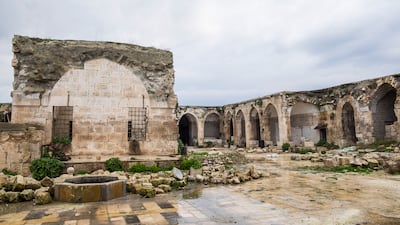
Housed in a 16th-century Ottoman building, Maarat Al Numan Museum opened in 1987 and became known for one of Syria’s most important collections of Roman and Byzantine mosaics.
The building was hit during the war, including by missile strikes and barrel bombs, while parts of its mosaic collection were also damaged. Surviving objects were later inventoried, wrapped and placed in storage.
An engineering study is being prepared to establish the cost of restoring the museum.
“There is currently no timetable or schedule for the completion of the restoration work,” Abdul Salam Al Hamo, director of antiquities at Maarat Al Numan, told Syria TV.
“All of the archaeological objects in the museum have, of course, been inventoried and documented, the missing objects and those that were damaged have been identified, and the remaining objects have been wrapped and stored.
“These objects will later be displayed once restoration of the museum is complete and a new scenario for the museum display has been developed.”
Al Qabbani Theatre, Damascus

Restoration due to begin
Restoration work at Al Qabbani Theatre is expected to begin within weeks.
The 216-seat theatre opened in 1959 as a base and rehearsal space for the emerging Syrian National Theatre. Despite its ageing infrastructure and need for restoration, it has remained active this year, hosting the children’s production Ahla Al Hikaya during Eid Al Fitr and World Theatre Day events in March.
“The higher aim of restoring the theatre is to begin the theatrical season after it opens,” Nawar Bulbul, director of Syria’s Directorate of Theatres and Music, told Al Watan earlier this year. “The theatre season will not stop. Even now, alongside the restoration, performances are being submitted to us, and we ask them to work so they are ready after the opening.
“We want the place to be buzzing with work and rehearsals, so that as soon as one production ends another arrives.”
Fateh Moudarres Studio Gallery, Damascus

Opened: September
The late pioneering Syrian artist Fateh Moudarres established his studio in central Damascus in 1967, and it went on to serve as both his workplace and a cultural salon for artists, writers and intellectuals.
The studio reopened this month after work that included repairing damp walls while preserving Moudarres’s brushes, paints, tools, personal possessions and a large mural.
Its first exhibition, Eleven Years, is by Syrian artist Khaled Al Attar and marks his return to exhibit in Damascus after more than a decade abroad.
“After 11 years of work, absence and exile, I return to Damascus to exhibit a group of works that accompanied these years, in a space that bears the name of the great artist Fateh Moudarres,” Al Attar said in announcing the exhibition.
Homs Museum

Opened: one hall in August
Homs Museum began receiving visitors again in August for the first time since activities stopped there in 2011 at the onset of the Syrian conflict.
Stone Sculpture Week ran from August 1 to 6, with some of the archaeological works on display dating back 3,000 to 4,000 years.
A full reopening has not yet been announced. Local officials say the museum still requires a new display plan, purpose-built exhibition cases, specialist lighting, temperature and humidity controls and trained museum staff before all of its galleries can return to use.
Al Fayhaa Sports Hall, Damascus

Opened: April
Opened 50 years ago for the fifth Pan Arab Games, the indoor arena was damaged during the war by mortar shells.
The venue recently welcomed Syrian singer Assala Nasri for a sold-out concert, her first in Damascus in about 16 years. The show followed the hall’s reopening on April 20 with a basketball match between Syria and Lebanon.
“How beautiful love is and what it does to people,” Nasri wrote ahead of the concert in a social media post. “There is nothing more beautiful than a message of love in a song, how deeply it affects people and how long it lives. I love you, people of my country.”
Azaz Cultural Centre

Opened: April
Home to a library of more than 30,000 books and volumes, Azaz Cultural Centre reopened in April with a programme including poetry, public talks and visual-art exhibitions.
Centre director Sohaib Antakli told Syrian state news agency Sana that the first poetry evening after reopening marked the beginning of “a broad programme of cultural activities”.
In September, the centre staged Tafasil, an exhibition of painting, portraiture and Arabic calligraphy by local artists.
The library had suffered years of neglect during fighting in northern Syria. In 2020, Al Jazeera reported that about 1,500 volumes needed their covers repaired, while other books had been damaged and equipment required replacement.
Historic Orthodox Theatre, Homs

Opened: March
Tracing its history to 1890, the Historic Orthodox Theatre is regarded as the first purpose-built theatre in Homs and the second-oldest in Syria.
After sustaining damage during the war, restoration began in 2022 and the theatre formally reopened on March 14 with From Rubble to the Stage, an exhibition documenting its rehabilitation.
“The restoration and rehabilitation of the Orthodox Theatre carried out by the foundation forms part of efforts to preserve cultural heritage, particularly because it is the second-oldest theatre in Syria and one of the most important cultural landmarks in Homs,” said Lama Abboud, chairwoman of Turathuna Foundation, which led the restoration. “It sustained damage during the years of the conflict.”
Since reopening, the theatre has hosted a lecture on the history of theatre in Homs, a Beethoven concert by pianist Ghazwan Zarkali and, in September, a public conversation with Syrian artist Sara Shamma.
Talkalakh Arab Cultural Centre

Opened: February
The centre, first established in 1978 as a venue for performances, film screenings and literary events, reopened in February after being closed for about a decade.
In September, the centre hosted an event honouring families of those killed in the conflict.
“The cultural centre was closed during the previous era, which concentrated on security branches, destruction and neglect,” Culture Minister Mohammad Yasin Saleh told Syria TV.
“This step comes as part of the ministry’s plan to revive the cultural movement, expand the range of activities and put cultural centres back into operation in order to strengthen their role in Syria’s intellectual renaissance.”
Damascus Citadel

Opened: Tower Eight and Syrian Heritage House, January
Damascus Citadel is an Ayyubid fortress complex of towers, gates, halls and courtyards.
In January, Syria’s Ministry of Culture completed restoration of Tower Eight, one of the citadel’s surviving medieval towers, along with the main gate facing Souq Al Asrouniyeh. The tower was then converted into the Syrian Heritage House, a multipurpose cultural space introducing visitors to Syria’s tangible and intangible heritage through exhibitions, traditional crafts and other activities.
In August, the citadel hosted the Summer of Syria Family Festival, including concerts, puppet theatre, dance and an exhibition of 23 Syrian antiquities returned from France after nearly 15 years abroad.

