• The sculpture 'Anonymous' is part of the Sovereignty exhibition at the Venice Art Biennale, featuring works by US artist Simone Leigh at the US pavilion. Leigh was awarded the Golden Lion for the best presentation. EPA
    The sculpture 'Anonymous' is part of the Sovereignty exhibition at the Venice Art Biennale, featuring works by US artist Simone Leigh at the US pavilion. Leigh was awarded the Golden Lion for the best presentation. EPA
  • Simone Leigh's sculpture of an eyeless African-American woman, surrounded by Cuban artist Belkis Ayon's prints of a secret Afro-Cuban society in the main exhibition The Milk of Dreams. Photo: Roberto Marossi
    Simone Leigh's sculpture of an eyeless African-American woman, surrounded by Cuban artist Belkis Ayon's prints of a secret Afro-Cuban society in the main exhibition The Milk of Dreams. Photo: Roberto Marossi
  • Francis Alys’ 'The Name of the Game' at the Belgian pavilion. Photo: Roberto Ruiz
    Francis Alys’ 'The Name of the Game' at the Belgian pavilion. Photo: Roberto Ruiz
  • Textiles, and their evocations of craft and slow, painstaking labour, were an important theme, as was spirituality. Both came together in Myrlande Constant's Voodoo flags. Photo: Roberto Marossi
    Textiles, and their evocations of craft and slow, painstaking labour, were an important theme, as was spirituality. Both came together in Myrlande Constant's Voodoo flags. Photo: Roberto Marossi
  • Brazilian artist Solange Pessoa paints creatures on the verge of transformation in 'Sonhiferas, I, 2020', on view in the Arsenale. Photo: Roberto Marossi
    Brazilian artist Solange Pessoa paints creatures on the verge of transformation in 'Sonhiferas, I, 2020', on view in the Arsenale. Photo: Roberto Marossi
  • Visitors take in Pessoa's work. EPA
    Visitors take in Pessoa's work. EPA
  • The Milk of Dreams had several 'capsule' shows. One of the best explored the work of female surrealists, or women whose work can be considered in line with Surrealism, such as the Algerian artist Baya Mahieddine. Photo: Marco Cappelletti
    The Milk of Dreams had several 'capsule' shows. One of the best explored the work of female surrealists, or women whose work can be considered in line with Surrealism, such as the Algerian artist Baya Mahieddine. Photo: Marco Cappelletti
  • Belkis Ayon's prints document the secret Afro-Cuban society known as Abakua. Photo: Roberto Marossi
    Belkis Ayon's prints document the secret Afro-Cuban society known as Abakua. Photo: Roberto Marossi
  • Cecilia Alemani, the Italian curator of the 59th Venice Art Biennale. AFP
    Cecilia Alemani, the Italian curator of the 59th Venice Art Biennale. AFP
  • The Milk of Dreams is notable for its wide geographical representation. In the Arsenale, the late US artist Ficre Ghebreyesus shows memories of his youth in Asmara, Eritrea. Photo: Roberto Marossi
    The Milk of Dreams is notable for its wide geographical representation. In the Arsenale, the late US artist Ficre Ghebreyesus shows memories of his youth in Asmara, Eritrea. Photo: Roberto Marossi
  • In the section focused on organic forms, this installation by Ruth Asawa is called 'A Leaf a Gourd a Shell a Net a Bag a Sling a Sack a Bottle a Pot a Box a Container'. Photo: Roberto Marossi
    In the section focused on organic forms, this installation by Ruth Asawa is called 'A Leaf a Gourd a Shell a Net a Bag a Sling a Sack a Bottle a Pot a Box a Container'. Photo: Roberto Marossi
  • Visitors at Asawa's installation. AFP
    Visitors at Asawa's installation. AFP
  • Delcy Morelos' 'Earthly Paradise, 2022', fills the cavernous Arsenale with packed, redolent earth. Photo: Roberto Marossi
    Delcy Morelos' 'Earthly Paradise, 2022', fills the cavernous Arsenale with packed, redolent earth. Photo: Roberto Marossi
  • Monira Al Qadiri's drill bits, 'Orbital, 2022', resemble a trio of sci-fi temples. Photo: Roberto Marossi
    Monira Al Qadiri's drill bits, 'Orbital, 2022', resemble a trio of sci-fi temples. Photo: Roberto Marossi
  • A video and collage by Lynn Hershman Leeson, who connects digital culture to new modes of identity. Cyborgs and digital art are a major sub-theme of the Venice Art Biennale. Photo: Roberto Marossi
    A video and collage by Lynn Hershman Leeson, who connects digital culture to new modes of identity. Cyborgs and digital art are a major sub-theme of the Venice Art Biennale. Photo: Roberto Marossi
  • Veteran New York artist Barbara Kruger has been given a whole room to fill with her cutting proclamations on politics and social responsibilities. Photo: Roberto Marossi
    Veteran New York artist Barbara Kruger has been given a whole room to fill with her cutting proclamations on politics and social responsibilities. Photo: Roberto Marossi
  • Portia Zvavahera creates oil-based stencils on linen, in invocations of animals and subjects. Photo: Roberto Marossi
    Portia Zvavahera creates oil-based stencils on linen, in invocations of animals and subjects. Photo: Roberto Marossi
  • Lebanese artist Ali Cherri's 'Titans, 2022', resemble gods made from the earth itself. Photo: Roberto Marossi
    Lebanese artist Ali Cherri's 'Titans, 2022', resemble gods made from the earth itself. Photo: Roberto Marossi
  • Visitors look at the 'Untitled' installation by Lebanese artist Ali Cherri. EPA
    Visitors look at the 'Untitled' installation by Lebanese artist Ali Cherri. EPA

Venice Biennale's main show 'The Milk of Dreams' highlights great artists often overlooked


Melissa Gronlund
  • English
  • Arabic

Sensual and surprising, Cecilia Alemani’s exhibition for the Venice Biennale, The Milk of Dreams, thrums with beautiful work from artists who have been largely ignored by renowned art shows in the West throughout their careers. The shapes and forms of animals, the work of dreams — the title is taken from a surrealist short story by Leonora Carrington — the smells of plant life, and the worlds beyond gallery walls create a diverse, inviting terrain that Biennale goers slip quietly into.

The artworks are richly rewarding, in scenes of memory, imagination and anger.

Paintings by Portia Zvavahera from Zimbabwe balance block-printing techniques with stencilled swirls and arabesques that resemble delicate cosmogonies. Ficre Ghebreyesus, who died in 2012, painted large-scale memories of his youth in Eritrea, with figures, plants and animals superimposed against colourful textile-like patterns in the background. Myrlande Constant, from Port-au-Prince, continues this interest in textiles with her intricately beaded Voodoo flags, documents of a changing Haiti and its syncretic religions.

Portia Zvavahera creates oil-based stencils on linen, in invocations of animals and subjects. Photo: Roberto Marossi

And this is all in the first few rooms of the exhibition at the Arsenale. It goes on to take in more direct contemporary art forms, such as the Colombian artist Delcy Morelos' installation of soil and its aromas inspired by Amerindian beliefs — a response to Walter De Maria’s minimalist The New York Earth Room (1977), which conflated the earth with the US — and Ali Cherri’s equally rooted, earthy sculptures, rising up like Kraken of the deep.

Delcy Morelos's 'Earthly Paradise' fills the cavernous Arsenale with packed, redolent earth at the Venice Biennale. Photo: Roberto Marossi

Five capsule presentations treat other subjects in depth, such as a well-researched mini-exhibition of female surrealists and a rather more slight examination of cybernetics. In the former, The Witch’s Cradle, Alemani again brought in a large geographic scope, allowing a varied but still intimate image of Surrealism to form, with presentations by Argentine-born British artist Eileen Agar, Algerian artist Baya Mahieddine and Antoinette Lubaki from Congo, among others.

Perhaps because of the sheer amount of space afforded to each presentation, Alemani evades the impression of this being a tokenistic biennial, simply paying lip service to non-western artists. The emphasis on widening representation also continues in the national pavilions, which are sited mostly in the Giardini at the eastern edge of Venice.

The Milk of Dreams had several 'capsule' shows. One of the best explored the work of female surrealists, such as the Algerian artist Baya Mahieddine. Photo: Marco Cappelletti

Black artists represent the UK and the US for the first time, and Barbadian-Scottish artist Alberta Whittle represents the offsite Scottish pavilion. Sonia Boyce, for the UK, won the Golden Lion for the best national pavilion, and Simone Leigh, who represents the US and is also included in The Milk of Dreams, won for the best presentation in the curated exhibition.

The Giardini also houses the second half of Alemani’s The Milk of Dreams, in the International Pavilion. Here, the show feels more chaotic, and the gallery’s warren of white cubes lacks the atmosphere that buoys the works in the Arsenale. It is notable that the International Pavilion’s showstopper is Paula Rego’s lurid, large-scale canvases of fleshy, wonderfully indolent women — paintings that are hung against dark walls. The Milk of Dreams is best seen in a moody setting, rather than in the stark white light of day.

'Sovereignty' featuring works by US artist Simone Leigh at the US Pavilion, was awarded with the Golden Lion for the best presentation at the Venice Biennale. EPA

In particular, the sensual works ably escape the academic formulations around the ideas of the “post-human” that are referenced in much of the exhibition texts. But like all group shows, the biennale has a flattening effect, ignoring the specificities of each artist's work over their formal similarities. Many pairings seem to be made because of the visual resemblance between the work, over and above any conceptual or contextual ties.

At the best of times, this pairing works to the betterment of all concerned: in the grandiose first room, visitors are greeted by Simone Leigh’s nearly five-metre-high sculpture of an eyeless black woman — a brilliantly strong statement of purpose. This piece, with its rounded, totemic aesthetic, is surrounded by equally striking prints from Cuban artist Belkis Ayon, who documents the secret Afro-Cuban society known as Abakua. Questions of forced and intentional visibility and invisibility, agency and subversion reverberate through the pairing.

At other times the formal juxtapositions are less successful. Ibrahim El-Salahi’s minute drawings, for example, are presented alongside the fantastical work by Brazilian artist Solange Pessoa, who depicts insects and creatures mid-metamorphosis. The influence of the Christian church on Pessoa, elsewhere, makes for a potentially fascinating link to El-Salahi’s own negotiations with his Islamic faith, which largely appears in his earlier canvases.

'Sonhiferas I, 2020' by artist Solange Pessoa. AFP

But this connection — an interesting avenue away from the idea of rational man — is not developed, and the show leaves a lingering fear that other similar specificities are elsewhere overridden, suppressed in favour of a good-looking exhibition.

It’s a funny thing to quibble with a show that presents so much great work. Flattening is also an effect of capitalism, in its reduction of everything to monetary exchange value — and the market hovers at the fringes of this exhibition, with the value of all of these “undiscovered” artists indubitably about to shoot up. Though many artists in The Milk of Dreams are outside of the mega-gallery system, with the exception of some New York painters, the galleries were far from absent in Venice. Collateral exhibitions include, for example, solos by Anselm Kiefer, Bruce Nauman, Ugo Rondinone, Anish Kapoor, Joseph Beuys and Marlene Dumas — a kind of Avengers-style return of the usual suspects with their big-pocketed galleries trailing behind, dropping dinners and exclusive invitations as they passed.

The Italian curator of the 59th Venice Art Biennale, Cecilia Alemani. AFP

Though the biennial danced around it, with its focus on the human, the sensual and the animal, the real question of this Venice Biennale was globalisation. The “world of man” fantasy has always been Venice’s subject ― from Harald Szeemann’s Plateau of Humankind (2001) to Daniel Birnbaum’s Making Worlds (2009), Massimiliano Gioni’s Encyclopedic Palace (2013) and Okwui Enzwezor's All the World's Futures (2015) — and, excepting Enwezor, the complications of this ideation are rarely met.

In this section focused on organic forms, is an installation by Ruth Asawa titled 'A Leaf a Gourd a Shell a Net a Bag a Sling a Sack a Bottle a Pot a Box a Container'. Photo: Roberto Marossi

Globalisation is the subject, too, of the national pavilions, for what is increased representation but an acknowledgement of migration and many identities within a nation-state? Several artists featured address the commingling of communities, against a backdrop — implicit or explicit — of the violence and precarity met by minority populations.

In its own way, Alemani’s biennial is also about the fantasy of a “world of man”, even if “man” here means woman or other gendered identity — the idea of a single human subjectivity, all changed in context-less ways by technology, shifting relations to animal species and plant life, and new anxieties. But technologies are not uniformly taken up across the world; attitudes towards animal species differ between Eritrea, Italy and Brazil; anxieties are still subordinate to socioeconomic circumstance. The Milk of Dreams leaves the category of “mankind” curiously unchallenged, despite filling the category with superb artists.

But these are minor gripes. Alemani’s exhibition takes on the changes that are winding through the intellectual subjectivity of the western art world and shows the overlooked lineages that have long been making work on these very subjects, beyond the limelight. Perhaps it is because there have been so few major group showings that this exhibition manages to feel timely and not simply trendy.

But more likely the bliss of The Milk of Dreams is simply in seeing what happens when the art world, finally, casts a wide net: there’s a lot of beauty to see.

Scroll through the gallery below for Emirati artist Mohamed Ahmed Ibrahim's installation at the Venice Biennale 2022:

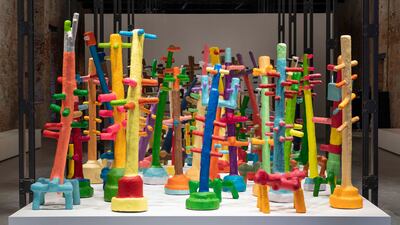
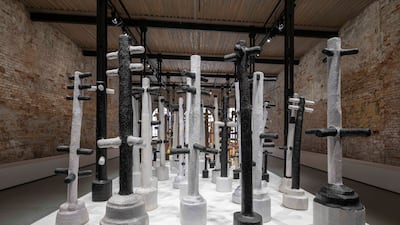
  • Emirati artist Mohamed Ahmed Ibrahim’s installation of 128 sculptures, Between Sunrise and Sunset, has opened at the Venice Biennale's National Pavilion UAE. All photos: Ismail Noor / National Pavilion UAE
    Emirati artist Mohamed Ahmed Ibrahim’s installation of 128 sculptures, Between Sunrise and Sunset, has opened at the Venice Biennale's National Pavilion UAE. All photos: Ismail Noor / National Pavilion UAE
  • Arranged in a thick column in the cavernous Arsenale room, the tree-like sculptures are inspired by Ibrahim's hometown of Khorfakkan
    Arranged in a thick column in the cavernous Arsenale room, the tree-like sculptures are inspired by Ibrahim's hometown of Khorfakkan
  • The forms remain the same but the colours change as one walks towards the back of the room, with beiges and taupes taking the place of formerly lurid shades
    The forms remain the same but the colours change as one walks towards the back of the room, with beiges and taupes taking the place of formerly lurid shades
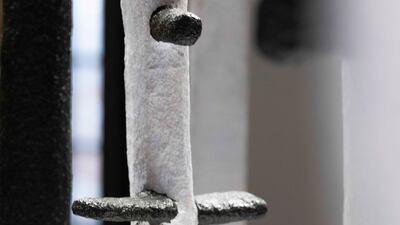
  • Made of papier-mache, the objects seem painted but actually gain their colour from the paper used to create them
    Made of papier-mache, the objects seem painted but actually gain their colour from the paper used to create them
  • Ibrahim mixed coloured sheaves of paper as a painter mixes paint, and also incorporated everyday, organic material from around him — leaves from trees in his garden in Khorfakkan, tobacco, tea, coffee, and even the cardboard packaging from toys which his grandchildren would save for him
    Ibrahim mixed coloured sheaves of paper as a painter mixes paint, and also incorporated everyday, organic material from around him — leaves from trees in his garden in Khorfakkan, tobacco, tea, coffee, and even the cardboard packaging from toys which his grandchildren would save for him
  • Curated by Maya Allison, executive director of NYU Abu Dhabi Art Gallery, the exhibition presents a major new work by an Emirati artist
    Curated by Maya Allison, executive director of NYU Abu Dhabi Art Gallery, the exhibition presents a major new work by an Emirati artist
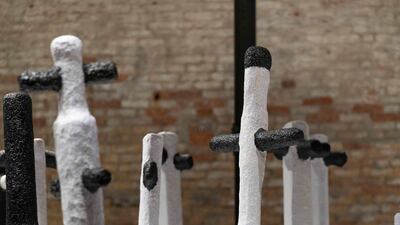
  • Bright colours change into a more desolate landscape of blacks and whites as you walk through the installation
    Bright colours change into a more desolate landscape of blacks and whites as you walk through the installation
  • The work, and the performative walk around it, affect the transition from day to night, as seen by the eye
    The work, and the performative walk around it, affect the transition from day to night, as seen by the eye
  • In some ways, the sculptures resemble trees and animals, but Ibrahim says they represent neither
    In some ways, the sculptures resemble trees and animals, but Ibrahim says they represent neither
  • Mohamed Ahmed Ibrahim: Between Sunrise and Sunset is now open to the public at the Venice Biennale and runs until November 27, 2022
    Mohamed Ahmed Ibrahim: Between Sunrise and Sunset is now open to the public at the Venice Biennale and runs until November 27, 2022
Company%20profile
%3Cp%3EName%3A%20Tabby%3Cbr%3EFounded%3A%20August%202019%3B%20platform%20went%20live%20in%20February%202020%3Cbr%3EFounder%2FCEO%3A%20Hosam%20Arab%2C%20co-founder%3A%20Daniil%20Barkalov%3Cbr%3EBased%3A%20Dubai%2C%20UAE%3Cbr%3ESector%3A%20Payments%3Cbr%3ESize%3A%2040-50%20employees%3Cbr%3EStage%3A%20Series%20A%3Cbr%3EInvestors%3A%20Arbor%20Ventures%2C%20Mubadala%20Capital%2C%20Wamda%20Capital%2C%20STV%2C%20Raed%20Ventures%2C%20Global%20Founders%20Capital%2C%20JIMCO%2C%20Global%20Ventures%2C%20Venture%20Souq%2C%20Outliers%20VC%2C%20MSA%20Capital%2C%20HOF%20and%20AB%20Accelerator.%3Cbr%3E%3C%2Fp%3E%0A
Updated: October 12, 2022, 10:12 AM