

The US regards the new deal between Saudi Arabia and Iran as “a very important moment”, according to US assistant secretary of state for Near Eastern Affairs Barbara Leaf.
In an exclusive interview with The National, Ms Leaf described it as a “detente, not a rapprochement or reconciliation … it is a resumption of a relationship that existed until the events of January 2016".
“But it would seem to signal towards a broader detente,” she said.
And despite the fact that the deal was sealed in Beijing, the US has been resoundingly supporting of it — and hoping that it leads to an end of the war in Yemen.
The Saudi-Iran detente comes at a time of general de-escalation in the region, which the US welcomes.
US Assistant Secretary of State for Near Eastern Affairs
Ms Leaf said that since President Joe Biden “came into office, the administration has been promoting privately and publicly the notion of de-escalation”.
She added that at the time it was “a very over-pressurised region, riven with rifts”.
The US “actively encouraged the Saudis” to engage the Iranians and it was “what they were already thinking about when we came into office and that they set themselves to with alacrity”.
The issue is “more than non-interference in domestic affairs … the heart of the matter has been Iranian lethal support, lethal training and resources to the Houthis who have promulgated several years of just relentless missile and drone attacks on the kingdom”.
While the Iranians had wanted to speak on resuming diplomatic ties “they wouldn't really acknowledge the core issue, which was Saudi security, or rather insecurity because of what Iran was doing”.
After “a two-year plus effort”, it appears the moment has arrived. The US official made a point of mentioning that there were several rounds of discussions in Baghdad and Muscat, ahead of the Beijing meeting that lead to the announcement of a resumption of ties on March 10.
Speaking to The National from her office at the State Department in Washington last week, Ms Leaf stressed that “we think it's a very good thing, if, and it is a big if, Iran does hold to these commitments, it would be a breakthrough, a very significant breakthrough”.
However, she said “but it would also be a departure from 40-plus years of Iranian foreign policy operations in constantly fostering insecurity, in its near abroad, and more than its near abroad, in order in some fashion to bolster its own security”.
She said it would be excellent if “by some miracle” Iran was to hold on to this set of commitments.
China role in deal

As for China’s role in the matter which many took to be a sign of reduced American influence, Ms Leaf made clear that Beijing “played host, but was not the mediator”.
She added that “Iran has been under increasingly severe pressures, economic pressures, other pressures that we have helped to muster. The US is not in a position to leverage its relationship with Iran for this purpose, but Beijing has touted its strategic relationship with Iran. So there's a logic there”.
Ms Leaf sounded encouragement for China’s role, saying “frankly, it's about time that it used whatever leverage it has with Iran, to constrain Iranian destructive behaviour”.
Asked about how the US may counter China’s increasingly active role in the region, Ms Leaf responded firmly: “We're not trying to counter, we are very confident in the length, duration, scope, richness of our relations across the region”.
Despite concerns in the region that the US would expect countries to choose sides between Washington and Beijing, Ms Leaf said: “We're not in a zero-sum (game) it’s either us, or them”.
The US has specific areas of concern when it comes to China which it communicates to its allies, including “concerns related to the highest end of our technology, or the commercial or defence. We have very specific concerns about juxtaposition of our systems near Chinese systems. But those are those are very carefully scoped discussions that we have. And I think it's fair to say that our partners understand that”.
As for America’s efforts to restart Joint Comprehensive Plan of Acrion talks with Iran, Ms Leaf said that they had been “derailed” by Tehran’s actions and the fact that it “walked away”.
Yemen optimism
She said Iran’s actions, including “the atrocious repression of public protests of its own people, and then followed by Iran entering into the European battlefield, on Russia's side against Ukraine, have gone from bad to worse”.
The one potential bright spot in the region at the moment is in Yemen, which is witnessing “the best hope we have seen in the last eight year”.
Ms Leaf said that “nothing's done until it's done, there's so many steps to go” before the war can come to an end.
She lauded Saudi efforts saying: “We've seen for months now, a really committed effort by Saudi Arabia to drive this thing to a durable ceasefire that then can be handed off to the UN to negotiate or to help mediate”.
-
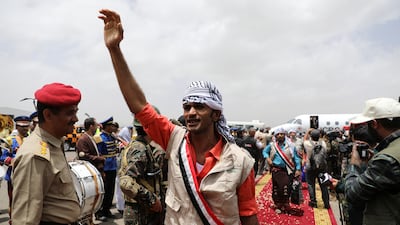
Freed prisoners celebrate after arriving in Sanaa following a swap between warring parties in Yemen. Reuters -
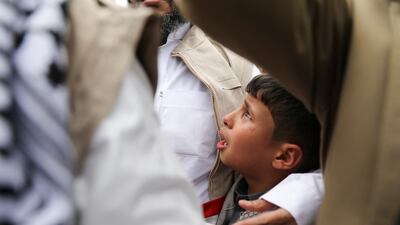
Relatives waited for the return of loved ones. Reuters -
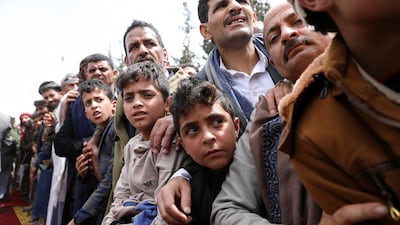
The International Committee of the Red Cross said 318 prisoners were released on the first day. Reuters -
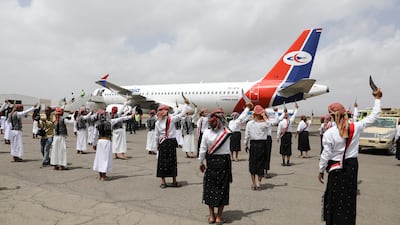
The ceremonial Baraa dance was performed for freed prisoners at Sanaa Airport. Reuters -
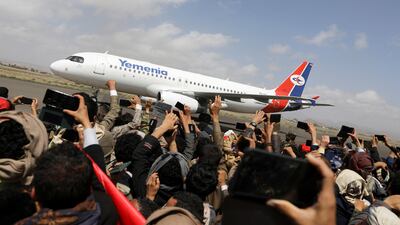
Relatives cheer as the plane lands. Reuters -
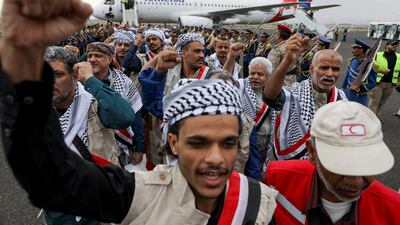
Freed prisoners of war walk at Sanaa Airport, after arriving on a flight chartered by the International Committee of the Red Cross as part of a prisoner swap between the rival sides in the Yemen conflict. Reuters -
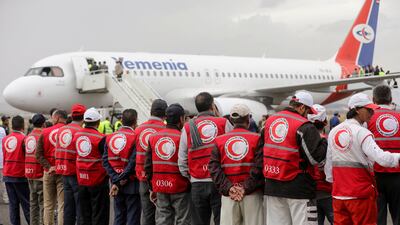
People wearing Yemen Red Crescent Society jackets wait as a plane carrying freed prisoners arrives at Sanaa Airport. Reuters -

Houthi prisoners, freed under a deal between the rebels and Yemen's internationally recognised government, pray on the tarmac at Sanaa International Airport. AFP -

Relatives of freed prisoners wait at Sanaa Airport. Reuters -
Mahmoud Al Subaihi, centre, former defence minister of Yemen's internationally recognised government, and Nasser Mansur Hadi, top, brother to former Yemeni president Abdrabbuh Mansur Hadi, arrive at Aden International Airport after being freed by the Houth rebels under the prisoner exchange deal. AFP -
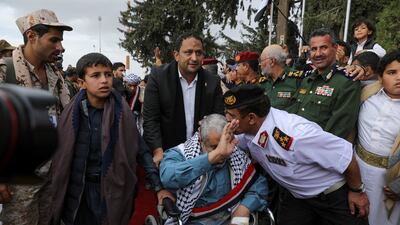
A freed prisoner is kissed after arriving at Sanaa Airport. Reuters -
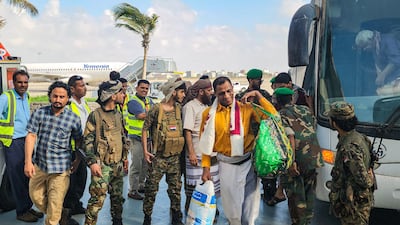
Yemeni Houthi rebel prisoners released as part of a prisoner exchange with the internationally recognised government, before boarding a flight to Sanaa. AFP -
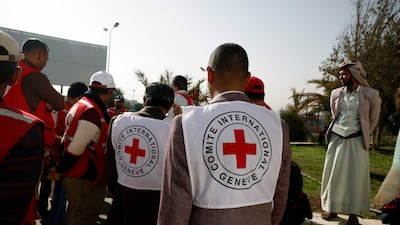
Members of the International Committee of the Red Cross wait to receive exchanged detainees loyal to the Houthis at Sanaa Airport. EPA -
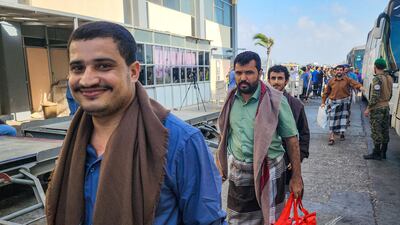
Released Houthi rebel prisoners in Aden, on their way to board a flight to Sanaa. AFP -
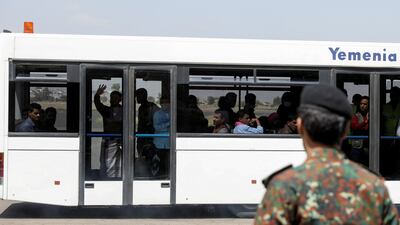
Freed prisoners travel on a bus to an ICRC-chartered plane at Sanaa Airport. Reuters -
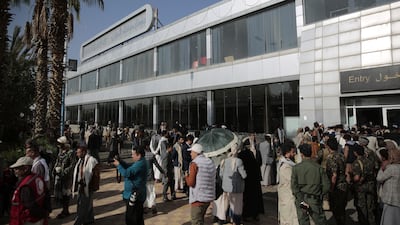
Yemenis gather at the capital's airport ahead of the prisoner exchange. AP Photo -
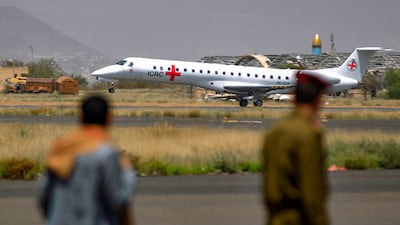
An Embraer ERJ aircraft flying under the banner of the ICRC takes off from Sanaa Airport. AFP


She stressed the importance of a “Yemeni-Yemeni proper set of negotiations … other steps that must follow lest things devolve into a resumption of another turn of a civil war”.
As Yemen witnesses “a very heightened period of diplomatic effort” the US envoy to Yemen Tim Lenderking is back in the region.
Ms Leaf said that the US is looking into “what good offices we might lend to the effort or to be to be on standby as needed”.
She added that it is important to “give full credit to the effort that the Saudis have put into this, to drive this terrible war to an end”.
Another country witnessing a de-escalation is Syria, where a number of Arab states have been resuming ties.
No change in stance on Syria's Assad
However, the US remains firm in its opposition to the government of Bashar Al Assad. Asked whether the US would consider lifting sanctions off Syria to allow for reconstruction, Ms Leaf gave a firm “no”.
“Our stance is unchanged. We're not going to normalise, we're not going to lift sanctions, nor moderate our stance on sanctions in such until such time as we see (Mr Al-Assad) progressing in a really clear and profound way, on the issues under UNSCR 2254,” she said.
While she expressed an understanding for the Arab view of engagement with Syria, but noted that “engagement should logically bring the leverage you have to bear”.
Ms Leaf recently returned from a 10-day trip to the region, where she took stock of the current economic and political situations in a host of countries including in Israel and Palestine, Lebanon and Tunisia.
The veteran diplomat described the current tensions between Israeli and Palestinians as a “very delicate moment” and one that the US has been actively working to defuse.
“We’ve had a very continuous effort in dialogue with Israeli officials and Palestinian officials,” Ms Leaf told The National.
Violence between the two sides has escalated in recent weeks following footage showing Israeli soldiers storming Al Aqsa Mosque and beating worshippers inside Islam’s third holiest site.
This year has already proved deadly in the region with 94 Palestinians and 19 Israelis killed, according to AFP.
Ms Leaf said she believed both sides had a “very strong desire” to avoid any further escalations.
She added that there has been an “extraordinary amount of intensive diplomacy behind the scenes” to try to bring the temperature down.
As for the internal protests in Israel over judicial restructuring, Ms Leaf said US officials are “very seized of the issue of trying to bring a greater level of calm and stability against a very difficult backdrop”, along with the Palestinian issue.
Lebanon turmoil
Ms Leaf described Lebanon’s current political and economic crises as “extraordinarily sobering”, adding “I am not very hopeful right now” on the naming of a president.
The country has been in economic free fall for several years and has been without a president since Michel Aoun’s term ended in October.
Ms Leaf chastised Lebanon’s political elite who have run the country into economic ruin and have yet to figure out how to right the course.
“I find it shocking that we’re not quite five months into an absence of a fully empowered government, no progress of the IMF programme and the Lebanese Armed Forces and the security forces are in a terrible state,” she said.
“The Lebanese public having predominantly fallen well below the poverty line and yet Lebanon’s political class is chattering away and not bothering to hold even any balloting for candidates.”

What angered her most was a lack of concern for the country’s myriad problems that many politicians she spoke to seemed to show, during her visit to Beirut.
“I came away with a feeling of why am I more concerned about all of this than many of the Lebanese politicians with whom we engage?”
Ms Leaf urged Lebanon to find its own way out of its current problems.
“I’m also struck by this sense that I had from a number of the discussions, that people are waiting for outside powers to sort this out,’ she said. “That is just not going to happen.”
In Tunisia, a country also on the precipice of economic disaster, which has seen widespread protests in 2023 against President Kais Saied’s consolidation of power, Washington is urging the government to pick a path forward.
Inflation has soared to nearly 11 per cent in the North African country, which has also begun to experience increased food scarcity.
In October, the government reached a staff level agreement with the International Monetary Fund for an Extended Fund Facility worth $1.9 billion, but it has thus far failed to make the necessary reforms to allow the bailout to go forward.
Ms Leaf said it was up to Tunis to decide how it wanted to proceed but that time was running out.
“This is a moment in time for the government to decide whether it wants to go down that road with that particular reform package or it comes up with an alternative approach but it is quite urgent that they decide and decide quickly.”
As for Iraq, where 20 years have passed since the US led a coalition to remove the regime of Saddam Hussein, Ms Leaf said “we have a really deep going commitment to that country”.
And while US troops have ended combat operations there, the US regards Iraq “as a keystone in the arch of security and stability for the region”, and will continue to support “reintegration of Iraq into its neighbourhood”.
And while problems remain in the country, Ms Leaf said “there is no straight path … it is a winding path, but we are, with every element of our engagement, reinforcing the message of capture of sovereignty”.

