
The EU's ambassador to the UN has said the 27-member bloc supports the creation of an independent tribunal that would hold Russian President Vladimir Putin and his top officials accountable for the invasion of Ukraine, even though experts believe it's a politically "risky move".
In an exclusive interview with The National, Olof Skoog said EU officials would meet in Brussels later this week to discuss the proposed tribunal, which would operate separately from the International Criminal Court, which Russia is not party to.
“It's very good that they [the Russian leadership] know that the prospect of indictments and punishment and, you know, accountability, is there as a reality,” Mr Skoog said at UN headquarters in New York.
Ukraine has been pushing for the creation of a tribunal akin to the Nuremberg trials after the Second World War, when the Allies prosecuted defeated Nazis.
European Commission President Ursula von der Leyen last month said “Russia must pay for its horrific crimes” as she announced the EU's support for the tribunal.
While the ICC is already investigating war crimes in Ukraine, Mr Skoog argued that it will not be able to prosecute the Kremlin's leadership for the overarching offence of “crimes of aggression”, as Russia has not ratified the court's Rome Statute, meaning its leaders have immunity from prosecution while in office.
“We may be able to fix that problem,” said Mr Skoog, noting that the Ukrainian proposal would “create a system where you can also cover the voids that are there today in the international legal system”.
The Swedish diplomat said a new tribunal would require UN backing to help bring it “a certain legitimacy”.
The UN General Assembly would be the only realistic avenue to back the court, since Russia would surely use its Security Council veto to block any anti-Moscow measures.
A Ukrainian draft resolution on the issue has been circulating at the UN headquarters.
Ukraine war latest — in pictures
-
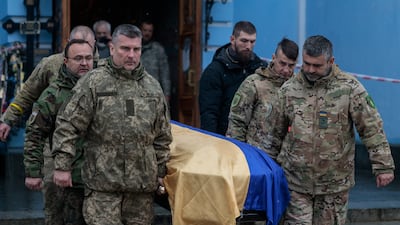
The coffin of Valeriy Krasnyan is brought out of St. Michael's Golden-Domed Monastery in Kyiv. Getty Images -
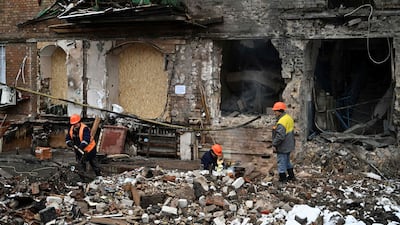
Repairmen work near a residential building damaged following a missile attack in Vyshgorod, outside of Kyiv. AFP -
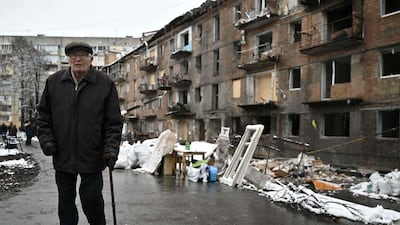
An elderly man walks in front of a residential building damaged following a missile attack in Vyshgorod. AFP -

A boy kisses a dog while he charges his phone at the heating tent dubbed a Point of Invincibly in Bucha, Ukraine. AP -
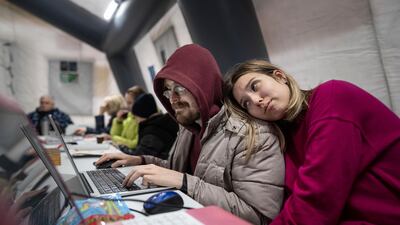
A couple uses a laptop in the heating tent. AP -
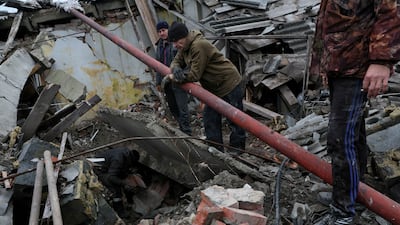
Workers dig out a tire from the rubble of a destroyed storage building at a grain processing center so they can use it for repairs in Siversk, Donetsk region. Reuters -
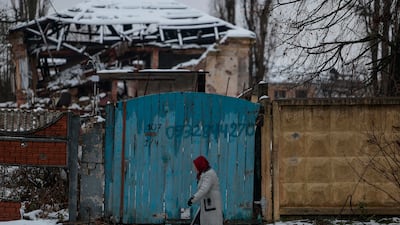
The Chernihiv region found itself on the frontline of Russia's invasion in February, when Moscow's forces were attempting to quickly seize Kyiv. Getty -
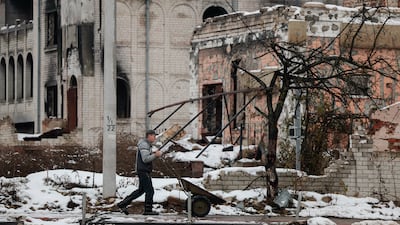
Russia ultimately retreated from northern Ukraine to focus its attack on the east and south. Getty -
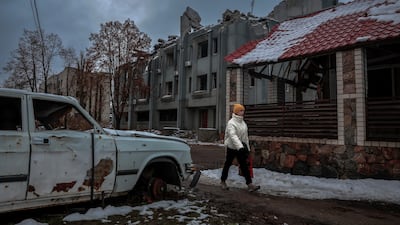
The city of Chernihiv on November 28, 2022 in Chernihiv, Ukraine. Getty -
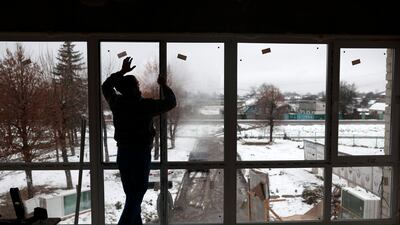
A worker fits in new windows of a building in Chernihiv. Getty -
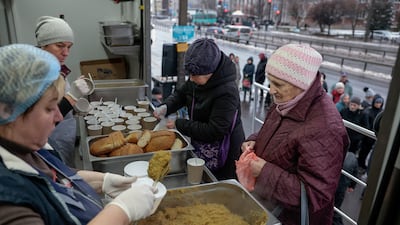
People receive food from AFAT - Disaster and Emergency Management Presidency in Chernihiv. Getty -
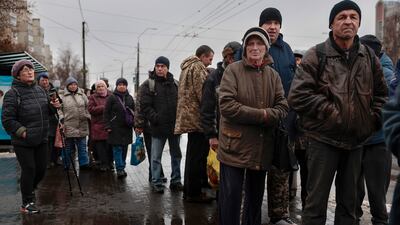
The people Chernihiv queue up for hot food. Getty -
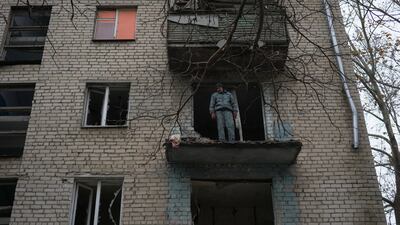
Oleksandr Antonenko stands on a balcony of his apartment damaged by a recent Russian military strike in Kherson. Reuters -
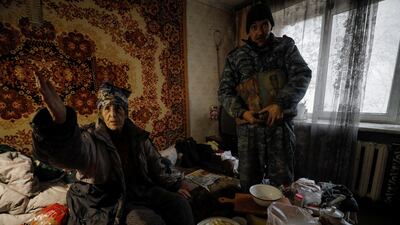
Mr Antonenko and his mother Liudmyla inside their apartment recently damaged by a Russian military strike in Kherson. Reuters -
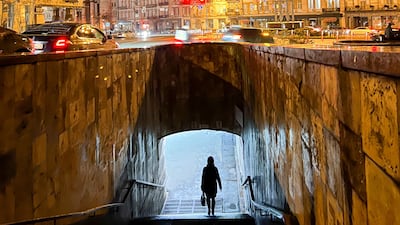
A woman walks in an underpass in Kyiv, on November 26, 2022. AFP -
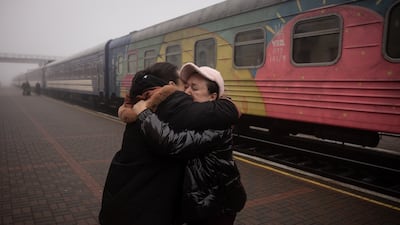
Friends hug after the arrival of a train in the southern city of Kherson. Getty -
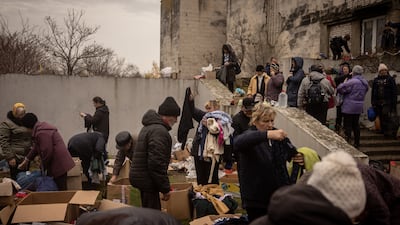
Residents sort through donated clothing at an aid centre in Kherson. Getty -
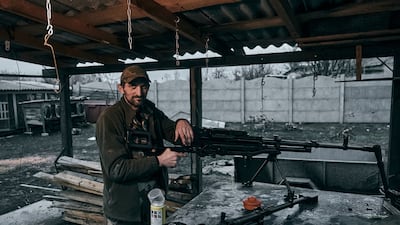
A Ukrainian soldier stands with a machinegun near Liman in the Donetsk region. AP -
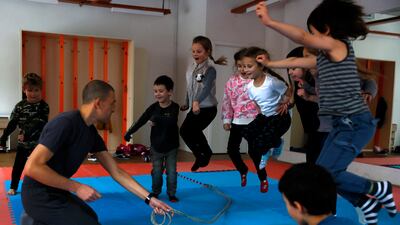
Children attend a physical education class at Spilno School in Kyiv. Getty -
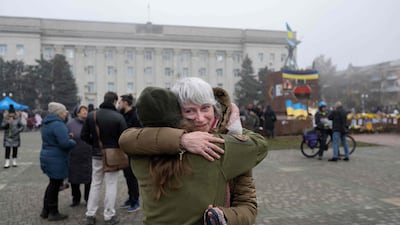
A woman embraces her friend, a soldier in the Ukrainian army, in Kherson. AFP -
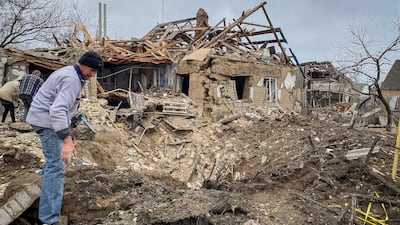
Residents inspect a crater left by a Russian military strike in the village of Komyshuvakha in the Zaporizhzhia region. Reuters -
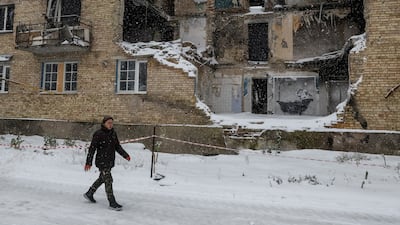
Resident Tetiana Reznychenko walks past a work by world-renowned graffiti artist Banksy, on the wall of a destroyed building in the Ukrainian village of Horenka. Reuters -
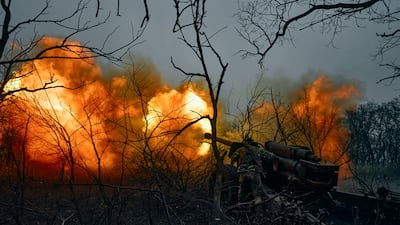
Ukrainian soldiers fire artillery at Russian positions near Bakhmut in the Donetsk region. AP -
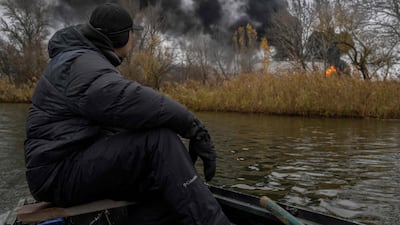
A fisherman sails his boat on the Dnipro as black smoke rises from an oil reserve in Kherson. AFP


Seen by The National, the draft resolution “requests the Secretary General to negotiate an agreement with the government of Ukraine to create an independent international tribunal with jurisdiction over crimes of aggression committed against Ukraine and to submit the agreement for the review to the General Assembly”.
The Netherlands, where the ICC is based, says it is willing to host the new court.
Moscow has dismissed the idea of the war crimes tribunal as illegitimate.
Russia has been accused of several war crimes, including the summary execution of civilians in Bucha and elsewhere. Ukrainian troops have also been accused of committing atrocities against Russian prisoners of war.
With Russia’s war against Ukraine now in its tenth month, a handful of EU states have voiced their support for such a tribunal, and Ukrainian officials have been lobbying to get more countries on board.
But significant resistance remains and the position of the US, which is also outside the ICC's jurisdiction, remains unclear so far.
European partners, Mr Skoog said, are considering various options and are scheduled to discuss the issue on December 14-15 in Brussels.
Richard Gowan, UN director at the International Crisis Group said that the idea of bringing the tribunal to the General Assembly is a "risky move politically, even if it makes sense morally and legally."
"A lot of countries that have backed Ukraine at the General Assembly to date will worry that this is a counterproductive move that is liable to make talks with Russia about ending the war harder," Mr Gowan told The National.
There is also the problem of precedent, Mr Gowan pointed out. The Ukrainian draft resolution opens up political possibilities for others to exploit.
"The EU is happy to back this resolution. But what happens if a coalition of Arab countries steps up in a few years with plans for a tribunal to challenge the US or Israel over future actions in the Middle East?"
"I am not sure that western diplomats are thinking about how this initiative could cause them trouble five or 10 years from now," he added.
Protests against Russia’s invasion in St Petersburg — in pictures
The EU ambassador, who has served in his current role since 2019, said he hoped discussion of a war crimes tribunal would have a tangible effect on the ground in Ukraine.
“Everything we do that relates to accountability for crimes committed … could maybe serve as a holding back on some of those that are committing these crimes,” he said.
The Iran file
Mr Skoog also touched on one of the most pressing issues facing the UN — the situation in Iran, which is supporting Russia in Ukraine while it violently cracks down on anti-government protests at home.
“We've had a very clear and open and frank criticism against Iran for its human rights record,” he said. “And that's certainly worsened with what we've seen, the reactions to the demonstrations that we've seen are horrendous.”
In response to the Iran-Russia connection, in October, the EU issued its first round of sanctions linked to Iran's transfer of drones to Moscow for use in Ukraine.
Iran protests, one month on and counting — in video
Despite recent tension, however, the EU ambassador underscored the importance of diplomacy when it comes to the Iran nuclear file, better known as the Joint Comprehensive Plan of Action (JCPOA).
The agreement led to Iran putting limits on its nuclear programme in return for sanctions relief.
“We had a very good agreement, the US decided to step away, that has put us in huge trouble,” he said, referring to Washington's withdrawal from the deal in 2018.
Unfortunately, he added, Iran has used that time to move ahead with its nuclear programme.
“Everyone is much worse off than we were once during the time when the JCPOA was implemented. So now it's urgent to come back to a full implementation of that agreement,” he said.
In an age of mounting scepticism towards global institutions, the EU envoy highlighted the importance of strengthening multilateralism in tackling compounding global crises.
“We're at great risk right now. Because we do have some very, very serious challenges that are coming at us at a speed where it's overwhelming. And many countries are suffering in a way with challenges that they cannot cope with on their own.”
This necessitates “international co-operation, and the UN is the natural platform for moving forward on that”, he said.
“We don't really have the relationships between major powers that we need in order to find a common ground. Russia has completely discredited itself as a player … and we have a tension between China and the US,” he said.
“But I strongly believe that we need to come back to a stronger multilateral system.”

