

The trial of a white Kentucky ex-police officer charged with wanton endangerment during the 2020 shooting death of Breonna Taylor began on Wednesday, casting a spotlight on another case in the US that sparked a summer of protests against racial injustice two years ago.
Brett Hankison, whose stray bullets hit a neighbouring apartment in the city of Louisville, Kentucky, during a botched execution of a search warrant in March 2020 was the only officer charged in the case.
Kentucky Assistant Attorney General Barbara Whaley reminded the jury in her opening statement on Wednesday that the case was not about Taylor. Rather, she said it concerned whether Mr Hankison exhibited “extreme indifference to human life” when firing the bullets that endangered Taylor's neighbours, shattered their glass patio door and caused drywall to fall on Cody Etherton
Mr Etherton gave evidence on Wednesday that he awoke that March night to a boom, then heard several shots and felt debris falling on him after he left his room.
When his glass patio door shattered, Mr Etherton said he went to check it out, whereupon officers pointed guns at him and told him to put his hands out through the broken glass.
“It was just reckless,” he said.
The death of Taylor, a 26-year-old black emergency medical technician who was unarmed, captured international attention and sparked weeks of protests over police violence against black people and other minority groups.
-
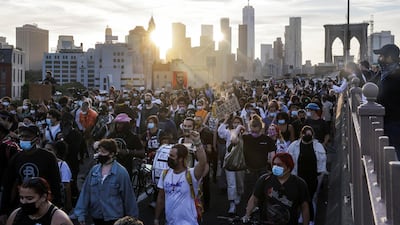
Protesters march on the Brooklyn Bridge during a demonstration on the first anniversary of the death of George Floyd, in New York. Reuters -

Some streets in Manhattan were closed due to the demonstrations on Tuesday evening. AP -

The musician Common performs with the Sounds of Blackness at George Floyd Square in Minneapolis, Minnesota. Floyd's death in May 2020 led to worldwide protests and calls for police reform or abolition. Getty -
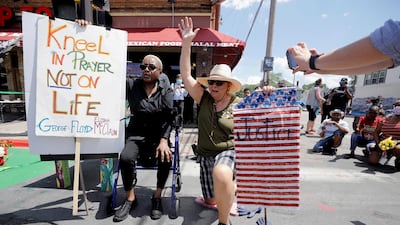
Robin Puttin leads a prayer while kneeling and raising her hand on the first anniversary of George Floyd's death, at George Floyd Square, in Minneapolis, Minnesota. Reuters -
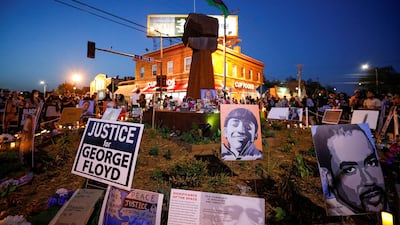
Electric and LED candles bearing the names of people killed by police illuminate the fist sculpture as people gather at the George Floyd Square. Reuters -
A man is reflected in a sign during a vigil held to remember George Floyd in Lynn, Massachusetts. Reuters -
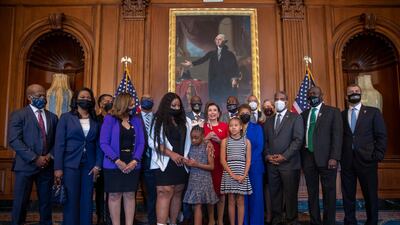
House Speaker Nancy Pelosi meets the family of the late George Floyd at the US Capitol in Washington. The family met President Joe Biden and various US politicians, and participated in a memorial at Black Lives Matter Plaza. EPA -
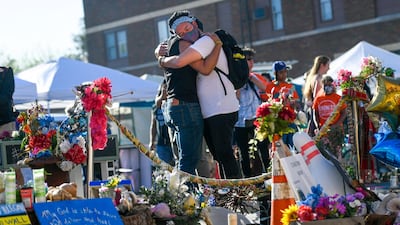
People gather at the sight where George Floyd was killed one year ago, at 38th Street and Chicago Avenue in Minneapolis - an area now called George Floyd Square. EPA -
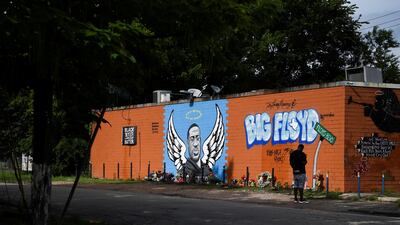
A man stands next to a mural of George Floyd in Houston, Texas. Reuters -
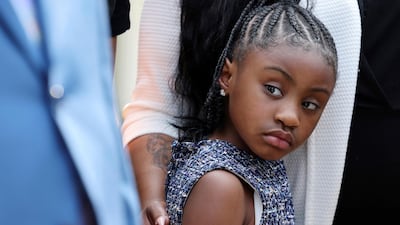
A family member holds onto Gianna Floyd, daughter of George Floyd, at the White House following their meeting with President Biden in Washington. Reuters -
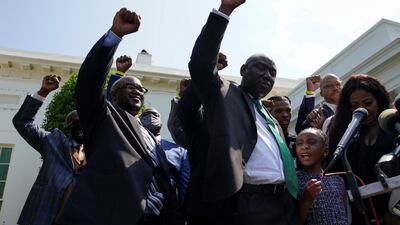
Gianna Floyd and other family members and lawyers, raise fists after meeting President Biden in Washington. Reuters -
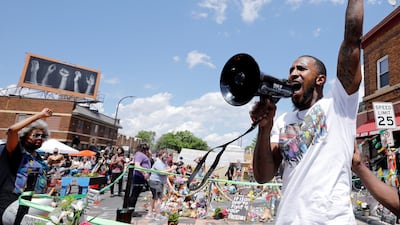
Community organiser Tommy McBrayer leads a chant in solidarity with George Floyd, at George Floyd Square, in Minneapolis. Reuters -
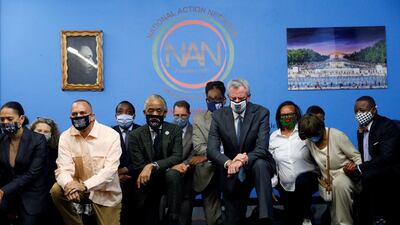
New York City Mayor Bill de Blasio and Reverend Al Sharpton kneel with community leaders for nine minutes and 29 seconds, symbolising Floyd's ordeal at the hands of police. Reuters -
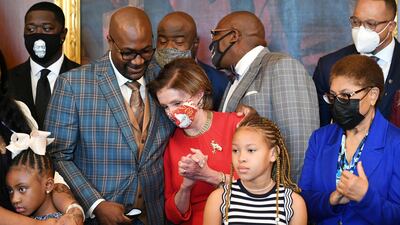
Philonise Floyd, brother to George Floyd, puts his arm around Speaker Nancy Pelosi, near Rep. Karen Bass, as he and other members of the Floyd family meet politicians at the US Capitol. Reuters -
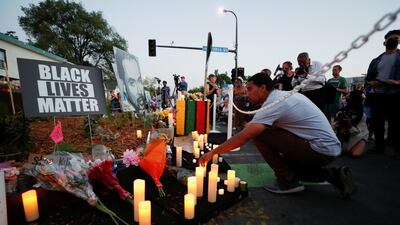
A man places a candle at a memorial in honour of George Floyd, at George Floyd Square in Minneapolis. Reuters -
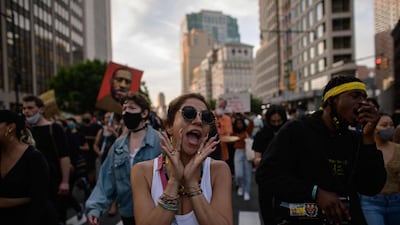
Black Lives Matter protesters hold placards and shout slogans in Brooklyn, New York. AFP -
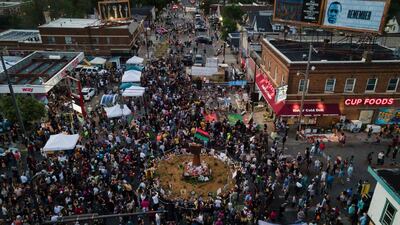
People gather at George Floyd Square in Minneapolis. AP -
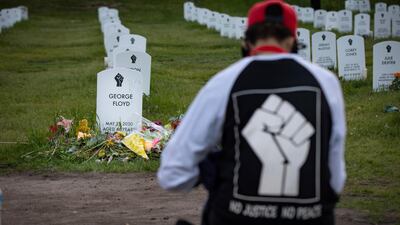
A man sits in front of the Say Their Names cemetery, close to George Floyd Square, in Minneapolis. AP -
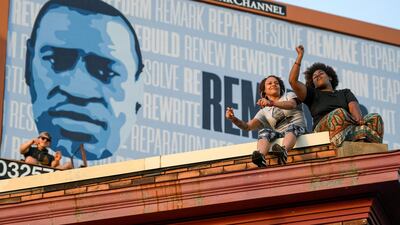
Two women sit on a roof as they listen to a memorial music performance, at George Floyd Square, in Minneapolis. EPA


Mr Hankison's trial has failed to satisfy activists who believe police got off too easily after Kentucky Attorney General Daniel Cameron, the lead investigator, said police were justified in using deadly force.
The charge against Mr Hankison, who has pled not guilty, is a Class D felony punishable by up to five years in prison.
A grand jury cleared the two white officers who actually shot Taylor but found reason to charge Mr Hankison for endangering neighbours in the adjacent apartment.
Mr Hankison fired 10 rounds from outside the apartment and through a sliding glass patio door that had the blinds drawn when police were serving a search warrant at Taylor's home. Some of his shots pierced the wall and entered the next-door home occupied by a child, a pregnant woman and a man.

He told a grand jury he opened fire once the shooting started. As he saw flashes light up the room, he said he mistakenly believed one of the occupants was holding an AR-15 or other long gun as his colleagues came under assault.
“I thought they were just being executed,” Mr Hankison said of his fellow officers.
Instead, mostly what he heard was other police firing their weapons after Taylor's boyfriend fired one round from a handgun that he was licensed to carry, wounding one officer in the leg.
Police wanted to search the home in connection with a drug investigation in which Taylor's ex-boyfriend was a suspect.
Taylor's family won a $12 million wrongful death settlement from the city of Louisville.

