

Canadian Prime Minister Justin Trudeau on Monday invoked the Emergencies Act for the first time since its creation more than three decades ago in an attempt to quell the protests against Covid-19 vaccine mandates that have rocked the country.
The move comes more than two weeks after hundreds of lorry drivers parked their heavy-goods haulers in downtown Ottawa, paralysing the nation’s capital. Protests have sprouted up across the country including at key border crossings to the United States.
Passed in 1988, the Emergencies Act grants the government special temporary powers during a period of national emergency.
Read more: What is Canada's Emergencies Act?
"The scope if these measures will be time-limited, geographically targeted as well as reasonable and proportionate to the threats they are meant to address," Mr Trudeau said in a televised address.
The Emergencies Act replaced the War Measures Act, which Mr Trudeau’s father Pierre Elliott Trudeau invoked in 1970 to tackle the Front de Liberation du Quebec (FLQ), a militant separatist group that was trying to get the province of Quebec to secede from Ottawa.
Thousands of Canadian troops marched through the streets in Montreal from October to December 1970 as they attempted to root out the group.
It is a moment in history etched in Canadian lore and fear.
Civil liberties were suspended and the government -- while ultimately successful in defeating the FLQ and restoring order -- arrested hundreds of people without charge.
The Emergencies Act is narrower in focus and scope compared to its predecessor. Mr Trudeau made clear he was not bringing in the military.
"We're not using the Emergencies Act to call in the military," he said.
Law enforcement experts say the move may help communication across Canada's various levels of government and local police forces.
"What this Act may actually allow for is easier co-ordination, less bureaucracy, less red tape between the provincial policing powers and the federal powers," said Bruce Pitt-Payne, a retired major crimes investigator with the Royal Canadian Mounted Police (RCMP).
The announcement comes after Canadian police on Monday said they had arrested 11 protesters with a "cache of firearms" blocking a border crossing between Coutts, Alberta and the US state of Montana, where they are demonstrating against Covid health restrictions.
The RCMP said it raided three trailers after learning of "a small organised group within the larger Coutts protest... that had access to a cache of firearms with a large quantity of ammunition."
Rifles, handguns, body armour, a machete and "a large quantity of ammunition" were seized, the RCMP said.
The presence of weapons in Coutts casts a pall across the freedom convoy protests, Mr Pitt-Payne said.
"To me, it says this is now more of an insurrection," he told The National.
"If it happened in one area of the country, could it be happening in the other border blockades, could there also be weapons hidden somewhere close by in Ottawa?"
Late on Sunday night, North America’s busiest border crossing re-opened after a weeklong blockade.
The Ambassador Bridge connecting Windsor, Ontario and Detroit, Michigan carries a quarter of all trade between the two countries.
Its closure put economic strains on both Canada and the US, including Detroit's car-manufacturing hub, and Canadian authorities came under increasing pressure to get traffic flowing again.
“The Ambassador Bridge is open,” tweeted the Windsor Police Department, whose officers, with the help of reinforcements from the Ontario Provincial Police and the Royal Canadian Mounted Police, engaged in a multi-day operation to clear out protesters.
Police made several arrests and had to tow multiple vehicles away but ultimately the situation, while tense, unfolded peacefully.
“I am very thankful for today's peaceful outcome,” Windsor Police Chief Pam Mizuno said in a Tweet.
-
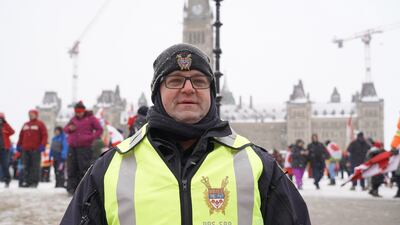
A police officer stands guard at Parliament Hill in Ottawa. Willy Lowry / The National. -
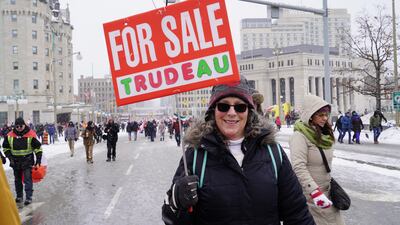
A woman carries a sign that says "For Sale: Trudeau." Willy Lowry / The National. -

A man holds a boombox and a Canadian flag. Willy Lowry / The National. -

Three men pose for a picture while attending the anti-vaccine protests in Ottawa. Willy Lowry / The National. -
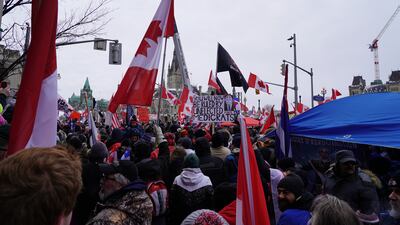
Thousands of people attend an anti-vaccine mandate protest in Ottawa on Saturday, February, 12. Willy Lowry / The National. -
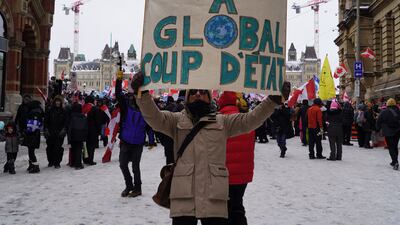
A man holds a sign reading "A global coup d'etat" at a protest in downtown Ottawa. Willy Lowry / The National. -

Two people pose for a picture while attending the anti-vaccine protest in Ottawa. Willy Lowry / The National. -

Thousands of people protest against government vaccine mandates in front of Peace Tower in Ottawa. Willy Lowry / The National. -
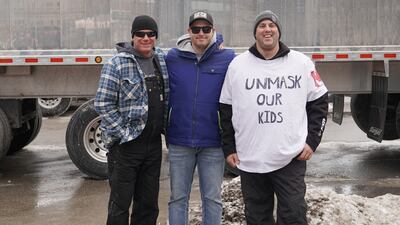
Mike Card, right, poses with two friends. They drove in from Sarnia, Ontario, to support the lorry drivers. Willy Lowry / The National -

A sign that reads 'my body, my choice' sits in front of the Canadian Parliament. Willy Lowry / The National -
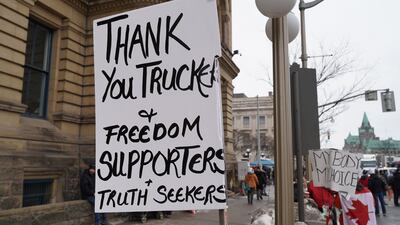
A sign thanking drivers hangs on Wellington Street in central Ottawa. Willy Lowry / The National -
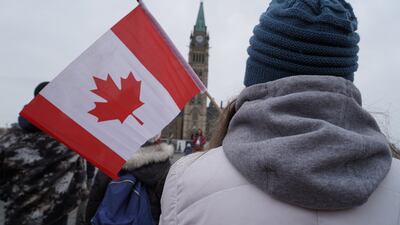
A woman waves a Canadian flag in front of Parliament. Willy Lowry / The National -
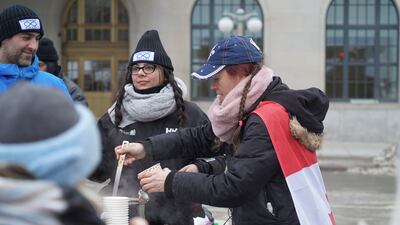
A woman hands out soup to protesters. Willy Lowry / The National -
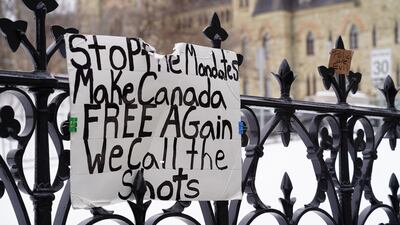
A sign calling for an end to mandates sits on the fence around the Canadian Parliament. Willy Lowry / The National -

Police officers stand guard at a city intersection in central Ottawa. Willy Lowry / The National -

A car is decorated with an anti-vaccine sign and both the American and Canadian flags. Willy Lowry / The National -
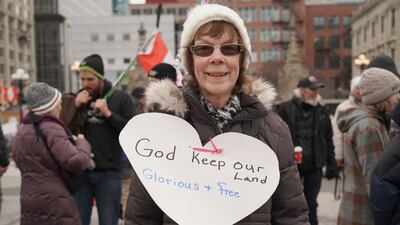
Donna Curry holds a sing saying 'God keep our land glorious and free' outside of Parliament. Willy Lowry / The National -
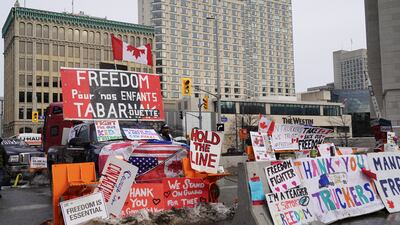
Ant-vaccine signs litter and block a city intersection in central Ottawa. Willy Lowry / The National -

Police cruisers block an intersection in central Ottawa. Willy Lowry / The National -
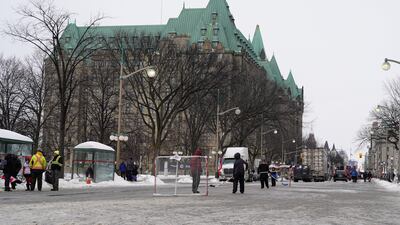
Children play hockey on the street in front of the Canadian Parliament. Willy Lowry / The National -

A man cracks an egg to help prepare food for the protesters. Willy Lowry / The National -
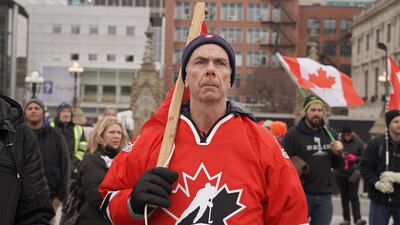
A protester wears a Hockey Canada jersey outside of Parliament. Willy Lowry / The National -

Two men pose outside of Parliament. Willy Lowry / The National -
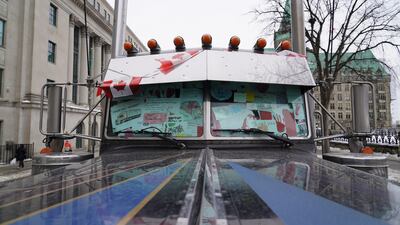
Signs fill the windshield of a parked lorry in central Ottawa. Willy Lowry / The National -
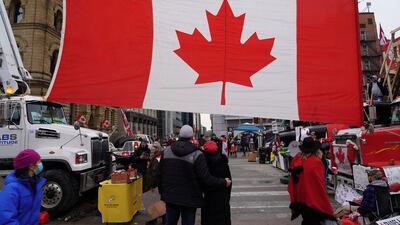
A giant Canadian flag hangs at an intersection near the Parliament. Willy Lowry / The National -
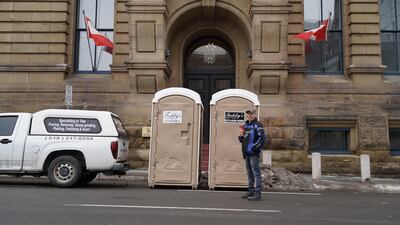
Portable toilets have been set up near the main protest site in Ottawa. Willy Lowry / The National -

A counter-protester stands near the anti-vaccine protesters in central Ottawa. Willy Lowry / The National -
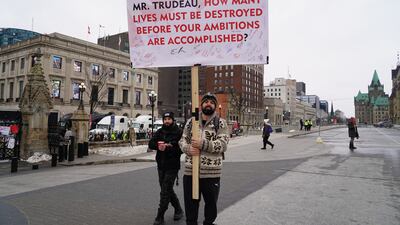
A man holds a sign criticising Canadian Prime Minister Justin Trudeau. Willy Lowry / The National


Over the weekend, thousands of Canadians descended on Ottawa to show solidarity with lorry drivers who are protesting against vaccine mandates and Covid-19 restrictions.
Now in their third week, the protests have become a major political problem for Prime Minister Justin Trudeau.
According Canadian media, he is expected to meet with provincial leaders on Monday to discuss the ongoing demonstrations.
Late on Sunday, Mr Trudeau chaired a session of his Cabinet's Incident Response Group which was established to handle the growing protests.
“We covered further actions the government can take to help end the blockades and occupations,” tweeted Mr Trudeau. “We’ll keep working urgently on this – to protect jobs, public safety, our neighbourhoods, and our economy.”
Agencies contributed to this piece.

