

A brass candelabra and a pair of leather-healed shoes wrapped in plastic packaging are among the objects the artist Christo chose to express ideas of movement, migration and preservation.
They form part of a presentation of early work by Christo by the Gagosian gallery, which will go on display in a grade two listed Georgian house in East London in October
Produced in the 1960s and 1970s, these early sculptural works reveal the artist's interest in mundane, every day objects years before he began making the large-scale public works that he became known for.
Christo Javacheff was a political refugee who escaped Stalin-era Bulgaria to Prague, then relocating to Vienna, Geneva, Paris and eventually New York. This defined him as an eternal wanderer – “l’etranger”, as he referred to himself.
He and his wife Jeanne-Claude Genat de Guillebon became known for their monumental collaborative contemporary art works. These often involved wrapping large landscapes and buildings in fabric.
Among their most famous works was the wrapping of Berlin's Reichstag, the Arc de Triomphe in Paris, and the gates of New York City's Central Park. A 150m high prismatic sculpture by Christo and Jeanne Claude is planned to be built in the Abu Dhabi desert.
Together, they came to redefine the relationship between art and public space, expanding the possibilities of scale and transforming familiar landscapes.
The exhibition will reveal how the artist, even at this formative stage of his career, responded creatively to domestic and urban environments, drawing attention to overlooked details by obscuring them from view.
The exhibition is part of Gagosian Open, a new series by the gallery showcasing artworks in unusual spaces. In this case, the choice of 4, Princelet Street in the East End was an opportunity to attract audiences and visitors beyond the traditional collector circles in London's Mayfair.
-
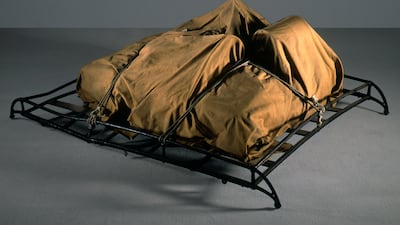
Package on a luggage rack, 1962. Photo: Christo and Jeanne-Claude Foundation and Gagosian -
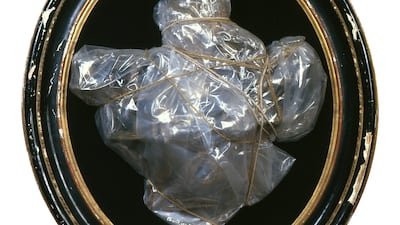
Applique Empaquetée, 1963-1981. Photo: Christo and Jeanne-Claude Foundation and Gagosian -
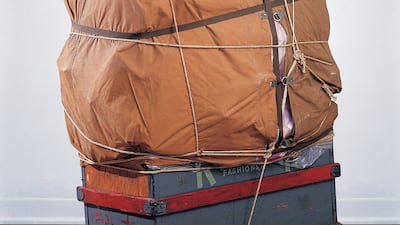
Dolly, 1964. Photo: Christo and Jeanne-Claude Foundation and Gagosian -
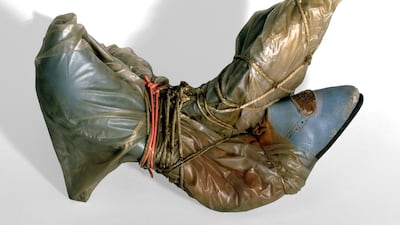
J-C's Wrapped Shoes, 1962. Photo: Christo and Jeanne-Claude Foundation and Gagosian -
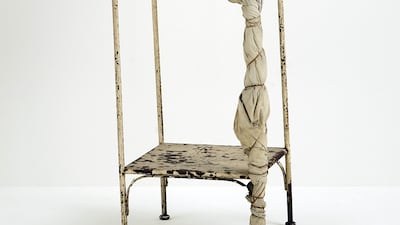
Package on a Table, 1961. Photo: Gagosian


Christo's story is echoed by the exhibition venue itself, which has been home to successive migrant families.
The property was first constructed in 1723 to house Huguenot migrants – the UK’s first refugees. The area has since welcomed Irish linen workers, Eastern European Jews, Jews from the Netherlands, and most recently members of Spitalfields’s large Bangladeshi community.
The presentation will coincide with another Gagosian presentation at their gallery in Basel, that gathers other sculptures by Christo alongside preparatory drawings and collages for large-scale projects.
-
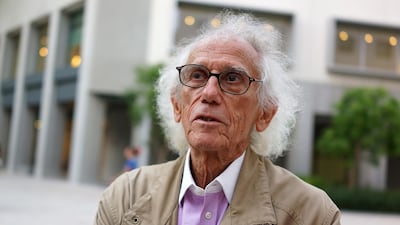
Christo Vladimirov Jaacheff at the unveiling of 'Dunescape', an installation by Anna Kurkova, at NYUAD in Abu Dhabi in 2017. Delores Johnson / The National -
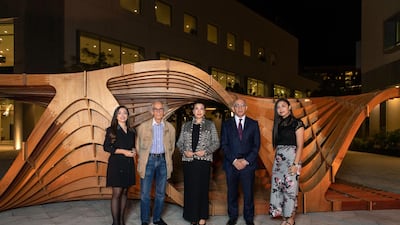
Maram Kassab, Christo, Huda Kanoo, WHO, and Mariam Ayoub in front of the 2018 Christo and Jeanne-Claude Award-winning pavilion -
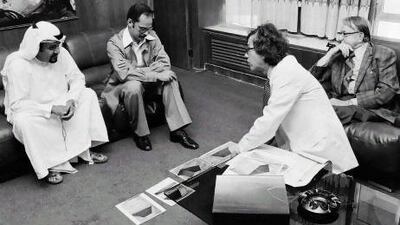
Christo visits the UAE in 1979 to explain the preliminary engineering concept for The Mastaba to officials of the Ministry of Construction. -
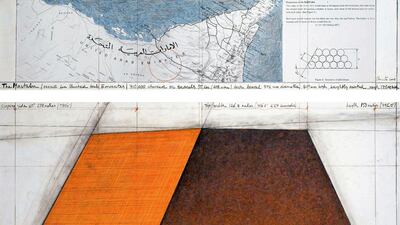
A 2009 drawing showing the concept for Christo's 'The Mastaba' project in the UAE. Photo by Wolfgang Volz -
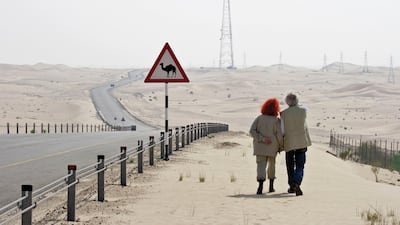
Christo and Jeanne-Claude scout for locations for the site of 'The Mastaba' in October 2007. Photo by Wolfgang Volz -
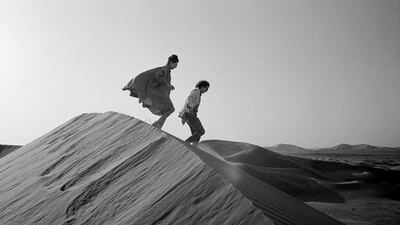
Christo and Jeanne-Claude looking for a possible site for 'The Mastaba' in February 1982. Photo by Wolfgang Volz -
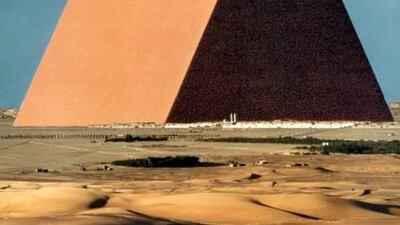
A collage, from 1979, showing how 'The Mastaba' would appear in the Liwa desert. Photo by Wolfgang Volz -
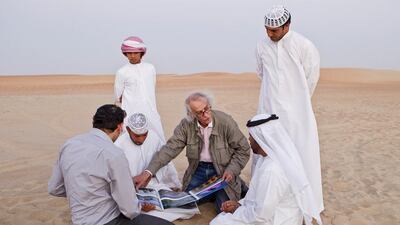
Christo meets with Liwa residents Khalfan Al Qubasi, left, Saeed Al Falahi, right, and Obaid Al Mazrouei, front right, in October 2012, to discuss his plans to construct 'The Mastaba', a pyramid of 410,000 barrels. Antonie Robertson / The National -
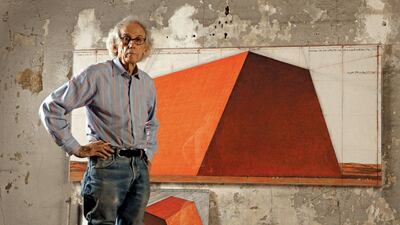
Christo in his studio with a preparatory drawing for 'The Mastaba' Courtesy Christo and the Maeght Foundation -

Christo with Mohammed bin Azzan Al Mazrouei, the director general of the Western Region Development Council. Delores Johnson / The National -
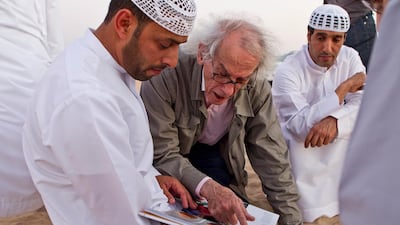
Christo Yavacheff (centre), meets with Liwa residents Khalfan Al Qubasi (L) and Saeed Al Falahi (R) to discuss his plans to construct in Liwa a pyramid of 415,000 oil drums that will be bigger than the main pyramid of giza. Antonie Robertson / The National -
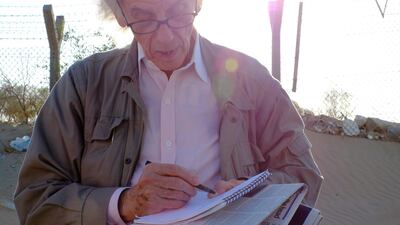
Christo Yavacheff sketches out his plans to construct in Liwa a pyramid of 415,000 oil drums that will be bigger than the main pyramid of giza. Antonie Robertson / The National -
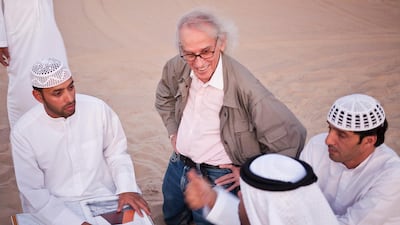
Christo with Khalfan Al Qubasi, left, Saeed Al Falahi, right, and Obaid Al Mazrouei, front right, in Liwa. Antonie Robertson / The National -
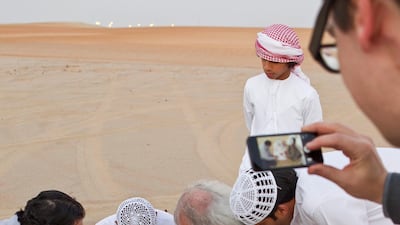
Christo meets with Liwa residents Khalfan Al Qubasi, left, and Saeed Al Falahi, right. Antonie Robertson / The National -
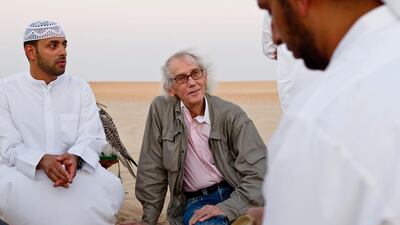
Christo Yavacheff (centre), meets with Liwa residents Khalfan Al Qubasi (L) to discuss his plans to construct in Liwa a pyramid of 415,000 oil drums that will be bigger than the main pyramid of giza. Antonie Robertson / The National


Selected Works marks the 25th anniversary of Christo and Jeanne-Claude’s last project in the city in 1998, when they wrapped 178 trees around the Fondation Beyeler in 55,000 square metres of woven polyester fabric.
Selected works from both exhibitions will be for sale through the gallery.
The exhibition at 4, Princelet Street, London, runs from October 6 to 22.

