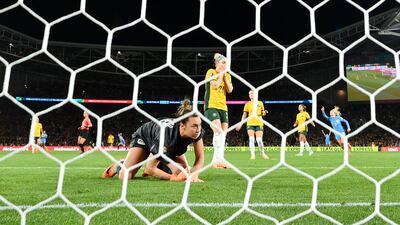
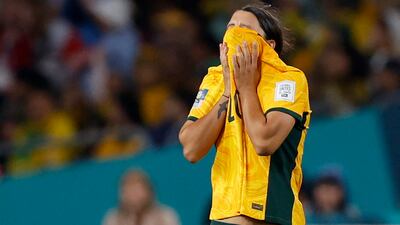
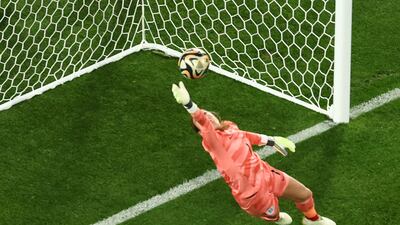
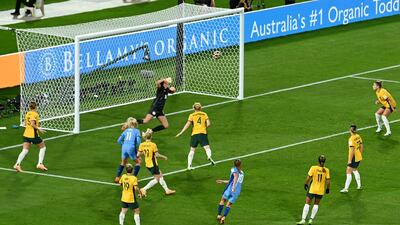
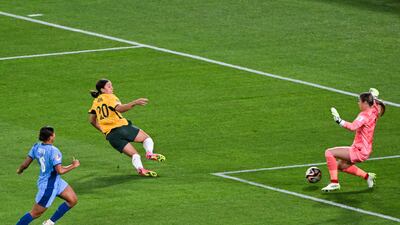
The Lionesses’ success in Australia means a familiar tune is being belted out – several times over – at the stadium, in people’s homes and anywhere else fans gather to cheer on the team.
Sweet Caroline may not be an obvious football song – it is, after all, a love ballad – but it is one of England's favourite footballing anthems.
Even the Welsh Guards Band performed it during Wednesday's Changing of the Guard outside Buckingham Palace after the Lionesses' win against Australia, ensuring their place in the final this weekend.
But the question is, why has it become so popular among England fans?
The answer is rather peculiar, and harks back to when it became a victory song for the Boston Red Sox baseball team, after the employee in charge of the music at a 1997 game played it in honour of a friend who had just had a baby whom she called Caroline.
Over time, it became good luck anthem among fans, to be belted out whenever the team was playing well.
And that somehow caught on in the UK.
It is believed Arsenal was the first UK team to adopt it at the 2017 FA Cup semi-final win.
But others have used it as well, including Aston Villa and boxer Tyson Fury.
It cemented its place as an English team anthem in the 2020 Euro football tournament, when the DJ for matches at Wembley, Tony Perry, decided to use it to follow up Three Lions following the team’s win against Germany.
Some of the German fans even reportedly sang along.
“It’s kind of become like a good-luck charm in this tournament,” Perry told The New York Times.
He had first heard the song’s “special powers”, as he described them to the paper in 2019, when the Red Sox and the New York Yankees played two games in London. When the song came on, the crowd started singing along.
“That’s where I picked up on those special powers,” Perry said.
The Lionesses sang it themselves on the pitch following their Euro final victory last year.
What is the song about and who wrote it?
It was once believed that the 1969 Neil Diamond song was an ode to the daughter of John F Kennedy and Jacqueline.
But decades later, in 2014, Diamond revealed that he actually wrote it for his wife at the time, Marsha.
“I was writing a song in Memphis, Tennessee, for a session. I needed a three-syllable name,” Diamond said told the Today show in the US.
“The song was about my wife at the time – her name was Marsha – and I couldn’t get a ‘Marsha’ rhyme.”
Diamond has said in the past how happy he is that it has become an anthem of not only the Red Sox, but the England football team.
In 2021, when the tournament was being played, he told the Times: “It’s a song to celebrate good things, and it seems to bring good luck to those who embrace it.
“It’s also a song of unity and can bring together even the fiercest of competitors. But of course I want England to win because I love the way they sing it with such gusto.”
What are the lyrics?
Where it began, I can't begin to knowing
But then I know it's growing strong
Was in the spring
And spring became the summer
Who'd have believed you'd come along
Hands, touching hands
Reaching out, touching me, touching you
Sweet Caroline
Good times never seemed so good
I've been inclined
To believe they never would
But now
I Look at the night and it don't seem so lonely
We filled it up with only two
And when I hurt
Hurting runs off my shoulders
How can I hurt when holding you
One, touching one
Reaching out, touching me, touching you
Sweet Caroline
Good times never seemed so good
I've been inclined
To believe they never would
Oh no, no
Sweet Caroline
Good times never seemed so good
Sweet Caroline
I believe they never could
Sweet Caroline
Good times never seemed so good

HOW DO SIM CARD SCAMS WORK?
Sim swap frauds are a form of identity theft.
They involve criminals conning mobile phone operators into issuing them with replacement Sim cards, often by claiming their phone has been lost or stolen
They use the victim's personal details - obtained through criminal methods - to convince such companies of their identity.
The criminal can then access any online service that requires security codes to be sent to a user's mobile phone, such as banking services.
How Tesla’s price correction has hit fund managers
Investing in disruptive technology can be a bumpy ride, as investors in Tesla were reminded on Friday, when its stock dropped 7.5 per cent in early trading to $575.
It recovered slightly but still ended the week 15 per cent lower and is down a third from its all-time high of $883 on January 26. The electric car maker’s market cap fell from $834 billion to about $567bn in that time, a drop of an astonishing $267bn, and a blow for those who bought Tesla stock late.
The collapse also hit fund managers that have gone big on Tesla, notably the UK-based Scottish Mortgage Investment Trust and Cathie Wood’s ARK Innovation ETF.
Tesla is the top holding in both funds, making up a hefty 10 per cent of total assets under management. Both funds have fallen by a quarter in the past month.
Matt Weller, global head of market research at GAIN Capital, recently warned that Tesla founder Elon Musk had “flown a bit too close to the sun”, after getting carried away by investing $1.5bn of the company’s money in Bitcoin.
He also predicted Tesla’s sales could struggle as traditional auto manufacturers ramp up electric car production, destroying its first mover advantage.
AJ Bell’s Russ Mould warns that many investors buy tech stocks when earnings forecasts are rising, almost regardless of valuation. “When it works, it really works. But when it goes wrong, elevated valuations leave little or no downside protection.”
A Tesla correction was probably baked in after last year’s astonishing share price surge, and many investors will see this as an opportunity to load up at a reduced price.
Dramatic swings are to be expected when investing in disruptive technology, as Ms Wood at ARK makes clear.
Every week, she sends subscribers a commentary listing “stocks in our strategies that have appreciated or dropped more than 15 per cent in a day” during the week.
Her latest commentary, issued on Friday, showed seven stocks displaying extreme volatility, led by ExOne, a leader in binder jetting 3D printing technology. It jumped 24 per cent, boosted by news that fellow 3D printing specialist Stratasys had beaten fourth-quarter revenues and earnings expectations, seen as good news for the sector.
By contrast, computational drug and material discovery company Schrödinger fell 27 per cent after quarterly and full-year results showed its core software sales and drug development pipeline slowing.
Despite that setback, Ms Wood remains positive, arguing that its “medicinal chemistry platform offers a powerful and unique view into chemical space”.
In her weekly video view, she remains bullish, stating that: “We are on the right side of change, and disruptive innovation is going to deliver exponential growth trajectories for many of our companies, in fact, most of them.”
Ms Wood remains committed to Tesla as she expects global electric car sales to compound at an average annual rate of 82 per cent for the next five years.
She said these are so “enormous that some people find them unbelievable”, and argues that this scepticism, especially among institutional investors, “festers” and creates a great opportunity for ARK.
Only you can decide whether you are a believer or a festering sceptic. If it’s the former, then buckle up.
Teri%20Baaton%20Mein%20Aisa%20Uljha%20Jiya
%3Cp%3E%3Cstrong%3EDirectors%3A%3C%2Fstrong%3E%20Amit%20Joshi%20and%20Aradhana%20Sah%3C%2Fp%3E%0A%3Cp%3E%3Cstrong%3ECast%3A%3C%2Fstrong%3E%20Shahid%20Kapoor%2C%20Kriti%20Sanon%2C%20Dharmendra%2C%20Dimple%20Kapadia%2C%20Rakesh%20Bedi%3C%2Fp%3E%0A%3Cp%3E%3Cstrong%3ERating%3A%3C%2Fstrong%3E%204%2F5%3C%2Fp%3E%0A
Mercer, the investment consulting arm of US services company Marsh & McLennan, expects its wealth division to at least double its assets under management (AUM) in the Middle East as wealth in the region continues to grow despite economic headwinds, a company official said.
Mercer Wealth, which globally has $160 billion in AUM, plans to boost its AUM in the region to $2-$3bn in the next 2-3 years from the present $1bn, said Yasir AbuShaban, a Dubai-based principal with Mercer Wealth.
“Within the next two to three years, we are looking at reaching $2 to $3 billion as a conservative estimate and we do see an opportunity to do so,” said Mr AbuShaban.
Mercer does not directly make investments, but allocates clients’ money they have discretion to, to professional asset managers. They also provide advice to clients.
“We have buying power. We can negotiate on their (client’s) behalf with asset managers to provide them lower fees than they otherwise would have to get on their own,” he added.
Mercer Wealth’s clients include sovereign wealth funds, family offices, and insurance companies among others.
From its office in Dubai, Mercer also looks after Africa, India and Turkey, where they also see opportunity for growth.
Wealth creation in Middle East and Africa (MEA) grew 8.5 per cent to $8.1 trillion last year from $7.5tn in 2015, higher than last year’s global average of 6 per cent and the second-highest growth in a region after Asia-Pacific which grew 9.9 per cent, according to consultancy Boston Consulting Group (BCG). In the region, where wealth grew just 1.9 per cent in 2015 compared with 2014, a pickup in oil prices has helped in wealth generation.
BCG is forecasting MEA wealth will rise to $12tn by 2021, growing at an annual average of 8 per cent.
Drivers of wealth generation in the region will be split evenly between new wealth creation and growth of performance of existing assets, according to BCG.
Another general trend in the region is clients’ looking for a comprehensive approach to investing, according to Mr AbuShaban.
“Institutional investors or some of the families are seeing a slowdown in the available capital they have to invest and in that sense they are looking at optimizing the way they manage their portfolios and making sure they are not investing haphazardly and different parts of their investment are working together,” said Mr AbuShaban.
Some clients also have a higher appetite for risk, given the low interest-rate environment that does not provide enough yield for some institutional investors. These clients are keen to invest in illiquid assets, such as private equity and infrastructure.
“What we have seen is a desire for higher returns in what has been a low-return environment specifically in various fixed income or bonds,” he said.
“In this environment, we have seen a de facto increase in the risk that clients are taking in things like illiquid investments, private equity investments, infrastructure and private debt, those kind of investments were higher illiquidity results in incrementally higher returns.”
The Abu Dhabi Investment Authority, one of the largest sovereign wealth funds, said in its 2016 report that has gradually increased its exposure in direct private equity and private credit transactions, mainly in Asian markets and especially in China and India. The authority’s private equity department focused on structured equities owing to “their defensive characteristics.”
COMPANY%20PROFILE
%3Cp%3E%3Cstrong%3EName%3A%3C%2Fstrong%3E%20Floward%0D%3Cbr%3E%3Cstrong%3EBased%3A%20%3C%2Fstrong%3ERiyadh%2C%20Saudi%20Arabia%0D%3Cbr%3E%3Cstrong%3EFounders%3A%20%3C%2Fstrong%3EAbdulaziz%20Al%20Loughani%20and%20Mohamed%20Al%20Arifi%0D%3Cbr%3E%3Cstrong%3ESector%3A%20%3C%2Fstrong%3EE-commerce%0D%3Cbr%3E%3Cstrong%3ETotal%20funding%3A%20%3C%2Fstrong%3EAbout%20%24200%20million%0D%3Cbr%3E%3Cstrong%3EInvestors%3A%20%3C%2Fstrong%3EAljazira%20Capital%2C%20Rainwater%20Partners%2C%20STV%20and%20Impact46%0D%3Cbr%3E%3Cstrong%3ENumber%20of%20employees%3A%20%3C%2Fstrong%3E1%2C200%3C%2Fp%3E%0A
What is blockchain?
Blockchain is a form of distributed ledger technology, a digital system in which data is recorded across multiple places at the same time. Unlike traditional databases, DLTs have no central administrator or centralised data storage. They are transparent because the data is visible and, because they are automatically replicated and impossible to be tampered with, they are secure.
The main difference between blockchain and other forms of DLT is the way data is stored as ‘blocks’ – new transactions are added to the existing ‘chain’ of past transactions, hence the name ‘blockchain’. It is impossible to delete or modify information on the chain due to the replication of blocks across various locations.
Blockchain is mostly associated with cryptocurrency Bitcoin. Due to the inability to tamper with transactions, advocates say this makes the currency more secure and safer than traditional systems. It is maintained by a network of people referred to as ‘miners’, who receive rewards for solving complex mathematical equations that enable transactions to go through.
However, one of the major problems that has come to light has been the presence of illicit material buried in the Bitcoin blockchain, linking it to the dark web.
Other blockchain platforms can offer things like smart contracts, which are automatically implemented when specific conditions from all interested parties are reached, cutting the time involved and the risk of mistakes. Another use could be storing medical records, as patients can be confident their information cannot be changed. The technology can also be used in supply chains, voting and has the potential to used for storing property records.
Brief scores:
Barcelona 3
Pique 38', Messi 51 (pen), Suarez 82'
Rayo Vallecano 1
De Tomas Gomez 24'