

Docked in London’s Greenwich district, days before the Cop26 summit on climate change, is the RRS Sir David Attenborough.
Named after the TV presenter and naturalist, the UK’s most advanced polar research ship is a symbol of hope in a world facing mounting environmental challenges.
It was almost called Boaty McBoatface after a national competition to name it threatened to backfire. Instead, sense prevailed and a submersible on the ship got that honour instead.
At 129 metres in length and costing £200 million ($275m), the ship is one of the most advanced research vessels in the world and can carry up to 60 scientists deep into the heart of the ice-covered polar seas.
Many of them looked giddy with excitement as they took international media on a tour, pointing out the advanced technology on deck and the various “war-rooms” they will use to map routes, collect samples and analyse data.
-

The RRS Sir David Attenborough docks in Greenwich, London. The UK's most advanced polar research ship is in London to mark the start of the Cop26 climate conference. PA -

David Attenborough, centre, with the crew on the deck of the RRS Sir David Attenborough. The ship is named after the famed TV presenter and naturalist. AP Photo -
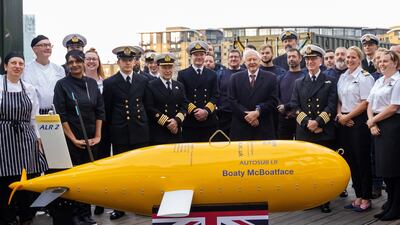
David Attenborough and crew members with Boaty McBoatface, a submersible on the ship that was named in a competition. EPA -
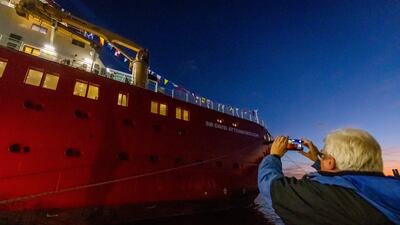
The RRS Sir David Attenborough on the River Thames in Greenwich. At 129 metres long and built at a cost of £200 million, the ship is one of the most advanced research vessels in the world. EPA -

Visitors take photographs of Boaty McBoatface, a robotic submersible. EPA -
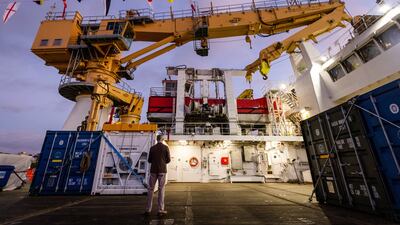
The state-of-the-art polar research ship will set off for its maiden voyage to Antarctica after global leaders meet at Cop26. EPA -
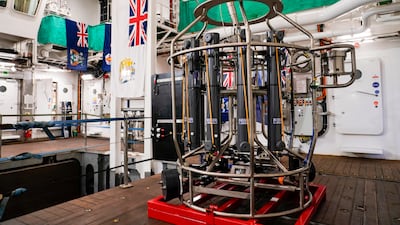
The RRS Sir David Attenborough can carry up to 60 scientists deep into the heart of the ice-covered polar seas. AP Photo -
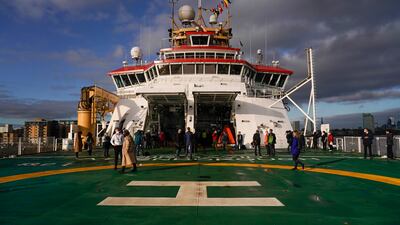
The heliport on the RRS Sir David Attenborough. Its maiden voyage to the Antarctic next month will be a trip aimed primarily at testing the ship's new technology and capability in arctic conditions. AP Photo


Having completed sea trials around the UK, the ship, which can crash through metre-thick ice floes at a steady pace, will embark on its maiden voyage to the Antarctic next month.
With only its 30-person crew on board, it will be a trip largely aimed at trialling its new technology and capabilities in arctic conditions, after which scientists will join to embark on their own studies on the effects of global warming.
Capt Will Whatley said he was “incredibly excited” to be commanding the “first of its class vessel”, while reeling off its impressive capabilities to The National.

“There’s no other ship like this in the world, we have a whole lot of capability in one hull, we have a helideck now so can do airborne sights in the Antarctic, we have a moon pool so can deploy scientific equipment through the middle of the ship so even if we are surrounded by ice we can still access the sea through the middle, we have scientific winches that can go down at least 7,000 metres of depth, a main crane that can lift 50 tonnes,” said the captain, who has been working for the British Antarctic Survey since 2008.
Of the many impressive machines in the RRS David Attenborough’s arsenal, the small yellow autosubmarine, known affectionately as Boaty McBoatface, is undoubtedly its brightest.
Part of a growing fleet of autonomous fleets in the UK, the long-range submarine greatly extends the already sizeable capabilities of the state-of-the-art ship, said one of its chief robotics engineers.
“A lot of the R&D over recent years has been about taking the sensors to the level of capability that the ship itself can do, like measuring nutrients, oxygen, carbon, all the way through to biology. We are now getting to the point where we have standalone sensors that can look at environmental DNA, so getting that sort of sensor on this type of vehicle really extends the capability of marine scientists,” said Dr Mathew Palmer, chief scientist with the UK’s National Oceanography Centre.

Boaty McBoatface’s mission on the Antarctic trip this winter will be to go under ice, navigate itself, collect data and then find its way back to the ship through the “extremely capable compass” that Dr Palmer’s team has been developing. Its success, he said, will be a huge leap forward in allowing the research platform to “go beyond one place at a time”.
“We could send the autosubs off to take their own measurements and potentially leave them behind when the ship and scientists leave to keep measuring for weeks, maybe months, afterwards, and potentially even operate alone and undertake their own missions,” he said.

Commissioned by the Natural Environment Research Council – part of UK Research and Innovation – the RRS David Attenborough was built by Cammell Laird and is operated by the British Antarctic Survey.
The research platform is part of the UK government's polar infrastructure investment programme, its largest in the field since the 1980s, designed to keep Britain at the forefront of world-leading research on climate change.
“Science is not just necessary to diagnose the state of the planet – it is also needed to understand how to treat it. Through research, we can accelerate the technological, social and economic change needed to reach net zero and this wonderful ship and its scientists will play a significant role in furthering our understanding of the effects of climate change,” said the government’s chief scientific adviser, Sir Patrick Vallance.
Speaking aboard the ship at its unveiling in the UK capital, Sir David Attenborough said he was “very proud” to be associated with the vessel, calling its naming “no greater compliment”.
He also called on world leaders meeting for Cop26 to listen to the science and take action.
“Would it not be marvellous to suppose that as a consequence of science’s discoveries that the nations of the world join together and actually did something at Cop," he said.
"I hope and pray for nations getting together and listening to the science of what has to be done if the world is not to be overcome by catastrophe.”

