US intelligence officials found no evidence that unidentified aerial phenomena observed by Navy aviators in recent years were alien spacecraft.
But, in a highly anticipated government report, no explanations were offered for the sightings, The New York Times said on Thursday.
The report also found the vast majority of incidents documented over the past two decades did not originate from any US military or other advanced government technology, the Times said, citing senior administration officials briefed on the report.
Many of the 120-plus sightings reviewed in the classified intelligence study from a Pentagon task force were reported by US Navy personnel, while some involved foreign militaries, the Times report said.
The newspaper said US intelligence officials believe experimental technology of a rival power could account for at least some of the aerial phenomena in question.
One unnamed senior US official briefed on the report told the Times there was concern among American intelligence and military officials that China or Russia could be experimenting with hypersonic technology.
An unclassified version of the report expected to be submitted to Congress by June 25 will present few other conclusions, the newspaper said.
Public fascination with unidentified flying objects, or UFOs, was stoked in recent weeks by the forthcoming report, with UFO enthusiasts anticipating revelations about unexplained sightings many believe the government has for decades sought to discredit or cover up.
But senior US officials cited in the Times article said the report's ambiguity meant the government was unable to definitively rule out theories that the unidentified phenomena might have been extraterrestrial in nature.
The government's Unidentified Aerial Phenomena (UAP) Task Force was created after a spate of observations by military pilots of unknown aerial objects exhibiting speeds and manoeuvrability that seemingly defied the limits of known technology and the laws of physics.
Led by the Navy, the task force was established last year to "improve its understanding of, and gain insight into, the nature and origins of UAP incursions into our training ranges and designated airspace", Pentagon spokeswoman Sue Gough told Reuters.
She said such incidents are of concern because of safety and national security implications.
Responding to Reuters' questions about the task force report, Ms Gough said in an email earlier on Thursday: "We do not publicly discuss the details of the UAP observations, the task force or examinations."
The term "unidentified flying objects", long associated with the idea of alien spacecraft, has been largely supplanted in official government parlance by UAP, short for unidentified aerial phenomena, since December 2017.
It was then that the Pentagon first went on record, in a New York Times article, acknowledging documented UAP encounters by aircraft and ships and efforts to catalogue them – marking a turnaround from decades of publicly treating the subject as taboo.
-
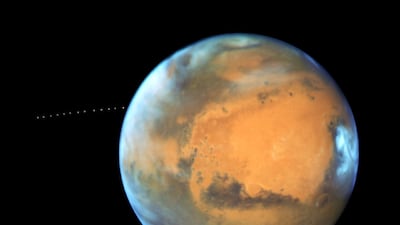
Nasa's Hubble Space Telescope captured the tiny moon Phobos during its orbital trek around Mars. Because the moon is so small, it appears star-like in the Hubble pictures. The Hubble observations were intended to photograph Mars, and the moon's cameo appearance was a bonus. Phobos is one of the smallest moons in the solar system. It is so tiny that it would fit comfortably inside the Washington, DC. Courtesy: Nasa -
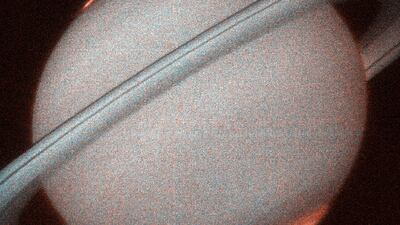
This is the first image of Saturn's ultraviolet aurora taken by the Space Telescope Imaging Spectrograph (STIS) on board the Hubble Space Telescope (HST) in October 1998, when Saturn was a distance of 810 million miles (1.3 billion km) from Earth. Courtesy: Nasa -
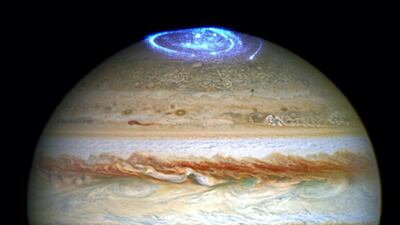
Astronomers are using the Nasa / ESA Hubble Space Telescope to study auroras — stunning light shows in a planet’s atmosphere — on the poles of the largest planet in the solar system, Jupiter. Courtesy: Nasa -
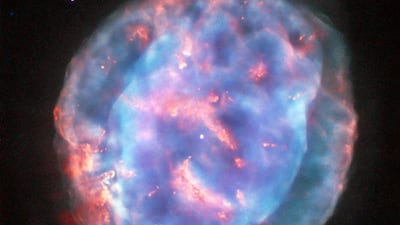
This colourful bubble is a planetary nebula called NGC 6818, also known as the Little Gem Nebula. It is located in the constellation of Sagittarius (The Archer), roughly 6000 light-years away from us. Courtesy: Nasa -
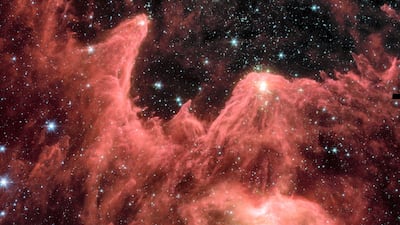
This majestic false-colour image from Nasa's Spitzer Space Telescope shows 'mountains' where stars are born. These towering pillars of cool gas and dust are illuminated at their tips with light from warm embryonic stars. Courtesy: Nasa -
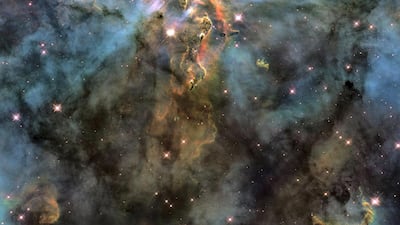
This Nasa Hubble Space Telescope photograph captures the chaotic activity atop a three-light-year-tall pillar of gas and dust that is being eaten away by the brilliant light from nearby bright stars. The pillar is also being assaulted from within, as infant stars buried inside it fire off jets of gas that can be seen streaming from towering peaks. This turbulent cosmic pinnacle lies within a tempestuous stellar nursery called the Carina Nebula, located 7,500 light-years away in the southern constellation Carina. Courtesy: Nasa -
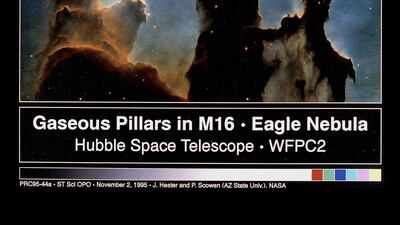
These eerie, dark, pillar-like structures are actually columns of cool interstellar hydrogen gas and dust that are also incubators for new stars. The pillars protrude from the interior wall of a dark molecular cloud like stalagmites from the floor of a cavern. They are part of the Eagle Nebula (also called M16), a nearby star-forming region 7,000 light-years away, in the constellation Serpens. Courtesy: Nasa -
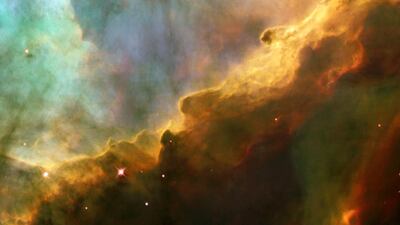
In this image provided by the Hubble Space Telescope (HST), the Omega Nebula (M17) resembles the fury of a raging sea, showing a bubbly ocean of glowing hydrogen gas and small amounts of other elements such as oxygen and sulphur. The nebula, also known as the Swan Nebula, is a hotbed of newly born stars residing 5,500 light-years away in the constellation Sagittarius. Courtesy: Nasa -
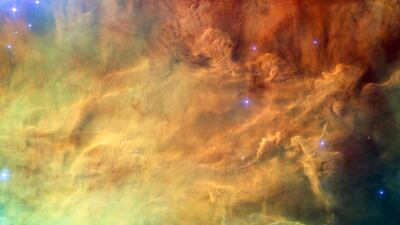
Nasa / ESA Hubble Space Telescope image reveals the heart of the Lagoon Nebula. Courtesy: Nasa -
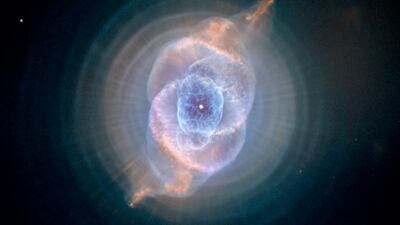
The Cat's Eye Nebula, one of the first planetary nebulae discovered, also has one of the most complex forms known to this kind of nebula. Eleven rings, or shells, of gas make up the Cat's Eye. Courtesy: Nasa -
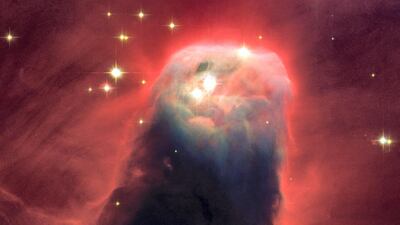
The Cone Nebula resides 2,500 light-years away in the constellation Monoceros. Radiation from hot, young stars (located beyond the top of the image) has slowly eroded the nebula over millions of years. Courtesy: Nasa -
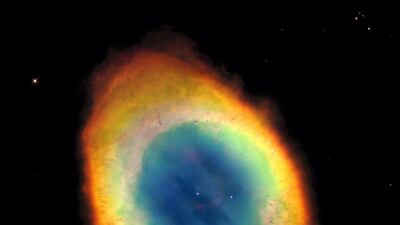
This planetary nebula's simple, graceful appearance is thought to be due to perspective: our view from Earth looking straight into what is actually a barrel-shaped cloud of gas shrugged off by a dying central star. Hot blue gas near the energising central star gives way to progressively cooler green and yellow gas at greater distances with the coolest red gas along the outer boundary. Courtesy: Nasa -
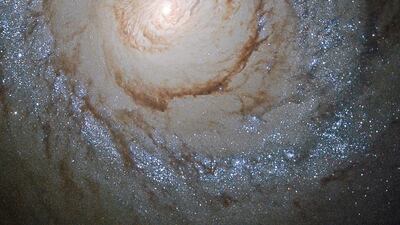
This image shows the galaxy Messier 94, which lies in the small northern constellation of the Hunting Dogs, about 16 million light-years away. Within the bright ring around Messier 94 new stars are forming at a high rate and many young, bright stars are present within it – thanks to this, this feature is called a starburst ring. The cause of this peculiarly shaped star-forming region is likely a pressure wave going outwards from the galactic centre, compressing the gas and dust in the outer region. Courtesy: Nasa



