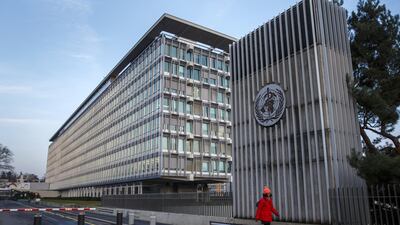
The World Health Organisation headquarters in Geneva. EPA

Trump exit from WHO could cause coronavirus resurgence, say doctors


Thomas Harding
  • English
  • Arabic

Leading medical experts warned the American withdrawal from the World Health Organisation could lead to a resurgence of global diseases.

It will also leave the WHO with a deep hole in its finances, because the US provided almost a quarter of assessed fees and a voluntary contribution of $656 million (Dh2.4 billion).

President Donald Trump's announcement that the US would begin formal proceedings to pull out led to the last-minute cancellation of meetings by WHO officials to deal with the crisis.

The decision has caused an outcry at a time when the world is in the middle of a frightening surge in coronavirus infections, with the US reporting a record of almost 400,000 new cases in the past week.

America has provided the WHO with money and expertise for programmes to help eradicate polio, HIV, hepatitis and tuberculosis.

Prof David Heymann, an infectious diseases expert who worked for the world body from 1995 to 2003, said Mr Trump’s decision could have a serious effect on immunisation programmes.

“The WHO will struggle to keep its surveillance activities going, which are necessary to identify where polio is occurring and where it needs to be stamped out,” Prof Heymann told an online seminar run by Chatham House.

“The WHO has been able to work in these countries that are problem countries for US politics, but which are important in the global fight against infectious diseases.”

Dr Tedros Adhanom Ghebreyesus, director general of the WHO, cancelled his appearance at the seminar to deal with the situation.

Dr David Nabarro, the WHO’s special Covid-19 envoy for Europe, said the US financing and experts would be difficult to replace.

“It just seems really unfortunate that the most important country, in terms of size of the WHO budget, has decided to pull out,” Dr Nabarro told the BBC.

“I’m really sad also for the American people who I’m sure, by and large, want to be part of the global response and will be a bit confused about why this has happened.”

Globally, there are more than 12 million cases recorded and daily infections now exceed 200,000.

Dr Nabarro warned of a “massive health crisis” that will “get much worse in the next six months”.

“All world leaders and all world nations must work together to deal with this virus,” he said.

America has already passed 3 million cases and the virus is accelerating.

Mr Trump's handling of the crisis has been severely criticised and could affect his chances of re-election at the November presidential poll.

In trying to appeal to "America First" voters, he has now begun the formal withdrawal from the WHO, accusing it of spreading disinformation from China and being under Beijing’s control.

China, which contributes 12 per cent of the WHO's assessed fees, rejects the claims.

There has been a negative reaction to the decision with some US states experiencing a shortage in hospital beds.

“It leaves Americans sick and America alone,” Democrat Senator Robert Menendez tweeted.

The US withdrawal process is expected to take at least a year and it will be expected to pay all of its outstanding debts.

The WHO, which has a budget about similar to that of a large US hospital, could make up the funding shortfall from other countries such as Germany, Prof Heymann said.


The White Lotus: Season three

Creator: Mike White

Starring: Walton Goggins, Jason Isaacs, Natasha Rothwell

Rating: 4.5/5

New schools in Dubai

Mercer, the investment consulting arm of US services company Marsh & McLennan, expects its wealth division to at least double its assets under management (AUM) in the Middle East as wealth in the region continues to grow despite economic headwinds, a company official said.

Mercer Wealth, which globally has $160 billion in AUM, plans to boost its AUM in the region to $2-$3bn in the next 2-3 years from the present $1bn, said Yasir AbuShaban, a Dubai-based principal with Mercer Wealth.

Within the next two to three years, we are looking at reaching $2 to $3 billion as a conservative estimate and we do see an opportunity to do so,” said Mr AbuShaban.

Mercer does not directly make investments, but allocates clients’ money they have discretion to, to professional asset managers. They also provide advice to clients.

“We have buying power. We can negotiate on their (client’s) behalf with asset managers to provide them lower fees than they otherwise would have to get on their own,” he added.

Mercer Wealth’s clients include sovereign wealth funds, family offices, and insurance companies among others.

From its office in Dubai, Mercer also looks after Africa, India and Turkey, where they also see opportunity for growth.

Wealth creation in Middle East and Africa (MEA) grew 8.5 per cent to $8.1 trillion last year from $7.5tn in 2015, higher than last year’s global average of 6 per cent and the second-highest growth in a region after Asia-Pacific which grew 9.9 per cent, according to consultancy Boston Consulting Group (BCG). In the region, where wealth grew just 1.9 per cent in 2015 compared with 2014, a pickup in oil prices has helped in wealth generation.

BCG is forecasting MEA wealth will rise to $12tn by 2021, growing at an annual average of 8 per cent.

Drivers of wealth generation in the region will be split evenly between new wealth creation and growth of performance of existing assets, according to BCG.

Another general trend in the region is clients’ looking for a comprehensive approach to investing, according to Mr AbuShaban.

“Institutional investors or some of the families are seeing a slowdown in the available capital they have to invest and in that sense they are looking at optimizing the way they manage their portfolios and making sure they are not investing haphazardly and different parts of their investment are working together,” said Mr AbuShaban.

Some clients also have a higher appetite for risk, given the low interest-rate environment that does not provide enough yield for some institutional investors. These clients are keen to invest in illiquid assets, such as private equity and infrastructure.

“What we have seen is a desire for higher returns in what has been a low-return environment specifically in various fixed income or bonds,” he said.

“In this environment, we have seen a de facto increase in the risk that clients are taking in things like illiquid investments, private equity investments, infrastructure and private debt, those kind of investments were higher illiquidity results in incrementally higher returns.”

The Abu Dhabi Investment Authority, one of the largest sovereign wealth funds, said in its 2016 report that has gradually increased its exposure in direct private equity and private credit transactions, mainly in Asian markets and especially in China and India. The authority’s private equity department focused on structured equities owing to “their defensive characteristics.”

What is tokenisation?

Tokenisation refers to the issuance of a blockchain token, which represents a virtually tradable real, tangible asset. A tokenised asset is easily transferable, offers good liquidity, returns and is easily traded on the secondary markets. 

Our legal advisor

Ahmad El Sayed is Senior Associate at Charles Russell Speechlys, a law firm headquartered in London with offices in the UK, Europe, the Middle East and Hong Kong.

Experience: Commercial litigator who has assisted clients with overseas judgments before UAE courts. His specialties are cases related to banking, real estate, shareholder disputes, company liquidations and criminal matters as well as employment related litigation. 

Education: Sagesse University, Beirut, Lebanon, in 2005.

The%20specs
%3Cp%3E%3Cstrong%3EEngine%3A%20%3C%2Fstrong%3ETwin-turbo%2C%20V8%3Cbr%3E%3Cstrong%3ETransmission%3A%20%3C%2Fstrong%3E8-speed%20automatic%20and%20manual%3Cbr%3E%3Cstrong%3EPower%3A%20%3C%2Fstrong%3E503%20bhp%3Cbr%3E%3Cstrong%3ETorque%3A%20%3C%2Fstrong%3E513Nm%3Cbr%3E%3Cstrong%3EPrice%3A%20%3C%2Fstrong%3Efrom%20Dh646%2C800%20(%24176%2C095)%3Cbr%3E%3Cstrong%3EOn%20sale%3A%20%3C%2Fstrong%3Enow%3C%2Fp%3E%0A
NO OTHER LAND

Director: Basel Adra, Yuval Abraham, Rachel Szor, Hamdan Ballal

Stars: Basel Adra, Yuval Abraham

Rating: 3.5/5

ENGLAND SQUAD

Joe Root (c), Moeen Ali, Jimmy Anderson, Jonny Bairstow, Stuart Broad, Jos Buttler, Alastair Cook, Sam Curran, Keaton Jennings, Ollie Pope, Adil Rashid, Ben Stokes, James Vince, Chris Woakes

The years Ramadan fell in May

1987

1954

1921

1888

Most%20ODI%20hundreds
%3Cp%3E49%20-%20Sachin%20Tendulkar%2C%20India%0D%3Cbr%3E47%20-%20Virat%20Kohli%2C%20India%0D%3Cbr%3E31%20-%20Rohit%20Sharma%2C%20India%0D%3Cbr%3E30%20-%20Ricky%20Ponting%2C%20Australia%2FICC%0D%3Cbr%3E28%20-%20Sanath%20Jayasuriya%2C%20Sri%20Lanka%2FAsia%0D%3Cbr%3E27%20-%20Hashim%20Amla%2C%20South%20Africa%0D%3Cbr%3E25%20-%20AB%20de%20Villiers%2C%20South%20Africa%2FAfrica%0D%3Cbr%3E25%20-%20Chris%20Gayle%2C%20West%20Indies%2FICC%0D%3Cbr%3E25%20-%20Kumar%20Sangakkara%2C%20Sri%20Lanka%2FICC%2FAsia%0D%3Cbr%3E22%20-%20Sourav%20Ganguly%2C%20India%2FAsia%0D%3Cbr%3E22%20-%20Tillakaratne%20Dilshan%2C%20Sri%20Lanka%0D%3C%2Fp%3E%0A