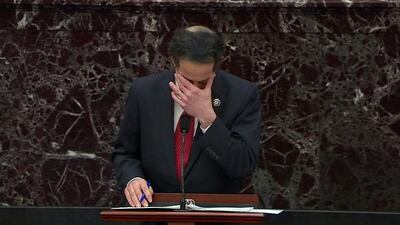
US House lead impeachment manager Jamie Raskin becomes emotional as he discusses his and his family's experiences inside the US Capitol building during the siege on January 6. Reuters

Tearful Raskin recalls daughter's riot fear in opening day of Trump impeachment trial


  • English
  • Arabic

The leader of the Democratic team prosecuting Donald Trump's impeachment trial became emotional on Tuesday as he recalled his daughter and son-in-law hiding in fear during the US Capitol riot on January 6.

Jamie Raskin,a constitutional law expert now in his third two-year term representing parts of Maryland, defended the legality of impeachment charges against a former president.

When he invited his family to see the January 6 joint session of Congress to certify Joe Biden's presidential election victory, Mr Raskin was also mourning the death of his son, 25, on December 31.

He said his daughter, 24, asked whether they would be safe visiting on January 6, after hearing of plans by thousands of Trump supporters to descend on Washington to try to stop the routine proceeding.

"I told them, of course it should be safe. This is the Capitol," Mr Raskin said as he wrapped up his opening argument.

But when the mob invaded the building in a violent assault that left a Capitol Police officer and four other people dead, his daughter, Tabitha, and other family members were forced to huddle in an office near the House of Representatives.

Mr Raskin said that when he was reunited with his daughter and son-in-law, he apologised and promised things would be better on their next visit.

"And you know what she said? She said, 'Dad, I don't want to come back to the Capitol'," he said.

The Senate's 100 members paused from taking notes and fiddling with papers on their desks, watching Mr Raskin as he spoke tearfully of his daughter's fear.

At times barely able to speak, he wrapped up his opening statement to the Senate by saying: "Of all the terrible things I saw ... that one hit me the hardest.

"That and watching someone use an American flagpole, the flag still on it, to spear and pummel one of our police officers."


Match info

Wolves 0

Arsenal 2 (Saka 43', Lacazette 85')

Man of the match: Shkodran Mustafi (Arsenal)

'Saand Ki Aankh'

Produced by: Reliance Entertainment with Chalk and Cheese Films
Director: Tushar Hiranandani
Cast: Taapsee Pannu, Bhumi Pednekar, Prakash Jha, Vineet Singh
Rating: 3.5/5 stars

Start-up hopes to end Japan's love affair with cash

Across most of Asia, people pay for taxi rides, restaurant meals and merchandise with smartphone-readable barcodes — except in Japan, where cash still rules. Now, as the country’s biggest web companies race to dominate the payments market, one Tokyo-based startup says it has a fighting chance to win with its QR app.

Origami had a head start when it introduced a QR-code payment service in late 2015 and has since signed up fast-food chain KFC, Tokyo’s largest cab company Nihon Kotsu and convenience store operator Lawson. The company raised $66 million in September to expand nationwide and plans to more than double its staff of about 100 employees, says founder Yoshiki Yasui.

Origami is betting that stores, which until now relied on direct mail and email newsletters, will pay for the ability to reach customers on their smartphones. For example, a hair salon using Origami’s payment app would be able to send a message to past customers with a coupon for their next haircut.

Quick Response codes, the dotted squares that can be read by smartphone cameras, were invented in the 1990s by a unit of Toyota Motor to track automotive parts. But when the Japanese pioneered digital payments almost two decades ago with contactless cards for train fares, they chose the so-called near-field communications technology. The high cost of rolling out NFC payments, convenient ATMs and a culture where lost wallets are often returned have all been cited as reasons why cash remains king in the archipelago. In China, however, QR codes dominate.

Cashless payments, which includes credit cards, accounted for just 20 per cent of total consumer spending in Japan during 2016, compared with 60 per cent in China and 89 per cent in South Korea, according to a report by the Bank of Japan.