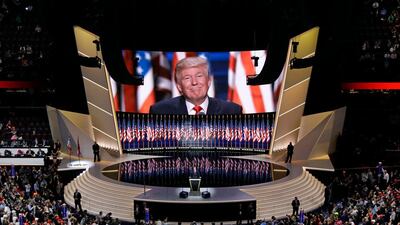

Planning for the Republican National Convention in Florida in seven weeks has hit major hurdles, with the state becoming the US hotspot after a record surge in coronavirus cases.
Organisers are faced with logistical complications in the format of the convention, from August 24 to 27, and the level of attendance.
President Donald Trump changed the location of the convention last month from North Carolina to Jacksonville, Florida, after a clash over restrictions caused by Covid-19.
But with Florida recording 15,300 new cases on Sunday, that decision is being questioned and plans to hold the convention indoors are being re-evaluated.
Duval Country, which incorporates the city of Jacksonville, has had the highest number of cases in north-east Florida, with 13,370 of the 282,435 recorded in the state so far.
Unlike previous conventions, the one in Jacksonville will not adopt a new platform but will stick to the one from 2016.
Any of the 336 state delegates who cannot attend will be able to designate a proxy from among those present to vote on their behalf on the closing day, to nominate Mr Trump as Republican presidential candidate.
His plan to deliver his acceptance speech at the Jacksonville VyStar Veterans Memorial Arena is being reassessed.
Mr Trump's aides are pushing to hold the speech outdoors to minimise the risk of virus transmission, AP reported.
“But Mr Trump has expressed reservations about an outdoor venue, believing it would lack the same atmosphere as a charged arena,” it said.
-
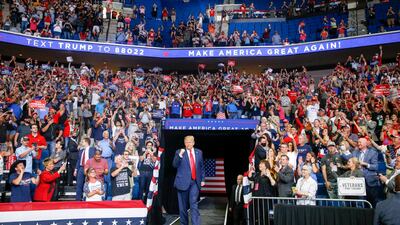
US President Donald Trump, centre, walks toward the stage while supporters cheer during his campaign rally at Bank of Oklahoma Center in Tulsa, Oklahoma, US. Tulsa World via AP -
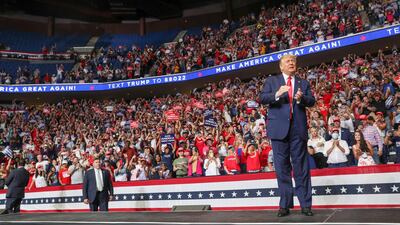
US President Donald Trump reacts to the crowd as he arrives onstage at his first re-election campaign rally in several months in the midst of the coronavirus disease outbreak, at the BOK Centre in Tulsa, Oklahoma. Reuters -
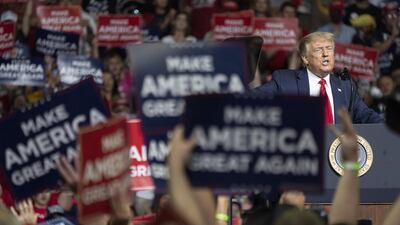
US President Donald Trump speaks during a rally in Tulsa, Oklahoma. Bloomberg -
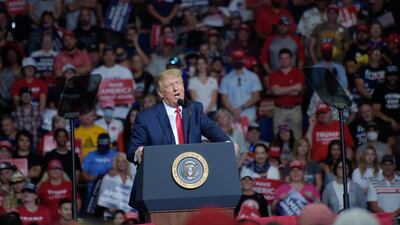
US President Donald Trump speaks during a rally inside the BOK Centre in Tulsa, Oklahoma. EPA -
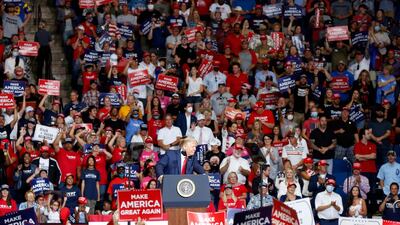
US President Donald Trump speaks at BOK Centre during his rally in Tulsa, Oklahoma. Tulsa World via AP -
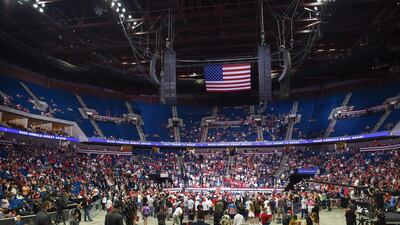
US President Donald Trump speaks during a rally inside the Bank of Oklahoma Centre in Tulsa, Oklahoma. EPA -
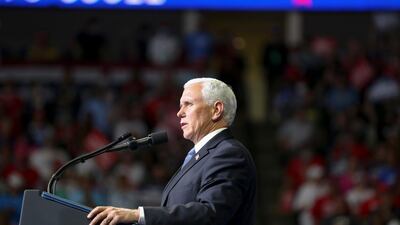
US Vice President Mike Pence speaks during a campaign rally for President Donald Trump at BOK Centre in Tulsa, Oklahoma. Tulsa World via AP -
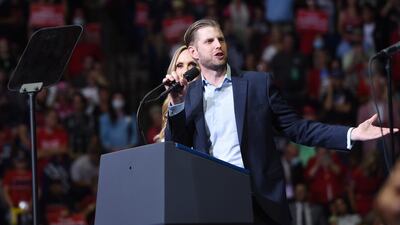
Eric Trump, son of US President Donald Trump, speaks during a rally inside the Bank of Oklahoma Centre in Tulsa, Oklahoma. EPA -
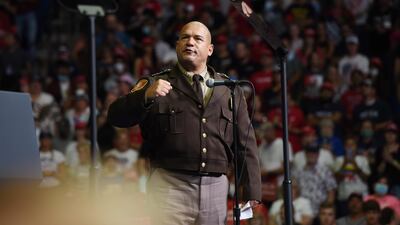
Tulsa County Sheriff Vic Regalado speaks before US President Donald Trump arrives. EPA -

Attendees cheer while US President Donald Trump speaks during his campaign rally. Tulsa World via AP -
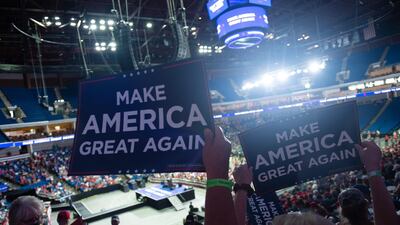
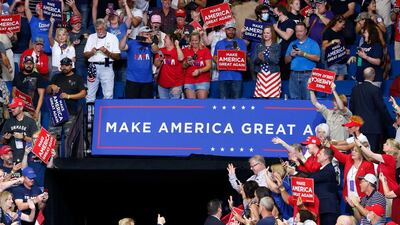
Supporters of US President Donald Trump hold placards during a rally inside the Bank of Oklahoma Centre in Tulsa. EPA -

Supporters of US President Donald Trump hold placards during a rally inside the Bank of Oklahoma Centre in Tulsa. EPA -
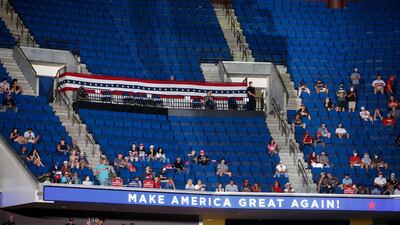
Empty seats are visible in the upper level at a campaign rally for US President Donald Trump at BOK Centre. Tulsa World via AP -
US President Donald Trump gives a thumbs-up to the crowd at the BOK Centre after his first re-election rally. Tulsa World via AP -
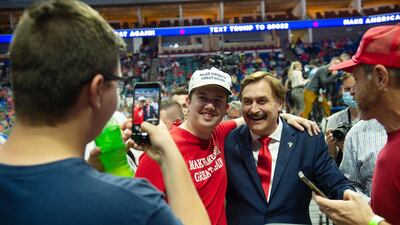
My Pillow CEO Michael Lindell, centre right, poses with supporters of US President Donald Trump during a rally inside the Bank of Oklahoma Centre. EPA -
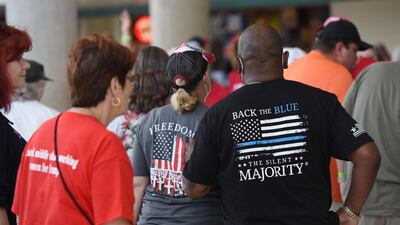
Supporters of US President Donald Trump gather during a rally inside the Bank of Oklahoma Centre. EPA -

Supporters of US President Donald Trump wait in line to enter a rally inside the Bank of Oklahoma Centre in Tulsa, Oklahoma. EPA


With cases rising and the Trump campaign already rescheduling rallies in Arizona and New Hampshire, he may have no choice but to amend the plans for Florida.
The health risks associated attending the convention have already prompted some Republican senators to decide against attending.
Lamar Alexander, Chuck Grassley, Susan Collins, Lisa Murkowski and Mitt Romney have said they will not be at the gathering.
Senator Pat Roberts said last week he would “probably not” attend the convention either.
On Monday, the Texas Supreme Court upheld Houston's decision to scrap this week's state Republican Party convention because of the pandemic.
The party is also facing a problem raising funds to meet the costs of moving the national convention.
The New York Times reported at the weekend that Florida Governor Ron DeSantis was directing his top fundraiser to tell donors not to give money for the event.
Mr DeSantis's decision was made because of a personal dispute between him and his former aide, Susie Wiles, the paper reported.
The pandemic has also affected the Democratic National Convention due to be held in Wisconsin from August 17 to 21.
The meeting will be held mostly online and voting for the party’s nominee, Joe Biden, will take place over two weeks before the event.

