
Deonte Bryant stands at a small pulpit in a dimly lit basement mosque in south Minneapolis and reads from an ornate Quran.
In slightly American-accented Arabic, he recites a text from the book that explains what happens when a “believer” kills another “believer” by mistake.
“Does it remind you of anything?” asked Mr Bryant, who also uses the name Abu Bakr. “Except what happened upstairs was not by mistake.”
He was referring to last year’s killing of George Floyd, who died under the knee of a Minneapolis policeman just metres from the Na’matul Islam Mosque, which is located in the basement of the Cup Foods grocery store.
Floyd, 46, died of asphyxiation outside the shop on May 25 as former police officer Derek Chauvin knelt on his neck for more than nine minutes.
On April 21, Chauvin was convicted of three charges in the killing, including second-degree murder.
For months after Floyd's death, protests raged around the globe, with calls for racial justice and greater police accountability.
At the bottom of a dark stairwell leading into the Cup Foods basement, the local Muslim community comes to grieve and escape the pain and chaos of the past year.
“It’s pretty easy to shut the whole world [out] and just focus on praying and after you’re done, get back to work and the real world,” said Mahmoud Abumayyeleh, who owns the building housing the mosque and Cup Foods.
Mr Bryant, who serves as the imam for Friday prayers, said many of the mosque’s 15 worshippers are of Somali descent.
"I think it affected us a lot," he told The National.
For the city’s wider Muslim community, Chauvin’s guilty verdict came as a relief.
“Immediately, when the judge read the verdicts, you could hear the people screaming, celebrating, a big sigh of relief,” Mr Abumayyeleh said.
'When we weren’t protesting, we were all praying'
-

A mural for George Floyd on the outside of the Da'wah Mosque in Saint Paul, Minnesota. Willy Lowry / The National -

A man walks toward the Da'wah Mosque in Saint Paul, Minnesota. Willy Lowry / The National -
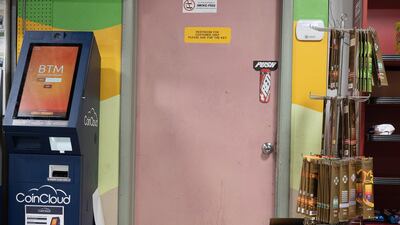
The door inside Cup Foods that leads to the basement where the mosque is located. Willy Lowry / The National -

The stairs that lead to the basement of Cup Foods where the mosque is located. Willy Lowry / The National -
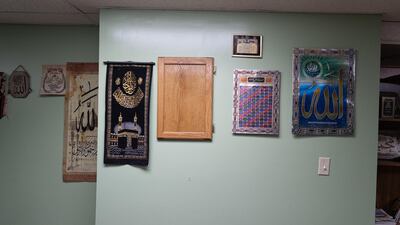
The Na'matul Islam Mosque located in the basement of Cup Foods. Willy Lowry / The National -

The Na'matul Islam Mosque located in the basement of Cup Foods. Willy Lowry / The National -

Deonte 'Abu Bakr' Bryant reads from the Quran in the Na'matul Islam Mosque. Willy Lowry / The National -

Ifrah Mansour, a Somali-American multimedia artist from Minneapolis, poses for a picture. Willy Lowry / The National -

Ruhel Islam stands in front of his temporary restaurant location. Willy Lowry / The National -

Framed thank you cards hang in Ruhel Islam's temporary restaurant location. Willy Lowry / The National -

A close up of a thank you card sent to Ruhel Islam after he expressed his continued support for Black Lives Matter even after his restaurant was burnt down. Willy Lowry / The National -

Ruhel Islam poses in front of thank you cards sent to him after he expressed his continued support for the Black Lives Matter protests even after his restaurant was burned down. Willy Lowry / The National


Some view the timing of Chauvin's conviction as especially meaningful. The jury’s decision came in the second week of Ramadan.
“How fitting is it that it is in Ramadan that we’ve got a little bit of justice, because when we weren’t protesting, I think we were all praying and I think this verdict is definitely a prayer being answered,” said Ifrah Mansour, a Somali-American multimedia artist and teacher in Minneapolis.
The twin cities of Minneapolis-St Paul are home to roughly 40,000 Somali Americans, by far the largest concentration in the US, and the community has been actively involved in protests supporting the Black Lives Matter movement.
"As a community of people of colour, when you see people like you that are constantly being killed, it really breaks your heart because that is your community that is being hurt," Ms Mansour told The National.
Across the US, police kill about three people a day, and people of colour are disproportionately affected. Officers seldom face charges and convictions are rare.
In December, Somali-American Dolal Idd, 23, was shot and killed in an exchange of gunfire with Minneapolis police.
His death was the city's first police killing since Floyd’s murder, sparking a new round of protests.
“You can’t imagine how many calls we’ve received from outside the United States [asking] ‘Are you OK, are you safe? Are Muslims safe?’” Imam Hassan Ali Muhammad of the Da'wah Mosque in St Paul said.
“Especially Somalis, because Somalis are black Muslims,” he added.
A time of reflection

On April 11, as Muslims across Minneapolis prepared to enter the holy month, the city was rocked by another police killing.
Daunte Wright, a 20-year-old black man, was fatally shot by a police officer during a traffic stop in a nearby suburb, setting off yet more protests.
For Ruhel Islam, whose restaurant Ghandi Mahal was burnt down in last summer’s protests following Floyd’s death, it’s been a difficult 11 months.
“It was very traumatising when we had to see all these problems, the protests, the riots, the burning, people not getting justice,” Mr Islam said.
The Bangladeshi American went viral last year when his daughter wrote a Facebook post recounting how she’d heard her dad say over the phone: “Let my building burn; justice needs to be served.”
The restaurant remains closed, but Mr Islam has opened a temporary location nearby. He still feels the protests are more important than his restaurant.
"It looks like our voice has been heard," he told The National. "We've got some justice coming. But we have more work to do."
Mr Islam, who grew up under a military dictatorship in Bangladesh, said he is determined to keep supporting protesters and the fight for racial justice.
On a recent cold evening just before breaking his fast, Mr Islam walked through his temporary restaurant. He stopped near the exit, where three large frames filled with letters of appreciation for his support of the protests hung.
Looking at the letters, he said: “George Floyd brought a lot of people together. His death opened up our moral responsibility. It woke us up.”

