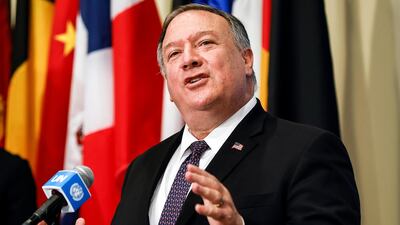
Secretary of State Mike Pompeo speaks to reporters following a meeting with members of the UN Security Council. AP

Pompeo: US will veto UN bid to oppose sanctions on Iran


  • English
  • Arabic

US Secretary of State Mike Pompeo has threatened to veto any attempts by UN Security Council members to oppose the reintroduction of sanctions on Iran next month.

“If any member of the UN Security Council introduces a resolution to continue sanctions relief, the US will oppose it," Mr Pompeo warned in a tweet on Thursday.

"If no resolution is introduced, the sanctions on Iran will still return on September 20.”

Thirteen of the 15 council members say Washington’s move to reimpose sanctions is void because it is using a process agreed to under a 2015 nuclear deal between Iran and world powers, from which the US withdrew two years ago.

In a vote on August 14, only the Dominican Republic sided with the US in calling for an extension of an arms embargo, due to expire in October, against Iran.

“Last week, the US triggered the 30-day process to restore virtually all UN sanctions on Iran after the Security Council failed to uphold its mission to maintain international peace and security,” Mr Pompeo said in another tweet.

The US says it can trigger the process known as snapback because a 2015 Security Council resolution that enshrines the nuclear deal still names it as a participant.

But the president of the Security Council, Indonesian ambassador Dian Triansyah Djani, said on Tuesday that the body was “not in the position to take further action” on the US bid to reintroduce the sanctions on Iran because of a lack of consensus.

Several countries outside the council have voiced a desire to return the sanctions, which were lifted under the terms of 2015 nuclear deal, signed by Iran, the US, China, France, Russia, the UK and Germany.

On Thursday, German Foreign Minister Heiko Maas met his Israeli counterpart in Berlin and affirmed the need to extend the weapons embargo on Iran.

“We are trying to reach a diplomatic solution so that there will be an arms embargo on Iran in the future,” Mr Maas said.

Israeli Foreign Minister Gabi Ashkenazi said that an extension was needed to prevent Iran from getting “more advanced weapons systems and spreading them around the Middle East".


BACK%20TO%20ALEXANDRIA
%3Cp%3E%3Cstrong%3EDirector%3A%20%3C%2Fstrong%3ETamer%20Ruggli%3C%2Fp%3E%0A%3Cp%3E%3Cstrong%3EStarring%3A%20%3C%2Fstrong%3ENadine%20Labaki%2C%20Fanny%20Ardant%3C%2Fp%3E%0A%3Cp%3E%3Cstrong%3ERating%3A%20%3C%2Fstrong%3E3.5%2F5%3C%2Fp%3E%0A

Dubai Rugby Sevens

November 30, December 1-2
International Vets
Christina Noble Children’s Foundation fixtures

Thursday, November 30:

10.20am, Pitch 3, v 100 World Legends Project
1.20pm, Pitch 4, v Malta Marauders

Friday, December 1:

9am, Pitch 4, v SBA Pirates

Why your domicile status is important

Your UK residence status is assessed using the statutory residence test. While your residence status – ie where you live - is assessed every year, your domicile status is assessed over your lifetime.

Your domicile of origin generally comes from your parents and if your parents were not married, then it is decided by your father. Your domicile is generally the country your father considered his permanent home when you were born. 

UK residents who have their permanent home ("domicile") outside the UK may not have to pay UK tax on foreign income. For example, they do not pay tax on foreign income or gains if they are less than £2,000 in the tax year and do not transfer that gain to a UK bank account.

A UK-domiciled person, however, is liable for UK tax on their worldwide income and gains when they are resident in the UK.

PROFILE OF HALAN

Started: November 2017

Founders: Mounir Nakhla, Ahmed Mohsen and Mohamed Aboulnaga

Based: Cairo, Egypt

Sector: transport and logistics

Size: 150 employees

Investment: approximately $8 million

Investors include: Singapore’s Battery Road Digital Holdings, Egypt’s Algebra Ventures, Uber co-founder and former CTO Oscar Salazar

Various Artists 
Habibi Funk: An Eclectic Selection Of Music From The Arab World (Habibi Funk)
​​​​​​​