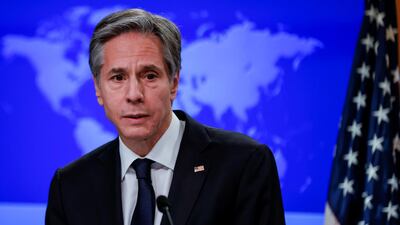
Newly confirmed US Secretary of State Antony Blinken addresses reporters during his first press briefing at the State Department in Washington, January 27, 2021. REUTERS

New US secretary of state sets agenda


Willy Lowry
  • English
  • Arabic

New US Secretary of State Antony Blinken on Wednesday laid out his vision for America's foreign policy and promised a more transparent office than his predecessor.

After not quite a full day in the job, Mr Blinken addressed and took questions from the press, and said his office would hold daily briefings.

He said his department was reviewing many last-minute decisions made by the Trump administration, including its decision to designate Yemen's Iran-backed Houthis as a foreign terrorist organisation.

“It is vitally important even in the midst of this crisis that we do everything we can to get humanitarian assistance to the people of Yemen who are in desperate need," Mr Blinken said.

"And what we want to make sure is that any steps we are taking do not get in the way of providing that assistance."

The Houthis control the capital Sanaa and much of the country’s north after a coup in 2015.

The internationally recognised government of President Abdrabu Mansur Hadi sought the help of Saudi Arabia and other Arab states to remove the rebels from the capital.

At the time of the administration's designation, fears were expressed of a backlash from the Houthis that would further hamper the delivery of humanitarian aid.

Mr Blinken said his goal was to make sure the previous administration's decision did not make things worse for Yemeni citizens.

"We want to make sure that any of these steps, including the designation, do not make what is already an incredibly difficult task even more difficult, that is the provision of humanitarian aid to the people of Yemen," he said.

"So we are taking a very urgent and very close look at that.”

Mr Blinken reaffirmed his support for the Abraham Accord between Israel, the UAE and Bahrain.

“We think that Israel normalising relations with its neighbours and other countries in the region is a very positive development and we applaud them and we hope that there may be an opportunity to build on them in the months and years ahead.”

Mr Blinken also touched on Russia's treatment of Alexei Nalvany, the future of the US relationship with Iran, the Afghan-Taliban talks and America's complex relationship with China.

He said fighting climate change would be at the centre of America’s foreign policy under the new administration.


Ten tax points to be aware of in 2026

1. Domestic VAT refund amendments: request your refund within five years

If a business does not apply for the refund on time, they lose their credit.

2. E-invoicing in the UAE

Businesses should continue preparing for the implementation of e-invoicing in the UAE, with 2026 a preparation and transition period ahead of phased mandatory adoption. 

3. More tax audits

Tax authorities are increasingly using data already available across multiple filings to identify audit risks. 

4. More beneficial VAT and excise tax penalty regime

Tax disputes are expected to become more frequent and more structured, with clearer administrative objection and appeal processes. The UAE has adopted a new penalty regime for VAT and excise disputes, which now mirrors the penalty regime for corporate tax.

5. Greater emphasis on statutory audit

There is a greater need for the accuracy of financial statements. The International Financial Reporting Standards standards need to be strictly adhered to and, as a result, the quality of the audits will need to increase.

6. Further transfer pricing enforcement

Transfer pricing enforcement, which refers to the practice of establishing prices for internal transactions between related entities, is expected to broaden in scope. The UAE will shortly open the possibility to negotiate advance pricing agreements, or essentially rulings for transfer pricing purposes. 

7. Limited time periods for audits

Recent amendments also introduce a default five-year limitation period for tax audits and assessments, subject to specific statutory exceptions. While the standard audit and assessment period is five years, this may be extended to up to 15 years in cases involving fraud or tax evasion. 

8. Pillar 2 implementation 

Many multinational groups will begin to feel the practical effect of the Domestic Minimum Top-Up Tax (DMTT), the UAE's implementation of the OECD’s global minimum tax under Pillar 2. While the rules apply for financial years starting on or after January 1, 2025, it is 2026 that marks the transition to an operational phase.

9. Reduced compliance obligations for imported goods and services

Businesses that apply the reverse-charge mechanism for VAT purposes in the UAE may benefit from reduced compliance obligations. 

10. Substance and CbC reporting focus

Tax authorities are expected to continue strengthening the enforcement of economic substance and Country-by-Country (CbC) reporting frameworks. In the UAE, these regimes are increasingly being used as risk-assessment tools, providing tax authorities with a comprehensive view of multinational groups’ global footprints and enabling them to assess whether profits are aligned with real economic activity. 

Contributed by Thomas Vanhee and Hend Rashwan, Aurifer

57%20Seconds
%3Cp%3E%3Cstrong%3EDirector%3A%3C%2Fstrong%3E%20Rusty%20Cundieff%0D%3Cbr%3E%3Cstrong%3EStars%3A%20%3C%2Fstrong%3EJosh%20Hutcherson%2C%20Morgan%20Freeman%2C%20Greg%20Germann%2C%20Lovie%20Simone%0D%3Cbr%3E%3Cstrong%3ERating%3A%20%3C%2Fstrong%3E2%2F5%0D%3Cbr%3E%0D%3Cbr%3E%3C%2Fp%3E%0A
SQUADS

UAE
Mohammed Naveed (captain), Mohamed Usman (vice-captain), Ashfaq Ahmed, Chirag Suri, Shaiman Anwar, Mohammed Boota, Ghulam Shabber, Imran Haider, Tahir Mughal, Amir Hayat, Zahoor Khan, Qadeer Ahmed, Fahad Nawaz, Abdul Shakoor, Sultan Ahmed, CP Rizwan

Nepal
Paras Khadka (captain), Gyanendra Malla, Dipendra Singh Airee, Pradeep Airee, Binod Bhandari, Avinash Bohara, Sundeep Jora, Sompal Kami, Karan KC, Rohit Paudel, Sandeep Lamichhane, Lalit Rajbanshi, Basant Regmi, Pawan Sarraf, Bhim Sharki, Aarif Sheikh

21 Lessons for the 21st Century

Yuval Noah Harari, Jonathan Cape