


The first potential coronavirus vaccine tested in the US caused all 45 volunteers in an early-stage trial to produce antibodies.
The vaccine, which was made by US biotech company Moderna, will begin the final stage of human trials on July 27, after encouraging results from an initial test were published on Tuesday.
“No matter how you slice this, this is good news,” Dr Anthony Fauci, the US government’s top infectious disease expert, said.
The phase 3 trial will recruit 30,000 volunteers in the US, with half of them to receive the vaccine at 100 microgram dose levels, and the other half to be given a placebo.
The trial will show whether the vaccine is safe and can prevent infection by the virus or, if people still get infected, whether it can prevent the infection progressing towards symptoms.
The announcement came after The New England Journal of Medicine published results from the first stage of Moderna's vaccine trial, which showed the first 45 participants all developed antibodies to the virus.
The participants were split into three groups of 15 to test doses of 25 micrograms, 100 micrograms and 250 micrograms.
They were given a second dose of the same amount 28 days later.
After the first round, antibody levels were found to be higher with higher doses.
After the second round, participants had higher levels of antibodies than most patients who have had Covid-19 and gone on to generate their own antibodies.
Coronavirus around the world
-
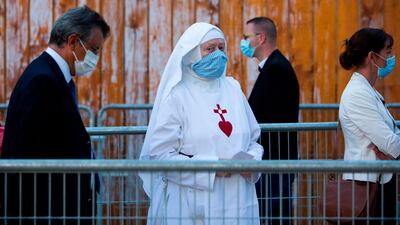
A nun who made 15,000 face masks during the coronavirus crisis queues outside the Grand Palais in Paris prior to a reception called by French health minister to honour about 800 health workers for their service during the pandemic. AFP -
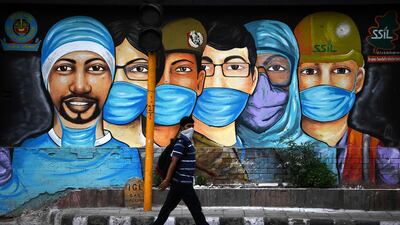
A man walks past a mural of frontline workers after the government eased a nationwide lockdown imposed as a preventive measure against the coronavirus in New Delhi. AFP -

Residents wearing face masks are seen next to the Yangtze River in Wuhan in China's central Hubei province. Various parts of China have been hit by continuous rain since June, with the damage adding pressure to a domestic economy already hit by the coronavirus pandemic. AFP -
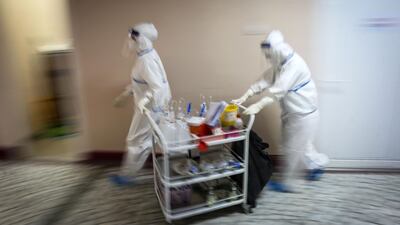
Medical workers bring medications to patients suffering from the coronavirus inside the Institute for Orthopaedic Surgery 'Banjica', recently transformed to a Covid-19 hospital, in Belgrade. AFP -

A medical worker wearing personal protective equipment collects a swab sample from a man for the coronavirus test, in Colombo. AFP -
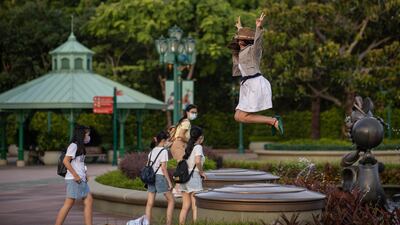
A visitor jumps for photographs in Disneyland in Hong Kong, China. The theme park will shut its doors until July 21, 2020 due to a surge in Covid-19 cases in Hong Kong. EPA -

Women wearing personal protective equipment look at mounted police patrolling a street in Medellin in Colombia amid the pandemic. AFP -

An activist kneels next to crosses symbolising the ones who died from the coronavirus in front of the National Congress during a protest against Brazil's President Jair Bolsonaro in Brasilia, Brazil. Reuters -

People protest against the government's response to the pandemic in La Paz, Bolivia. AP Photo -

Catalan regional President, Quim Torra, attends a tribute for the 147 victims who died in Catalonia region because of the coronavirus, in Girona, Catalonia, Spain. EPA


Moderna is considered to be in a leading position in the global race to find a vaccine against the coronavirus, which has infected more than 13.4 million people and killed 580,000.
Chinese biotech company Sinovac announced it would begin phase 3 trials of its vaccine.
The UAE is also is pushing ahead with efforts to develop two types of Covid-19 vaccine, which are being tested on more than 15,000 volunteers.
It is on the third stage of the clinical trials and if either vaccine is confirmed to be safe and effective, it will move to the manufacturing stage.
On Sunday, Russian news agency Tass announced researchers in the country completed clinical trials on a vaccine, although they had not yet shared their data.
But scientists gave a warning that the first vaccines to come to market may not be the most effective or safest.

