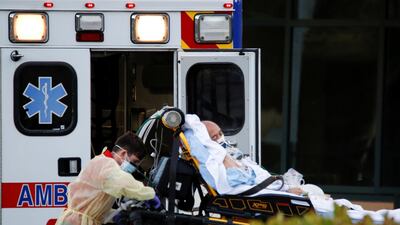

A US epidemiologist, whose institute’s research and projections are helping to steer the American government’s response to the coronavirus pandemic, has warned that Florida will probably be a future hotspot for the outbreak.
Florida has more than 8,000 cases already reported and 128 deaths.
Dr Ali Mokdad, of the Institute for Health Metrics and Evaluation at the University of Washington, sees many reasons to be concerned about the spread of Covid-19 in the sunshine state.
"Because of its more senior population and a delayed and insufficient response, Florida is a real concern," Dr Mokdad told The National.
Florida Governor Ron DeSantis waited until April to issue an order for citizens to stay home.
But that proved to be insufficient to counter the spread of the virus, Dr Mokdad said.
Florida reported its first case on March 6 but, unlike California, Washington and New York, it did not enforce a quarantine and kept its beaches open for thousands of students on spring break.
Now, the institute's model, which uses daily data for forecasts on the spread of the coronavirus in the US, projects that Florida could have as many as 6,897 Covid-19 deaths by August 4.
Dr Mokdad, also chief strategy officer for population health at the University of Washington, expects the state to peak later than mid-April, which he forecasts generally for the rest of the US.
He said more rural states such as Georgia, Alabama and Louisiana were vulnerable because of high rates of heart disease and high blood pressure, and more limited hospital capacity.
Dr Mokdad, a Lebanese-American, would not blame anyone for the spread of the pandemic in the US, but said the medical field “knew enough in December and January to be scared and to prepare”.
With more than 240,000 confirmed cases in the country, he said the peak was still expected in mid-April, and “in early June things could start getting back to normal”.
He said that by normal he meant fewer than 10 deaths a day from the virus, and a cautious, phased opening up of the country to prevent a second wave.
On the Middle East, Dr Mokdad painted a mixed picture.
“Iran is paying the price for being too relaxed early on,” he said.
Dr Mokdad said Egypt was also a cause for concern.
He said its crowded mega-cities, lack of sufficient testing and cases in other countries that were traced back to Egypt were worrying. The Egyptian government has so far reported 865 cases.
-
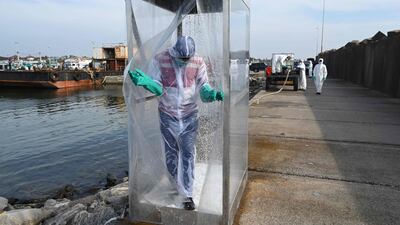
A Sri Lanka navy sailor uses a makeshift decontamination chamber after the seizure of narcotics from a flagless cargo carrier at a fisheries harbour during a government-imposed nationwide lockdown as a preventive measure against the COVID-19 coronavirus, near Colombo. AFP -

Jason Baird is seen dressed as Spiderman during his daily exercise to cheer up local children in Stockport, as the spread of the coronavirus disease (COVID-19) continues, Stockport, Britain. REUTERS -
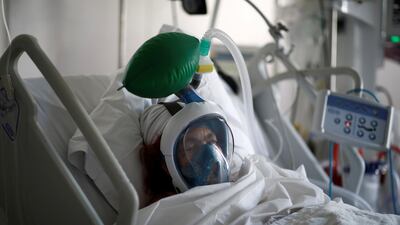
A patient suffering from coronavirus disease (COVID-19) wears a full-face Easybreath snorkelling mask given by sport chain Decathlon and turned into a ventilator for coronavirus treatment at the intensive care unit at Ambroise Pare clinic in Neuilly-sur-Seine near Paris. REUTERS -
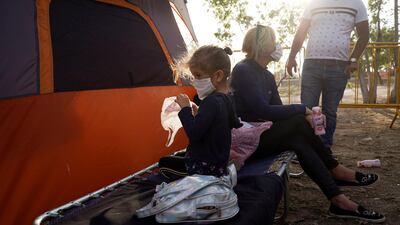
Yanisleydi de la Rosa, 34, and her daughter Anyeli cruz de la Rosa, 4, who are seeking asylum in the U.S. wear protective masks, amid an outbreak of coronavirus disease (COVID-19), in the migrant camp of Matamoros, Mexico. REUTERS -

A police officer (C) rides a horse covered with coronavirus-themed paintings as he speaks to the public during a government-imposed nationwide lockdown against the COVID-19 coronavirus, in Peapally Mandal village of Kurnool district in Andhra Pradesh state. AFP -
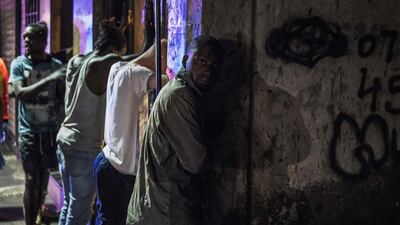
Suspects are lined up against a wall while they are being arrested by the South African Police Service (SAPS) because they defied the lockdown order during an operation in the Johannesburg CBD. AFP -
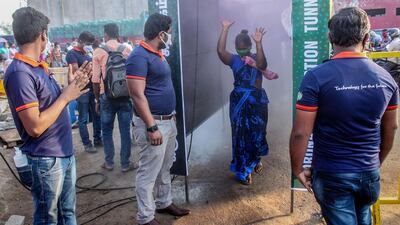
A woman (2R) gestures as she walks through a disinfection tunnel set up at the entrance of Thennampalayam market in Tiruppur district of Tamil Nadu state. AFP -
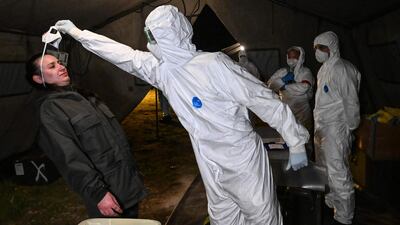
A firefighter wearing protective suit helps a soldier to decontaminate after she stepped out of a French army medicalized Airbus A320 upon their arrival from a mission in Mulhouse at the Istres military base. AFP -

Japan's Prime Minister Shinzo Abe, wearing a face mask amid concerns over the spread of COVID-19 coronavirus, attends an upper house committee meeting at the parliament in Tokyo. AFP -
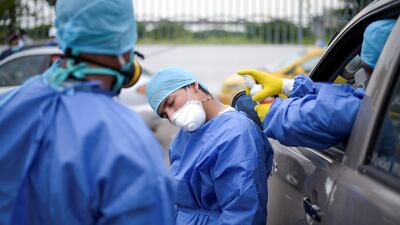
A hospital worker is sprayed with disinfectant at Guasmo Sur General Hospital after Ecuador reported new cases of coronavirus disease (COVID-19), in Guayaquil, Ecuador. REUTERS -
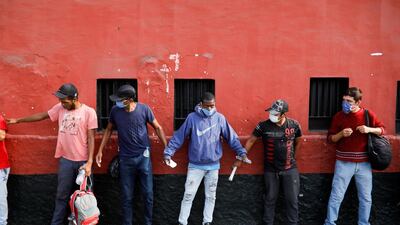
Homeless people use their arms to measure a safe distance from each other while waiting for a medical examination before entering the Plaza de Acho bullring, which the Peruvian government is retooling into a homeless shelter as part of its response to the spread of coronavirus disease (COVID-19), in Lima, Peru. REUTERS -

A mural showing medical personel wearing protective masks is seen painted on a wall of a building following the coronavirus disease (COVID-19) outbreak in Warsaw, Poland. REUTERS -
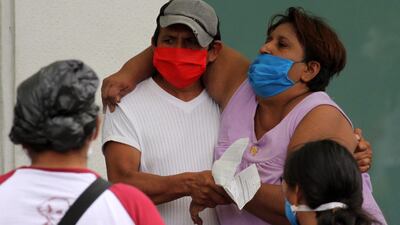
A man helps a sick woman enter a hospital in Guayaquil, Ecuador. AFP -
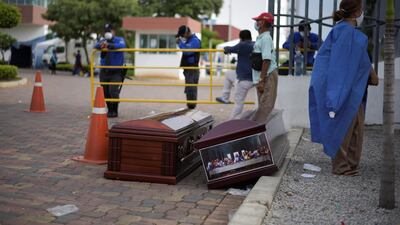
People wait next to coffins outside of Guasmo Sur General Hospital after Ecuador reported new cases of coronavirus disease (COVID-19), in Guayaquil, Ecuador. REUTERS


Conflict-hit countries in the region including Yemen, Iraq and Syria are also concerning, he said, because of continuing violence limiting the efforts of health organisations to fight the virus.
But he said the outlook for Gulf countries was more optimistic “because they have the means and the resources and many have invested in women’s education”.
Dr Mokdad, whose family comes from the Lebanese city of Jbeil, praised Beirut for a proactive response to the outbreak by shutting down all non-essential services, allowing testing and more recently imposing a night curfew.

