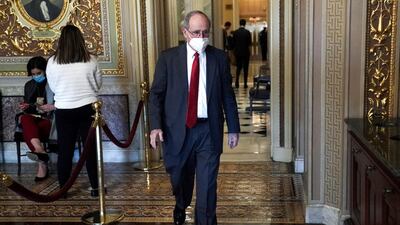
James Risch, the top Republican on the Senate Foreign Relations Committee, is urging the Biden administration to “show some muscle” against Iran after renewed rocket attacks on US forces in Iraq. He said he was “disappointed with the start of the administration".
Like its predecessors, the Biden administration has indicated that it wants to focus more on great-power competition with Russia and China, but Mr Risch said in an interview with The National on Tuesday that the US should maintain an assertive posture in the Middle East to counter Iran.
"Historically, if you do turn your attention away from the Middle East, it's going to cause you problems in the future," Mr Risch said. "I don't view this as an either-or – I think both need our attention."
Mr Risch said the Biden administration should not have engaged in negotiations after last week's rocket attacks in Erbil, saying that the White House should instead be preparing for the possibility of an Israeli strike on Iran.
He also pushed back against public reports estimating that Iran's breakout time to build a nuclear weapon could be as low as three and a half months – a figure first mentioned by former UN weapons inspector David Albright in November. Mr Risch said that the figure, cited by Secretary of State Antony Blinken during his confirmation hearing in January, "is not accurate".
The following interview was lightly edited for brevity and clarity.
One of the big things that the Biden administration seems to want to do, as have previous administrations – both presidents Trump and Obama – is put more emphasis on East Asia and try to extract the United States from Middle Eastern military quagmires. Can I get your perspective on how the focus on great-power competition will affect US posture and engagement in the Middle East?
Mr Risch: Well, first of I all, I was kind of stunned when the last administration said they were going to recalibrate – turn our attention to Asia. We're a country that can walk and chew gum at the same time. There are issues in both regions that need our attention, and I don't think it's appropriate to say we're going to shift our attention from one to the other.
Certainly, one or the other may be getting more attention from us, but that doesn’t mean by any means that we would turn away or reduce our involvement or our interest in the Middle East. Historically, if you do turn your attention away from the Middle East, it’s going to cause you problems in the future. I don’t view this as an either-or – I think both need our attention.
The prior administration was tolerant with Iran for longer than it should have been and finally did something about it. And it changed the landscape dramatically. Now we're just gazing towards a new administration and Iran's testing. Obviously, a week ago today, they dropped 14 missiles on one of our facilities in Iraq, in Erbil. The administration responded three days later by telling them they were going to sit down and renegotiate. Iran responded by announcing this weekend that they were going to start enriching considerably more [uranium] than they were. This is nonsense. I'm disappointed with the start of the administration.
With the Iranians, we’ve learnt over and over and over again how to deal with them, and it isn’t by making nice. They don’t understand that. Not only don’t they understand that, they don’t want to do that. They understand power. When we took [Gen Qassem] Suleimani out, they understood that and things went quiet. I’m hoping they’re going to start to show some muscle as opposed to turning the other cheek.
What do you think the appropriate response from the Biden administration should be? If you had a direct line to President Joe Biden and told him what he should do, what would you tell him?
Mr Risch: I do have a direct line and I will tell him, but I'm not going to tell you – any more than I did with [former] president Trump. We had a relationship where we could argue about these things and discuss them and try to come to a conclusion. This is not a political thing. These kinds of issues, particularly the Iran issue, is not a political matter.
Another place Iran is very involved in is Yemen with the Houthi rebels. You called for the Biden administration to repeal the foreign terrorist designation on the Houthis, which they did. But you also said there needs to be more pressure on the Houthis. As we see them continue their offensive against Marib, which the Biden administration has warned against, what does that pressure against the Houthis look like, absent the terrorist designation?
Mr Risch: Hanging over the Houthis' head, always, is our engagement as far as the Saudis are concerned. Everybody in the world, with the exception of the Houthis and the Iranians, want this thing over with. I talk to the Saudis regularly. They don't want to be there. They don't want any part of this, but they have no choice. So long as the Houthis continue doing what they're doing to the Saudis, this is going to go on.
The administration is going to have to continue to pressure the Houthis, and there are ways we can do that, which hopefully they will understand. But again, this is all about Iran. If Iran walked away from this thing, it would be over tomorrow. But they won’t because they are anarchists and like these proxy kind of things. And we’re going to have to deal with this.
Iran’s nuclear breakout time is approximately three months. When the US remained in the nuclear deal, it was approximately one year. Can you respond to the argument that the nuclear deal was good because the breakout time was longer?
Mr Risch: The breakout time that you are citing right now, I'm not sure where that comes from. I sat on the intelligence committee, I deal regularly with the Israelis. That three months number is not accurate.
But set that aside, the question is where do we go from here, what do we do here? And my complaint with the nuclear deal is not focused strictly on the nuclear part of it. That’s where they got in trouble.
That’s where I argued with John Kerry, who refused to do anything but talk about the nuclear part of this. I said, John, you can’t do this. This is one aspect to misconduct that the Iranians are involved in. And they’ve got at least half a dozen different areas where they’ve got to change their ways or there’s going to be serious consequences. And he declined to engage in that argument and said, nope, all we’re going to do is the nuclear. And everything I suggested, he said 'they won’t go for that'.
Believe me, I’d love to see that agreement with the Iranians. But you need two things if you’re going to do that. Number one, you need a common objective. And number two, you need to have parties on both sides acting in good faith. You have neither when you’re interacting with the Iranians. And as long as that exists, it’s going to be very elusive as far as a deal is concerned.
As you know, the Biden administration announced they're going to start talking again to the Iranians. You saw how they responded to that: with arrogance and without the humility that you need to get into these agreements. I'm not optimistic, at the end of the day.
What all these people need to be talking about is what they’re going to do when the Israelis decide to do something about this, because we can make any agreement we want with the Iranians. But if the Israelis determine that a point has been crossed in which they need to do something about the Iranians developing a nuclear weapon, they are going to do something. And people need to be answering the question, what are you going to do when you get that phone call?
Now that the UAE, Bahrain, Sudan and Morocco signed on to the Abraham Accord, what’s the future direction for normalisation with Israel in the Arab world? Are there any countries you hope would sign on soon?
Mr Risch: I would hope that every Arab country would sign on. Obviously, there's at least one population that wouldn't sign on. In talking with the Arabs on this, they were very optimistic about it. They speak glowingly of it. The ones who have entered into this did not enter into it reluctantly. They're embracing it and they want them to succeed. The ones that haven't talked about entering at some point in the future and would like to, but obviously each country has its own issues that drive whether they can or can't do that, be it domestic politics or whatever. I think these things, these accords are a huge step forward. They're historical. I don't think they've been highlighted as much as they should because of their significance, but I'm very optimistic, looking forward with the Abraham Accord.
In the last Congress, when you were chairman of the committee, you were working with [New Jersey senator] Robert Menendez on a Turkey sanctions bill. Obviously, the S-400 is still an issue, there are still issues with Turkey and the Kurds in Syria. At this point, do you think the US-Turkish alliance should be salvaged or scrapped?
Mr Risch: I would really hope that the relationship with Turkey does not get scrapped. They're a Nato ally. They've been a great friend to the United States and a good ally for many, many years. Under [Recep Tayyip] Erdogan's leadership, that has deteriorated dramatically. I have spoken numerous times with Turkish officials and once with Mr Erdogan himself in person. And I have to tell you after my conversations with Mr Erdogan that I'm simply not optimistic that he's going to do what he needs to do in order to rehabilitate the relationship.
It absolutely astounded me that he turned around to buy those S-400 missiles. His statement to me was the same as the other officials I dealt with previously. They told me they had to buy them because we wouldn't sell them the Patriot [missiles]. At which point, I sent him a letter signed by myself and [New Hampshire senator Jeanne] Shaheen which we delivered to the foreign minister in Ankara in October of 2012, when they were shopping for these things. Buy them from us. We are willing to sell you as many as you want to buy. They're a good product, let us know what you want.
And they didn't. They turned around and bought S-400s. Their argument that they had to buy those is absolutely false. I know it for a fact because I was involved in inviting them to purchase the Patriots. The other thing I explained to them is that they can't be involved in the F-35 programme and they can't have F-35s as long as there's a Russian S-400 missile in the country. And they absolutely reject that, and the result of that is I reject their rejection and I'm not signing off on the F-35s that they've paid for. They're here in the United States waiting to be delivered.
The long and short of it is, they’re headed in the wrong direction. I don’t think under Mr Erdogan that that’s going to turn around. But we are ready and willing and able to take Turkey back with open arms if they will do what they’ve always done in the past, and that is treat us as a friendly and trusted ally.

Who's who in Yemen conflict
Houthis: Iran-backed rebels who occupy Sanaa and run unrecognised government
Yemeni government: Exiled government in Aden led by eight-member Presidential Leadership Council
Southern Transitional Council: Faction in Yemeni government that seeks autonomy for the south
Habrish 'rebels': Tribal-backed forces feuding with STC over control of oil in government territory
More from Neighbourhood Watch:
Where to buy art books in the UAE
There are a number of speciality art bookshops in the UAE.
In Dubai, The Lighthouse at Dubai Design District has a wonderfully curated selection of art and design books. Alserkal Avenue runs a pop-up shop at their A4 space, and host the art-book fair Fully Booked during Art Week in March. The Third Line, also in Alserkal Avenue, has a strong book-publishing arm and sells copies at its gallery. Kinokuniya, at Dubai Mall, has some good offerings within its broad selection, and you never know what you will find at the House of Prose in Jumeirah. Finally, all of Gulf Photo Plus’s photo books are available for sale at their show.
In Abu Dhabi, Louvre Abu Dhabi has a beautiful selection of catalogues and art books, and Magrudy’s – across the Emirates, but particularly at their NYU Abu Dhabi site – has a great selection in art, fiction and cultural theory.
In Sharjah, the Sharjah Art Museum sells catalogues and art books at its museum shop, and the Sharjah Art Foundation has a bookshop that offers reads on art, theory and cultural history.
Timeline
2012-2015
The company offers payments/bribes to win key contracts in the Middle East
May 2017
The UK SFO officially opens investigation into Petrofac’s use of agents, corruption, and potential bribery to secure contracts
September 2021
Petrofac pleads guilty to seven counts of failing to prevent bribery under the UK Bribery Act
October 2021
Court fines Petrofac £77 million for bribery. Former executive receives a two-year suspended sentence
December 2024
Petrofac enters into comprehensive restructuring to strengthen the financial position of the group
May 2025
The High Court of England and Wales approves the company’s restructuring plan
July 2025
The Court of Appeal issues a judgment challenging parts of the restructuring plan
August 2025
Petrofac issues a business update to execute the restructuring and confirms it will appeal the Court of Appeal decision
October 2025
Petrofac loses a major TenneT offshore wind contract worth €13 billion. Holding company files for administration in the UK. Petrofac delisted from the London Stock Exchange
November 2025
180 Petrofac employees laid off in the UAE
The Transfiguration
Director: Michael O’Shea
Starring: Eric Ruffin, Chloe Levine
Three stars
The National's picks
4.35pm: Tilal Al Khalediah
5.10pm: Continous
5.45pm: Raging Torrent
6.20pm: West Acre
7pm: Flood Zone
7.40pm: Straight No Chaser
8.15pm: Romantic Warrior
8.50pm: Calandogan
9.30pm: Forever Young
Huroob Ezterari
Director: Ahmed Moussa
Starring: Ahmed El Sakka, Amir Karara, Ghada Adel and Moustafa Mohammed
Three stars
How much sugar is in chocolate Easter eggs?
- The 169g Crunchie egg has 15.9g of sugar per 25g serving, working out at around 107g of sugar per egg
- The 190g Maltesers Teasers egg contains 58g of sugar per 100g for the egg and 19.6g of sugar in each of the two Teasers bars that come with it
- The 188g Smarties egg has 113g of sugar per egg and 22.8g in the tube of Smarties it contains
- The Milky Bar white chocolate Egg Hunt Pack contains eight eggs at 7.7g of sugar per egg
- The Cadbury Creme Egg contains 26g of sugar per 40g egg
MATCH INFO
Uefa Champions League semi-final, second leg
Real Madrid (2) v Bayern Munich (1)
Where: Santiago Bernabeu, Madrid
When: 10.45pm, Tuesday
Watch Live: beIN Sports HD
ZAYED SUSTAINABILITY PRIZE
Match info
Athletic Bilbao 0
Real Madrid 1 (Ramos 73' pen)
MOUNTAINHEAD REVIEW
Starring: Ramy Youssef, Steve Carell, Jason Schwartzman
Director: Jesse Armstrong
Rating: 3.5/5
Poacher
%3Cp%3E%3Cstrong%3EDirector%3A%20%3C%2Fstrong%3ERichie%20Mehta%26nbsp%3B%3C%2Fp%3E%0A%3Cp%3E%3Cstrong%3EStarring%3A%3C%2Fstrong%3E%20Nimisha%20Sajayan%2C%20Roshan%20Mathew%2C%20Dibyendu%20Bhattacharya%3C%2Fp%3E%0A%3Cp%3E%3Cstrong%3ERating%3A%20%3C%2Fstrong%3E3%2F5%3C%2Fp%3E%0A
Ballon d’Or shortlists
Men
Sadio Mane (Senegal/Liverpool), Sergio Aguero (Aregentina/Manchester City), Frenkie de Jong (Netherlans/Barcelona), Hugo Lloris (France/Tottenham), Dusan Tadic (Serbia/Ajax), Kylian Mbappe (France/PSG), Trent Alexander-Arnold (England/Liverpool), Donny van de Beek (Netherlands/Ajax), Pierre-Emerick Aubameyang (Gabon/Arsenal), Marc-Andre ter Stegen (Germany/Barcelona), Cristiano Ronaldo (Portugal/Juventus), Alisson (Brazil/Liverpool), Matthijs de Ligt (Netherlands/Juventus), Karim Benzema (France/Real Madrid), Georginio Wijnaldum (Netherlands/Liverpool), Virgil van Dijk (Netherlands/Liverpool), Bernardo Silva (Portugal/Manchester City), Son Heung-min (South Korea/Tottenham), Robert Lewandowski (Poland/Bayern Munich), Roberto Firmino (Brazil/Liverpool), Lionel Messi (Argentina/Barcelona), Riyad Mahrez (Algeria/Manchester City), Kevin De Bruyne (Belgium/Manchester City), Kalidou Koulibaly (Senegal/Napoli), Antoine Griezmann (France/Barcelona), Mohamed Salah (Egypt/Liverpool), Eden Hazard (BEL/Real Madrid), Marquinhos (Brazil/Paris-SG), Raheem Sterling (Eengland/Manchester City), Joao Félix(Portugal/Atletico Madrid)
Women
Sam Kerr (Austria/Chelsea), Ellen White (England/Manchester City), Nilla Fischer (Sweden/Linkopings), Amandine Henry (France/Lyon), Lucy Bronze(England/Lyon), Alex Morgan (USA/Orlando Pride), Vivianne Miedema (Netherlands/Arsenal), Dzsenifer Marozsan (Germany/Lyon), Pernille Harder (Denmark/Wolfsburg), Sarah Bouhaddi (France/Lyon), Megan Rapinoe (USA/Reign FC), Lieke Martens (Netherlands/Barcelona), Sari van Veenendal (Netherlands/Atletico Madrid), Wendie Renard (France/Lyon), Rose Lavelle(USA/Washington Spirit), Marta (Brazil/Orlando Pride), Ada Hegerberg (Norway/Lyon), Kosovare Asllani (Sweden/CD Tacon), Sofia Jakobsson (Sweden/CD Tacon), Tobin Heath (USA/Portland Thorns)
In numbers
1,000 tonnes of waste collected daily:
- 800 tonnes converted into alternative fuel
- 150 tonnes to landfill
- 50 tonnes sold as scrap metal
800 tonnes of RDF replaces 500 tonnes of coal
Two conveyor lines treat more than 350,000 tonnes of waste per year
25 staff on site
Dengue%20fever%20symptoms
%3Cp%3EHigh%20fever%20(40%C2%B0C%2F104%C2%B0F)%3Cbr%3ESevere%20headache%3Cbr%3EPain%20behind%20the%20eyes%3Cbr%3EMuscle%20and%20joint%20pains%3Cbr%3ENausea%3Cbr%3EVomiting%3Cbr%3ESwollen%20glands%3Cbr%3ERash%26nbsp%3B%3C%2Fp%3E%0A
Tightening the screw on rogue recruiters
The UAE overhauled the procedure to recruit housemaids and domestic workers with a law in 2017 to protect low-income labour from being exploited.
Only recruitment companies authorised by the government are permitted as part of Tadbeer, a network of labour ministry-regulated centres.
A contract must be drawn up for domestic workers, the wages and job offer clearly stating the nature of work.
The contract stating the wages, work entailed and accommodation must be sent to the employee in their home country before they depart for the UAE.
The contract will be signed by the employer and employee when the domestic worker arrives in the UAE.
Only recruitment agencies registered with the ministry can undertake recruitment and employment applications for domestic workers.
Penalties for illegal recruitment in the UAE include fines of up to Dh100,000 and imprisonment
But agents not authorised by the government sidestep the law by illegally getting women into the country on visit visas.
Civil%20War
%3Cp%3E%3Cstrong%3EDirector%3A%3C%2Fstrong%3E%20Alex%20Garland%C2%A0%3C%2Fp%3E%0A%3Cp%3E%3Cstrong%3EStarring%3A%3C%2Fstrong%3E%20Kirsten%20Dunst%2C%20Cailee%20Spaeny%2C%20Wagner%20Moura%2C%20Nick%20Offerman%3C%2Fp%3E%0A%3Cp%3E%3Cstrong%3ERating%3A%3C%2Fstrong%3E%204%2F5%3C%2Fp%3E%0A
Wednesday's results
Finland 3-0 Armenia
Faroes Islands 1-0 Malta
Sweden 1-1 Spain
Gibraltar 2-3 Georgia
Romania 1-1 Norway
Greece 2-1 Bosnia and Herzegovina
Liechtenstein 0-5 Italy
Switzerland 2-0 Rep of Ireland
Israel 3-1 Latvia
COMPANY%20PROFILE
%3Cp%3E%3Cstrong%3EName%3A%20%3C%2Fstrong%3EQureos%0D%3Cbr%3E%3Cstrong%3EBased%3A%20%3C%2Fstrong%3EUAE%0D%3Cbr%3E%3Cstrong%3ELaunch%20year%3A%20%3C%2Fstrong%3E2021%0D%3Cbr%3E%3Cstrong%3ENumber%20of%20employees%3A%20%3C%2Fstrong%3E33%0D%3Cbr%3E%3Cstrong%3ESector%3A%20%3C%2Fstrong%3ESoftware%20and%20technology%0D%3Cbr%3E%3Cstrong%3EFunding%3A%20%3C%2Fstrong%3E%243%20million%0D%3Cbr%3E%3C%2Fp%3E%0A
SHAITTAN
%3Cp%3E%3Cstrong%3EDirector%3A%20%3C%2Fstrong%3EVikas%20Bahl%3Cbr%3E%3Cstrong%3EStarring%3A%20%3C%2Fstrong%3EAjay%20Devgn%2C%20R.%20Madhavan%2C%20Jyothika%2C%20Janaki%20Bodiwala%3Cbr%3E%3Cstrong%3ERating%3A%20%3C%2Fstrong%3E3%2F5%3C%2Fp%3E%0A
Victims%20of%20the%202018%20Parkland%20school%20shooting
%3Cp%3EAlyssa%20Alhadeff%2C%2014%3C%2Fp%3E%0A%3Cp%3EScott%20Beigel%2C%2035%0D%3C%2Fp%3E%0A%3Cp%3EMartin%20Duque%2C%2014%3C%2Fp%3E%0A%3Cp%3ENicholas%20Dworet%2C%2017%3C%2Fp%3E%0A%3Cp%3EAaron%20Feis%2C%2037%3C%2Fp%3E%0A%3Cp%3EJaime%20Guttenberg%2C%2014%0D%3C%2Fp%3E%0A%3Cp%3EChris%20Hixon%2C%2049%0D%3C%2Fp%3E%0A%3Cp%3ELuke%20Hoyer%2C%2015%3C%2Fp%3E%0A%3Cp%3ECara%20Loughran%2C%2014%0D%3C%2Fp%3E%0A%3Cp%3EGina%20Montalto%2C%2014%0D%3C%2Fp%3E%0A%3Cp%3EJoaquin%20Oliver%2C%2017%0D%3C%2Fp%3E%0A%3Cp%3EAlaina%20Petty%2C%2014%0D%3C%2Fp%3E%0A%3Cp%3EMeadow%20Pollack%2C%2018%3C%2Fp%3E%0A%3Cp%3EHelena%20Ramsay%2C%2017%0D%3Cbr%3E%0D%3C%2Fp%3E%0A%3Cp%3EAlex%20Schachter%2C%2014%0D%3C%2Fp%3E%0A%3Cp%3ECarmen%20Schentrup%2C%2016%0D%3C%2Fp%3E%0A%3Cp%3EPeter%20Wang%2C%2015%3Cbr%3E%3C%2Fp%3E%0A
Rebel%20Moon%20%E2%80%93%20Part%20Two%3A%20The%20Scargiver%20review%20
%3Cp%3E%3Cstrong%3EDirector%3A%3C%2Fstrong%3E%20Zack%20Snyder%3Cbr%3E%3Cstrong%3EStarring%3A%3C%2Fstrong%3E%20Sofia%20Boutella%2C%20Charlie%20Hunnam%2C%20Ed%20Skrein%2C%20Sir%20Anthony%20Hopkins%3Cbr%3E%3Cstrong%3ERating%3A%3C%2Fstrong%3E%202%2F5%3Cbr%3E%3Cbr%3E%3C%2Fp%3E%0A
Key figures in the life of the fort
Sheikh Dhiyab bin Isa (ruled 1761-1793) Built Qasr Al Hosn as a watchtower to guard over the only freshwater well on Abu Dhabi island.
Sheikh Shakhbut bin Dhiyab (ruled 1793-1816) Expanded the tower into a small fort and transferred his ruling place of residence from Liwa Oasis to the fort on the island.
Sheikh Tahnoon bin Shakhbut (ruled 1818-1833) Expanded Qasr Al Hosn further as Abu Dhabi grew from a small village of palm huts to a town of more than 5,000 inhabitants.
Sheikh Khalifa bin Shakhbut (ruled 1833-1845) Repaired and fortified the fort.
Sheikh Saeed bin Tahnoon (ruled 1845-1855) Turned Qasr Al Hosn into a strong two-storied structure.
Sheikh Zayed bin Khalifa (ruled 1855-1909) Expanded Qasr Al Hosn further to reflect the emirate's increasing prominence.
Sheikh Shakhbut bin Sultan (ruled 1928-1966) Renovated and enlarged Qasr Al Hosn, adding a decorative arch and two new villas.
Sheikh Zayed bin Sultan (ruled 1966-2004) Moved the royal residence to Al Manhal palace and kept his diwan at Qasr Al Hosn.
Sources: Jayanti Maitra, www.adach.ae
Mercer, the investment consulting arm of US services company Marsh & McLennan, expects its wealth division to at least double its assets under management (AUM) in the Middle East as wealth in the region continues to grow despite economic headwinds, a company official said.
Mercer Wealth, which globally has $160 billion in AUM, plans to boost its AUM in the region to $2-$3bn in the next 2-3 years from the present $1bn, said Yasir AbuShaban, a Dubai-based principal with Mercer Wealth.
“Within the next two to three years, we are looking at reaching $2 to $3 billion as a conservative estimate and we do see an opportunity to do so,” said Mr AbuShaban.
Mercer does not directly make investments, but allocates clients’ money they have discretion to, to professional asset managers. They also provide advice to clients.
“We have buying power. We can negotiate on their (client’s) behalf with asset managers to provide them lower fees than they otherwise would have to get on their own,” he added.
Mercer Wealth’s clients include sovereign wealth funds, family offices, and insurance companies among others.
From its office in Dubai, Mercer also looks after Africa, India and Turkey, where they also see opportunity for growth.
Wealth creation in Middle East and Africa (MEA) grew 8.5 per cent to $8.1 trillion last year from $7.5tn in 2015, higher than last year’s global average of 6 per cent and the second-highest growth in a region after Asia-Pacific which grew 9.9 per cent, according to consultancy Boston Consulting Group (BCG). In the region, where wealth grew just 1.9 per cent in 2015 compared with 2014, a pickup in oil prices has helped in wealth generation.
BCG is forecasting MEA wealth will rise to $12tn by 2021, growing at an annual average of 8 per cent.
Drivers of wealth generation in the region will be split evenly between new wealth creation and growth of performance of existing assets, according to BCG.
Another general trend in the region is clients’ looking for a comprehensive approach to investing, according to Mr AbuShaban.
“Institutional investors or some of the families are seeing a slowdown in the available capital they have to invest and in that sense they are looking at optimizing the way they manage their portfolios and making sure they are not investing haphazardly and different parts of their investment are working together,” said Mr AbuShaban.
Some clients also have a higher appetite for risk, given the low interest-rate environment that does not provide enough yield for some institutional investors. These clients are keen to invest in illiquid assets, such as private equity and infrastructure.
“What we have seen is a desire for higher returns in what has been a low-return environment specifically in various fixed income or bonds,” he said.
“In this environment, we have seen a de facto increase in the risk that clients are taking in things like illiquid investments, private equity investments, infrastructure and private debt, those kind of investments were higher illiquidity results in incrementally higher returns.”
The Abu Dhabi Investment Authority, one of the largest sovereign wealth funds, said in its 2016 report that has gradually increased its exposure in direct private equity and private credit transactions, mainly in Asian markets and especially in China and India. The authority’s private equity department focused on structured equities owing to “their defensive characteristics.”
