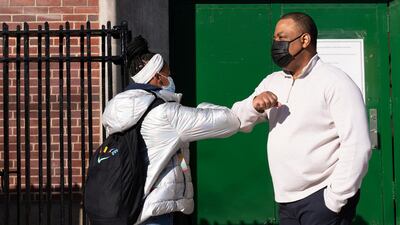
Linsey Johnson, a dean at Meyer Levin Middle School, greets a pupil on February 25, 2021, when in-school learning resumed in New York City for the first time since the fall of 2020. AP

Eyes on possible home-grown US variant found in New York


Patrick deHahn
  • English
  • Arabic

Two teams of researchers have discovered a Covid-19 variant in New York, raising alarm for the most populated city in the US as the country tries to eradicate variants with a large-scale vaccination programme.

The variant, called B1526, has been found in "diverse neighbourhoods in the metropolitan area" and scattered throughout the north-eastern region of the US, said a report from Columbia University's Vagelos College of Physicians and Surgeons.

B1526 may have mutations that are similar to the new strains found in South Africa and Brazil, which can work against the effectiveness of vaccines and monoclonal antibody treatments.

Researchers at the California Institute of Technology said they found instances of the variant as early as November 2020 and that it accounted for about one in four "coronavirus genomes sequenced and deposited from New York" in February.

The Columbia University study showed a similar trajectory when the mutation was found in December, with a 12.3 per cent rise over two weeks in New York City this month.

The teams found the variant independently of each other and the discoveries were first reported by The New York Times  on Wednesday night.

The reports from Columbia and Caltech have not been peer reviewed or published by scientific journals, but they have drawn interest from scientists, public health officials and news publications.

Mayor Bill de Blasio said there was no need for immediate concern.

“Until there’s evidence that tells us that a variant is not handled well by vaccines, for example, or a variant has different impacts, we shouldn’t assume the worst," Mr de Blasio said.

"We should say we need the full truth. We need the facts."

While some are calling for further confirmation, The New York Times noted that the case count in New York City is not dropping as sharply as the national US case count is.

The two academic reports suggest there has been a rise in cases of the novel New York variant in the past two to three months.

“No, we don’t have any evidence at this point that the variants — that this New York variant, the 1526, is what is contributing to the trajectory of cases, which we should emphasise continue to decrease,” said Dr David Chokshi, New York City’s health commissioner.

Nonetheless, the city is continuing with reopening efforts. The city's middle schools are welcoming back pupils for in-person learning on Thursday.

New York Governor Andrew Cuomo allowed for indoor dining to return at 25 per cent capacity in February and announced restaurants can bump this up to 35 per cent on Friday, February 26.

Mr Cuomo also gave the thumbs up for movie theatres to welcome back patrons at 25 per cent capacity — or no more than 50 people per screen — along with other required virus precautions starting on March 5.

Mutations and variants are normal in the trajectory of viruses but some have higher transmissibility or can evade treatments and vaccinations.

If there is further verification of the academic reports of a New York variant, it could mean there are two home-grown strains in the US.

The first is a variant that was discovered in Southern California, which may have led to the devastating surge in the Los Angeles region during December and January.

California became the first US state to record 50,000 Covid deaths this week.

The home-grown variants also add to the several variants the US currently hosts in its coronavirus outbreak, including all three of the "variants of concern" from Brazil, South Africa and the UK.

Health experts have been raising the alarm about variants that can reverse the downward Covid trend in cases, deaths and hospital admissions and are emphasising the need for quick vaccine distribution across the country.

At least 6 per cent of the US population has been fully vaccinated. More than 13 per cent have had one dose.

A vaccine tracker by Bloomberg News says the US has used 75 per cent of its vaccine supply.

President Joe Biden is marking the 50 millionth vaccination today.

The Food and Drug Administration is reviewing the single-dose Covid-19 vaccine from Johnson & Johnson on Friday.

The US has already approved and is disseminating vaccines from Moderna and Pfizer-BioNTech.

And vaccine makers are not ignoring the threat of mutations of variants.

Moderna announced on Wednesday it has shipped a variant-specific vaccine candidate for a clinical study.

Pfizer and BioNTech are researching the possibility of a third dose that could serve as a "booster" shot that would fend off Covid mutations.


UAE currency: the story behind the money in your pockets
If you go
Where to stay: Courtyard by Marriott Titusville Kennedy Space Centre has unparalleled views of the Indian River. Alligators can be spotted from hotel room balconies, as can several rocket launch sites. The hotel also boasts cool space-themed decor.

When to go: Florida is best experienced during the winter months, from November to May, before the humidity kicks in.

How to get there: Emirates currently flies from Dubai to Orlando five times a week.
Who's who in Yemen conflict

Houthis: Iran-backed rebels who occupy Sanaa and run unrecognised government

Yemeni government: Exiled government in Aden led by eight-member Presidential Leadership Council

Southern Transitional Council: Faction in Yemeni government that seeks autonomy for the south

Habrish 'rebels': Tribal-backed forces feuding with STC over control of oil in government territory

25%20Days%20to%20Aden
%3Cp%3EAuthor%3A%20Michael%20Knights%3C%2Fp%3E%0A%3Cp%3EPages%3A%20256%3C%2Fp%3E%0A%3Cp%3EAvailable%3A%20January%2026%3C%2Fp%3E%0A
Ten tax points to be aware of in 2026

1. Domestic VAT refund amendments: request your refund within five years

If a business does not apply for the refund on time, they lose their credit.

2. E-invoicing in the UAE

Businesses should continue preparing for the implementation of e-invoicing in the UAE, with 2026 a preparation and transition period ahead of phased mandatory adoption. 

3. More tax audits

Tax authorities are increasingly using data already available across multiple filings to identify audit risks. 

4. More beneficial VAT and excise tax penalty regime

Tax disputes are expected to become more frequent and more structured, with clearer administrative objection and appeal processes. The UAE has adopted a new penalty regime for VAT and excise disputes, which now mirrors the penalty regime for corporate tax.

5. Greater emphasis on statutory audit

There is a greater need for the accuracy of financial statements. The International Financial Reporting Standards standards need to be strictly adhered to and, as a result, the quality of the audits will need to increase.

6. Further transfer pricing enforcement

Transfer pricing enforcement, which refers to the practice of establishing prices for internal transactions between related entities, is expected to broaden in scope. The UAE will shortly open the possibility to negotiate advance pricing agreements, or essentially rulings for transfer pricing purposes. 

7. Limited time periods for audits

Recent amendments also introduce a default five-year limitation period for tax audits and assessments, subject to specific statutory exceptions. While the standard audit and assessment period is five years, this may be extended to up to 15 years in cases involving fraud or tax evasion. 

8. Pillar 2 implementation 

Many multinational groups will begin to feel the practical effect of the Domestic Minimum Top-Up Tax (DMTT), the UAE's implementation of the OECD’s global minimum tax under Pillar 2. While the rules apply for financial years starting on or after January 1, 2025, it is 2026 that marks the transition to an operational phase.

9. Reduced compliance obligations for imported goods and services

Businesses that apply the reverse-charge mechanism for VAT purposes in the UAE may benefit from reduced compliance obligations. 

10. Substance and CbC reporting focus

Tax authorities are expected to continue strengthening the enforcement of economic substance and Country-by-Country (CbC) reporting frameworks. In the UAE, these regimes are increasingly being used as risk-assessment tools, providing tax authorities with a comprehensive view of multinational groups’ global footprints and enabling them to assess whether profits are aligned with real economic activity. 

Contributed by Thomas Vanhee and Hend Rashwan, Aurifer

Know your camel milk:
Flavour: Similar to goat’s milk, although less pungent. Vaguely sweet with a subtle, salty aftertaste.
Texture: Smooth and creamy, with a slightly thinner consistency than cow’s milk.
Use it: In your morning coffee, to add flavour to homemade ice cream and milk-heavy desserts, smoothies, spiced camel-milk hot chocolate.
Goes well with: chocolate and caramel, saffron, cardamom and cloves. Also works well with honey and dates.