Former US president Barack Obama on Wednesday urged every American mayor to review and reform their police department's policies on use of force in consultation with their communities.
The country's first black president also struck a note of optimism, even as he acknowledged the despair and anger powering the protests since the death of George Floyd, an unarmed black man, in police custody nine days ago.
"In some ways, as tragic as these past few weeks have been, as difficult and scary and uncertain as they've been, they've also been an incredible opportunity for people to be awakened to some of these underlying trends," Mr Obama said from his Chicago home.
"And they offer an opportunity for us to all work together to tackle them, to take them on, to change America and make it live up to its highest ideals."
-
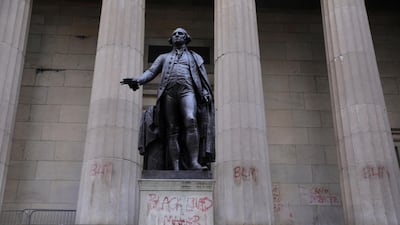
The Federal Hall in Manhattan, New York is seen marked with graffiti after protests against the death in Minneapolis police custody of George Floyd. Reuters -
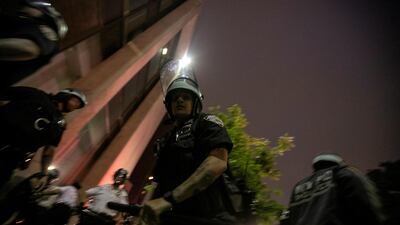
A NYPD policeman is seen during a protest in Brooklyn, New York City. Reuters -
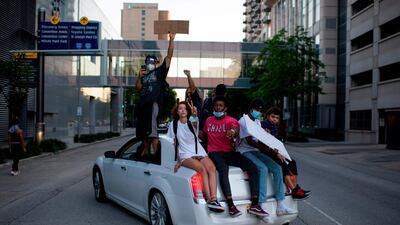
Protesters demonstrate during a peaceful march in downtown Houston, Texas. AFP -
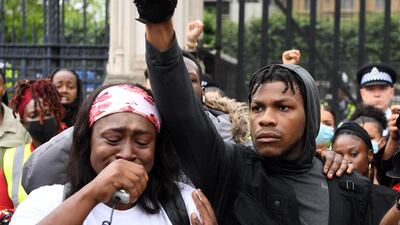
Protestors including British actor John Boyega, centre, raise their fists in Parliament square during an anti-racism demonstration in London. AFP -

British actor John Boyega speaks to protestors in Parliament square during an anti-racism demonstration in London. AFP -
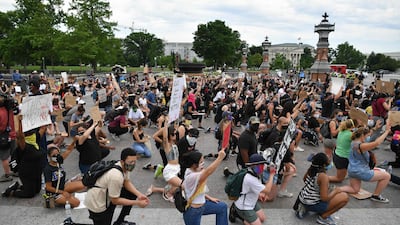
Protesters kneel to demonstrate against the death of George Floyd near the US Capitol, in Washington, DC. AFP -
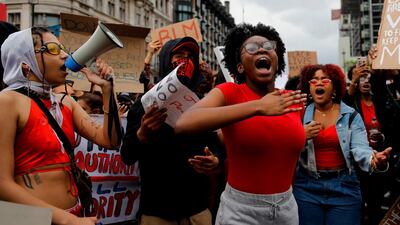
Protestors hold placards and shout slogans as they march during an anti-racism demonstration in central London. AFP -
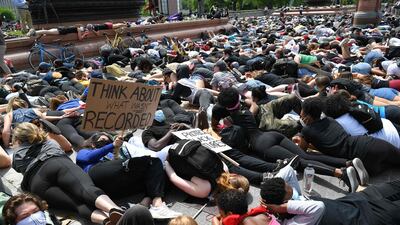
People lay down in protest for the death of George Floyd near the US Capitol, in Washington, DC. AFP -
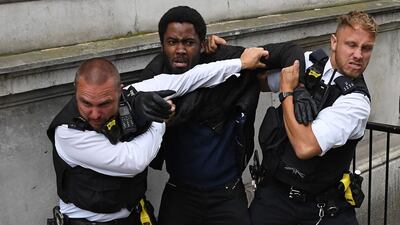
Police officers react as they attempt to detain a protestor near the entrance to Downing Street, during an anti-racism demonstration in London. AFP -
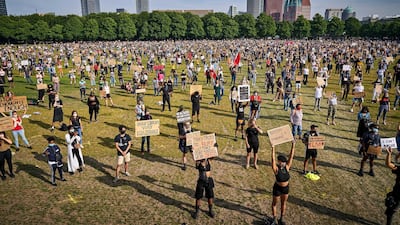
Protesters during a protest on the Malieveld in The Hague, The Netherlands. Organizer Black Lives Matter Netherlands organized the meeting in protest of violence against black people in the US and the death of 46-year-old George Floyd while in police custody. EPA -

Protestors scuffle with Police officers near the entrance to Downing Street, during an anti-racism demonstration in London. AFP -
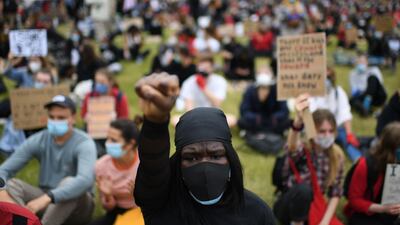
Protestors hold placards during a demonstration in London. AFP -
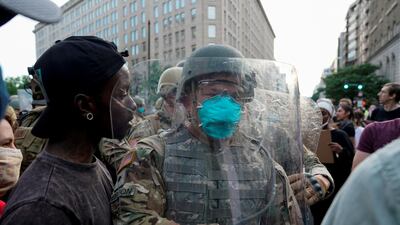
U.S. Army soldiers pass protesters as they arrive to maintain a perimeter during a rally against the death in Minneapolis police custody of George Floyd, near the White House, in Washington, U.S. REUTERS -
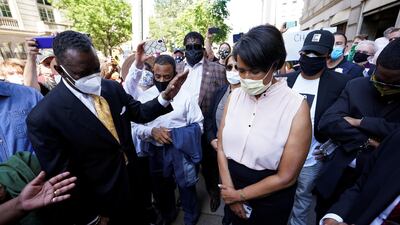
Washington, DC Mayor Muriel Bowser bows her head in prayer during a vigil as protests continue on the streets near the White House over the death in police custody of George Floyd, in Washington, U.S. REUTERS -
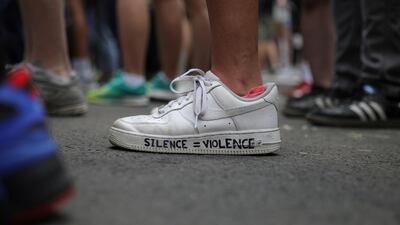
A demonstrator displays a message of protest on shoes as protesters rally against the death in Minneapolis police custody of George Floyd, near the White House in Washington, U.S. REUTERS -
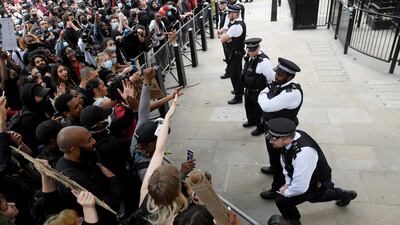
A police officer takes a knee in front of protesters near Downing Street during a "Black Lives Matter" protest following the death of George Floyd who died in police custody in Minneapolis, London, Britain. REUTERS -
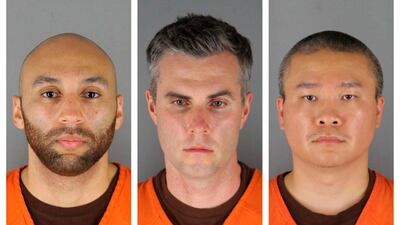
This combination of photos provided by the Hennepin County Sheriff's Office in Minnesota shows J. Alexander Kueng, from left, Thomas Lane and Tou Thao. They have been charged with aiding and abetting Derek Chauvin, who is charged with second-degree murder of George Floyd, a black man who died after being restrained by the Minneapolis police officers on May 25. AP -
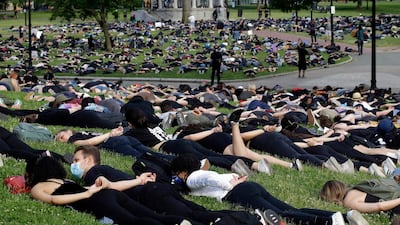
Hundreds of demonstrators lie face down depicting George Floyd during his detention by police during a protest against police brutality, on Boston Common. AP Photo -
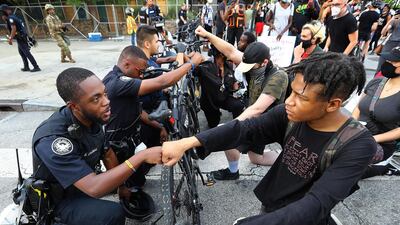
Atlanta Police Officer J. Coleman, left, and protester Elijah Raffington, of Sandy Springs, fist bump while an Atlanta Police bicycle unit blocking Marietta Street at Centennial Olympic Park Drive kneels down with protesters in a symbolic gesture of solidarity outside the CNN Center at Olympic Park, in Atlanta, during a protest sparked by the May 25 death of George Floyd in Minneapolis police custody. AP -

People continue to gather near the intersection of 38th and Chicago in front of the Cup Foods at the spot where George Floyd was arrested and who later died in police custody, in Minneapolis, Minnesota, USA. EPA


He also directly addressed young Americans of colour.
"I want you to know that you matter, I want you to know that your lives matter, that your dreams matter," Mr Obama said.
His speech offered a distinct contrast in tone to the way his successor, President Donald Trump, has responded to the protests, some of which have devolved into violence.
Mr Trump has threatened to send in the US military to quell demonstrations and told governors to get "tougher".
Mr Obama did not mention Mr Trump on Wednesday, although he has criticised the president's actions more frequently in recent weeks.
Wednesday's address was part of a discussion hosted by My Brother's Keeper, a programme Mr Obama founded in 2014 after police shot dead black teenager Michael Brown in Ferguson, Missouri, to address deep-seated racial inequities.
The panel included former Attorney General Eric Holder and other black leaders.
Mr Obama, who saw a similar outpouring of grief and frustration while in office after police killings of unarmed black men, rejected the notion that one must choose between "voting versus protests" or "politics and participation versus civil disobedience".
"This is not an either-or," he said. "This is a both-and".

