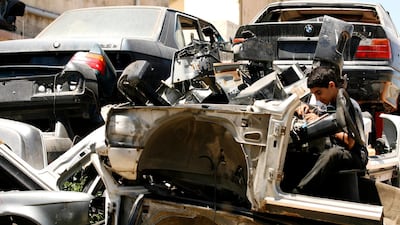
Last December, 15-year-old Yahya left school to help his father in his small car repair shop in Tripoli, Lebanon’s second-biggest city.
"It's temporary," he told The National on a hot summer afternoon after work. But his father, who stopped his own education when he was 12 years old, does not agree. "Children who leave school don't go back," Abu Taleb said.
After a brief silence, he softened. “It depends. If I can support him, he’ll go back,” he said.
There is little chance that Yahya will return to school to study his favourite subject, Arabic literature, or any other. Poverty increases child labour, and living conditions in Lebanon are expected to worsen as its economic crisis deepens. Local officials say that the World Bank’s prediction that half of Lebanese would be under the poverty line by the end of the year has already materialised. It defines the poverty line as those who cannot afford to pay for all of their food, accommodation, education and health needs.
“Today, people steal cars, motorbikes and batteries to sell them to buy food,” said Abu Taleb. Yahya's family lives in Bab Al Tabbaneh, a majority Sunni Muslim area of the city famous for a decade-old conflict with a nearby Alawite neighbourhood that picked up again with the Syrian civil war in 2011.
“A boy who works can look after himself, pay his phone bills. Otherwise, what would he do? Steal?” asked Abu Taleb.
His eldest son, 25-year-old Taleb, rummages through rubbish to find plastic to sell, despite holding a baccalaureate. “He’s an engineer of the streets,” laughed Abu Taleb, 50, who combines two jobs to support his wife and five sons. “They study, study, study and there’s no work,” he complained.
In the morning, Abu Taleb runs his shop with Yahya, and in the afternoon, he works at a local rubbish collection company, where he is paid a monthly salary of 850,000 Lebanese pounds, now worth a little over $100 (Dh367) on the black market as the local currency keeps falling.
Because of the crisis, he has not been paid in two months.
Lebanon's public services have always been weak, but they have become practically non-existent since the government defaulted on its debt for the first time in March. Electricity supply is limited to only a few hours a day because of a fuel shortage and private generator owners cannot keep up with the demand.
“Even if Yahya wanted to read and write, how could he see? Candles cost 2,000 Lebanese pounds each," complained Abu Taleb.
There are no recent statistics on child labour in Lebanon, but the UK-based international NGO Save the Children registered an increase in child labour between February, when Covid-19 hit Lebanon, and July – when confinement measures eased up.
The NGO noted a 55 per cent surge in families reporting that one of their children work and a 25 per cent increase in child labour referrals from other agencies in Beirut and Mount Lebanon, where it operates.
“Needless to say, this is because we are in a desperately bad situation economically and poverty is increasing at a very dramatic rate,” said Martha Reggiori-Wilkes, programme development and quality director at Save the Children.
“We noticed an increase in work that exposes children to extreme risk, whether in agriculture or in factories, where children have to manipulate heavy machinery.”
Ms Reggiori-Wilkes said the group has also seen a small increase in the number of girls working.
“They are normally less visible, but we see them more in other types of work, including in the streets,” she said.
The practice of child labour is illegal in Lebanon. Children are only allowed to begin light work at 14 years old and are banned from dangerous work, including in quarries or in the streets. Additionally, the Ministry of Health must issue a medical certificate ensuring that the child is physically and mentally fit to perform the job, according to Unicef.
Unicef’s figures show that the number of Lebanese children involved in child labour had already tripled between 2009 and 2016 because of growing poverty. At the time, Unicef estimated that 6 per cent of Lebanese children worked. Figures are expected to be higher because parents are often reluctant to admit that they put their children to work, said Ms Reggiori-Wilkes.
For children like Yahya, bringing money home in times of financial difficulty can be a source of pride. “Of course, I want to help,” he said. “My father and mother are in need. I give them the money I make.”
A huge FC Barcelona fan, Yahya is a shy teenager with a soft voice who only wears sports clothes and dreams of becoming a professional football player like his older brother Taha, 19, who briefly played in Qatar and now plays for the Lebanese army. “I’d make a lot of money to support my family,” he said.
He has little hope of finding work in Bab Al Tabbaneh. “You need wasta,” said Yahya, referring to the local word for the widespread usage of personal connections or bribery to secure a service. Thirteen years ago, his father became a rubbish collector through wasta.
“If I finished school but couldn’t find work, my certificate would only serve to decorate my wall.”

Skoda Superb Specs
Engine: 2-litre TSI petrol
Power: 190hp
Torque: 320Nm
Price: From Dh147,000
Available: Now
Abu Dhabi Desert Challenge – Rally schedule:
Saturday: Super Special Spectator Stage – Yas Marina Circuit – start 3.30pm.
Sunday: Yas Marina Circuit Stage 1 (276.01km)
Monday: Nissan Stage 2 (287.92km)
Tuesday: Al Ain Water Stage 3 (281.38km)
Wednesday: ADNOC Stage 4 (244.49km)
Thursday: Abu Dhabi Aviation Stage 5 (218.57km) Finish: Yas Marina Circuit – 4.30pm.
Kamindu Mendis bio
Full name: Pasqual Handi Kamindu Dilanka Mendis
Born: September 30, 1998
Age: 20 years and 26 days
Nationality: Sri Lankan
Major teams Sri Lanka's Under 19 team
Batting style: Left-hander
Bowling style: Right-arm off-spin and slow left-arm orthodox (that's right!)
Key findings of Jenkins report
- Founder of the Muslim Brotherhood, Hassan al Banna, "accepted the political utility of violence"
- Views of key Muslim Brotherhood ideologue, Sayyid Qutb, have “consistently been understood” as permitting “the use of extreme violence in the pursuit of the perfect Islamic society” and “never been institutionally disowned” by the movement.
- Muslim Brotherhood at all levels has repeatedly defended Hamas attacks against Israel, including the use of suicide bombers and the killing of civilians.
- Laying out the report in the House of Commons, David Cameron told MPs: "The main findings of the review support the conclusion that membership of, association with, or influence by the Muslim Brotherhood should be considered as a possible indicator of extremism."
Fixtures and results:
Wed, Aug 29:
- Malaysia bt Hong Kong by 3 wickets
- Oman bt Nepal by 7 wickets
- UAE bt Singapore by 215 runs
Thu, Aug 30: UAE v Nepal; Hong Kong v Singapore; Malaysia v Oman
Sat, Sep 1: UAE v Hong Kong; Oman v Singapore; Malaysia v Nepal
Sun, Sep 2: Hong Kong v Oman; Malaysia v UAE; Nepal v Singapore
Tue, Sep 4: Malaysia v Singapore; UAE v Oman; Nepal v Hong Kong
Thu, Sep 6: Final
THE SPECS
Engine: 1.6-litre turbo
Transmission: six-speed automatic
Power: 165hp
Torque: 240Nm
Price: From Dh89,000 (Enjoy), Dh99,900 (Innovation)
On sale: Now
The Dark Blue Winter Overcoat & Other Stories From the North
Edited and Introduced by Sjón and Ted Hodgkinson
Pushkin Press
Results
Men's finals
45kg:Duc Le Hoang (VIE) beat Zolfi Amirhossein (IRI) points 29-28. 48kg: Naruephon Chittra (THA) beat Joseph Vanlalhruaia (IND) TKO round 2.
51kg: Sakchai Chamchit (THA) beat Salam Al Suwaid (IRQ) TKO round 1. 54kg: Veerasak Senanue (THA) beat Huynh Hoang Phi (VIE) 30-25.
57kg: Almaz Sarsembekov (KAZ) beat Tak Chuen Suen (MAC) RSC round 3. 60kg: Yerkanat Ospan (KAZ) beat Ibrahim Bilal (UAE) 30-27.
63.5kg: Abil Galiyev (KAZ) beat Nouredine Samir (UAE) 29-28. 67kg: Narin Wonglakhon (THA) beat Mohammed Mardi (UAE) 29-28.
71kg: Amine El Moatassime (UAE) w/o Shaker Al Tekreeti (IRQ). 75kg: Youssef Abboud (LBN) w/o Ayoob Saki (IRI).
81kg: Ilyass Habibali (UAE) beat Khaled Tarraf (LBN) 29-28. 86kg: Ali Takaloo (IRI) beat Emil Umayev (KAZ) 30-27.
91kg: Hamid Reza Kordabadi (IRI) beat Mohamad Osaily (LBN) RSC round 1. 91-plus kg: Mohammadrezapoor Shirmohammad (IRI) beat Abdulla Hasan (IRQ) 30-27.
Women's finals
45kg: Somruethai Siripathum (THA) beat Ha Huu Huynh (VIE) 30-27. 48kg: Thanawan Thongduang (THA) beat Colleen Saddi (PHI) 30-27.
51kg: Wansawang Srila Or (THA) beat Thuy Phuong Trieu (VIE) 29-28. 54kg: Ruchira Wongsriwo (THA) beat Zeinab Khatoun (LBN) 30-26.
57kg: Sara Idriss (LBN) beat Zahra Nasiri Bargh (IRI) 30-27. 60kg: Kaewrudee Kamtakrapoom (THA) beat Sedigheh Hajivand (IRI) TKO round 2.
63.5kg: Nadiya Moghaddam (IRI) w/o Reem Al Issa (JOR).
Tips to avoid getting scammed
1) Beware of cheques presented late on Thursday
2) Visit an RTA centre to change registration only after receiving payment
3) Be aware of people asking to test drive the car alone
4) Try not to close the sale at night
5) Don't be rushed into a sale
6) Call 901 if you see any suspicious behaviour
How to watch Ireland v Pakistan in UAE
When: The one-off Test starts on Friday, May 11
What time: Each day’s play is scheduled to start at 2pm UAE time.
TV: The match will be broadcast on OSN Sports Cricket HD. Subscribers to the channel can also stream the action live on OSN Play.
Trump v Khan
2016: Feud begins after Khan criticised Trump’s proposed Muslim travel ban to US
2017: Trump criticises Khan’s ‘no reason to be alarmed’ response to London Bridge terror attacks
2019: Trump calls Khan a “stone cold loser” before first state visit
2019: Trump tweets about “Khan’s Londonistan”, calling him “a national disgrace”
2022: Khan’s office attributes rise in Islamophobic abuse against the major to hostility stoked during Trump’s presidency
July 2025 During a golfing trip to Scotland, Trump calls Khan “a nasty person”
Sept 2025 Trump blames Khan for London’s “stabbings and the dirt and the filth”.
Dec 2025 Trump suggests migrants got Khan elected, calls him a “horrible, vicious, disgusting mayor”
RESULTS
6pm: Mazrat Al Ruwayah – Group 2 (PA) $40,000 (Dirt) 1,600m
Winner: AF Alajaj, Tadhg O’Shea (jockey), Ernst Oertel (trainer)
6.35pm: Race of Future – Handicap (TB) $80,000 (Turf) 2,410m
Winner: Global Storm, William Buick, Charlie Appleby
7.10pm: UAE 2000 Guineas – Group 3 (TB) $150,000 (D) 1,600m
Winner: Azure Coast, Antonio Fresu, Pavel Vashchenko
7.45pm: Business Bay Challenge – Listed (TB) $100,000 (T) 1,400m
Winner: Storm Damage, Patrick Cosgrave, Saeed bin Suroor
20.20pm: Curlin Stakes – Listed (TB) $100,000 (D) 2,000m
Winner: Appreciated, Fernando Jara, Doug O’Neill
8.55pm: Singspiel Stakes – Group 2 (TB) $180,000 (T) 1,800m
Winner: Lord Glitters, Daniel Tudhope, David O'Meara
9.30pm: Al Shindagha Sprint – Group 3 (TB) $150,000 (D) 1,200m
Winner: Meraas, Antonio Fresu, Musabah Al Muhairi
Avatar: Fire and Ash
Director: James Cameron
Starring: Sam Worthington, Sigourney Weaver, Zoe Saldana
Rating: 4.5/5
Mercer, the investment consulting arm of US services company Marsh & McLennan, expects its wealth division to at least double its assets under management (AUM) in the Middle East as wealth in the region continues to grow despite economic headwinds, a company official said.
Mercer Wealth, which globally has $160 billion in AUM, plans to boost its AUM in the region to $2-$3bn in the next 2-3 years from the present $1bn, said Yasir AbuShaban, a Dubai-based principal with Mercer Wealth.
“Within the next two to three years, we are looking at reaching $2 to $3 billion as a conservative estimate and we do see an opportunity to do so,” said Mr AbuShaban.
Mercer does not directly make investments, but allocates clients’ money they have discretion to, to professional asset managers. They also provide advice to clients.
“We have buying power. We can negotiate on their (client’s) behalf with asset managers to provide them lower fees than they otherwise would have to get on their own,” he added.
Mercer Wealth’s clients include sovereign wealth funds, family offices, and insurance companies among others.
From its office in Dubai, Mercer also looks after Africa, India and Turkey, where they also see opportunity for growth.
Wealth creation in Middle East and Africa (MEA) grew 8.5 per cent to $8.1 trillion last year from $7.5tn in 2015, higher than last year’s global average of 6 per cent and the second-highest growth in a region after Asia-Pacific which grew 9.9 per cent, according to consultancy Boston Consulting Group (BCG). In the region, where wealth grew just 1.9 per cent in 2015 compared with 2014, a pickup in oil prices has helped in wealth generation.
BCG is forecasting MEA wealth will rise to $12tn by 2021, growing at an annual average of 8 per cent.
Drivers of wealth generation in the region will be split evenly between new wealth creation and growth of performance of existing assets, according to BCG.
Another general trend in the region is clients’ looking for a comprehensive approach to investing, according to Mr AbuShaban.
“Institutional investors or some of the families are seeing a slowdown in the available capital they have to invest and in that sense they are looking at optimizing the way they manage their portfolios and making sure they are not investing haphazardly and different parts of their investment are working together,” said Mr AbuShaban.
Some clients also have a higher appetite for risk, given the low interest-rate environment that does not provide enough yield for some institutional investors. These clients are keen to invest in illiquid assets, such as private equity and infrastructure.
“What we have seen is a desire for higher returns in what has been a low-return environment specifically in various fixed income or bonds,” he said.
“In this environment, we have seen a de facto increase in the risk that clients are taking in things like illiquid investments, private equity investments, infrastructure and private debt, those kind of investments were higher illiquidity results in incrementally higher returns.”
The Abu Dhabi Investment Authority, one of the largest sovereign wealth funds, said in its 2016 report that has gradually increased its exposure in direct private equity and private credit transactions, mainly in Asian markets and especially in China and India. The authority’s private equity department focused on structured equities owing to “their defensive characteristics.”
Contracted list
Ashton Agar, Alex Carey, Pat Cummins, Aaron Finch, Peter Handscomb, Josh Hazlewood, Travis Head, Usman Khawaja, Nathan Lyon, Glenn Maxwell, Shaun Marsh, Mitchell Marsh, Tim Paine, Matt Renshaw, Jhye Richardson, Kane Richardson, Billy Stanlake, Mitchell Starc, Marcus Stoinis, Andrew Tye.
About Karol Nawrocki
• Supports military aid for Ukraine, unlike other eurosceptic leaders, but he will oppose its membership in western alliances.
• A nationalist, his campaign slogan was Poland First. "Let's help others, but let's take care of our own citizens first," he said on social media in April.
• Cultivates tough-guy image, posting videos of himself at shooting ranges and in boxing rings.
• Met Donald Trump at the White House and received his backing.
UAE currency: the story behind the money in your pockets
Jawab Iteiqal
Director: Mohamed Sammy
Starring: Mohamed Ramadan, Ayad Nasaar, Mohamed Adel and Sabry Fawaz
2 stars
GAC GS8 Specs
Engine: 2.0-litre 4cyl turbo
Power: 248hp at 5,200rpm
Torque: 400Nm at 1,750-4,000rpm
Transmission: 8-speed auto
Fuel consumption: 9.1L/100km
On sale: Now
Price: From Dh149,900
The National's picks
4.35pm: Tilal Al Khalediah
5.10pm: Continous
5.45pm: Raging Torrent
6.20pm: West Acre
7pm: Flood Zone
7.40pm: Straight No Chaser
8.15pm: Romantic Warrior
8.50pm: Calandogan
9.30pm: Forever Young
The specs
Engine: 2.0-litre 4cyl turbo
Power: 261hp at 5,500rpm
Torque: 405Nm at 1,750-3,500rpm
Transmission: 9-speed auto
Fuel consumption: 6.9L/100km
On sale: Now
Price: From Dh117,059
The specs
Engine: 2.0-litre four-cylinder turbo
Power: 268hp at 5,600rpm
Torque: 380Nm at 4,800rpm
Transmission: CVT auto
Fuel consumption: 9.5L/100km
On sale: now
Price: from Dh195,000
More from Rashmee Roshan Lall
Volvo ES90 Specs
Engine: Electric single motor (96kW), twin motor (106kW) and twin motor performance (106kW)
Power: 333hp, 449hp, 680hp
Torque: 480Nm, 670Nm, 870Nm
On sale: Later in 2025 or early 2026, depending on region
Price: Exact regional pricing TBA
The five pillars of Islam
More from Neighbourhood Watch
UAE currency: the story behind the money in your pockets
Origin
Dan Brown
Doubleday
Race card
5pm: Handicap (PA) Dh80,000 (Turf) 1,600m; 5.30pm: Maiden (PA) Dh80,000 (T) 1,400m
6pm: Handicap (PA) Dh80,000 (T) 1,400m; 6.30pm: Handicap (PA) Dh80,000 (T) 1,200m
7pm: Wathba Stallions Cup Handicap (PA) Dh70,000 (T) 2,200m
7.30pm: Handicap (TB) Dh100,000 (PA) 1,400m
The five stages of early child’s play
From Dubai-based clinical psychologist Daniella Salazar:
1. Solitary Play: This is where Infants and toddlers start to play on their own without seeming to notice the people around them. This is the beginning of play.
2. Onlooker play: This occurs where the toddler enjoys watching other people play. There doesn’t necessarily need to be any effort to begin play. They are learning how to imitate behaviours from others. This type of play may also appear in children who are more shy and introverted.
3. Parallel Play: This generally starts when children begin playing side-by-side without any interaction. Even though they aren’t physically interacting they are paying attention to each other. This is the beginning of the desire to be with other children.
4. Associative Play: At around age four or five, children become more interested in each other than in toys and begin to interact more. In this stage children start asking questions and talking about the different activities they are engaging in. They realise they have similar goals in play such as building a tower or playing with cars.
5. Social Play: In this stage children are starting to socialise more. They begin to share ideas and follow certain rules in a game. They slowly learn the definition of teamwork. They get to engage in basic social skills and interests begin to lead social interactions.
