
A veteran negotiator and Palestinian architect of the Oslo peace accords, Saeb Erekat died in an Israeli hospital on Tuesday after developing Covid-19.
The 65-year-old secretary general of the Palestine Liberation Organisation died three weeks after being transferred to Jerusalem’s Hadassah hospital, where he was immediately put on a ventilator.
"Unfortunately, his condition did not improve and remained critical, and he passed away following multi-organ failure," hospital spokeswoman Hadar Elboim told The National.
“The Hadassah team extends its condolences to his family, admirers, friends and the Palestinian people,” she said. Treating Erekat was particularly challenging as he had a lung transplant in 2017, doctors said.
Erekat, who was central to peace talks over the past three decades, was described as a “great fighter” by Palestinian President Mahmoud Abbas.
"Our people will remember the deceased, Dr Saeb Erekat, the son of Palestine, who stood at the forefront defending the causes of his homeland and his people in the fields of the national struggle and in the international arena," Mr Abbas said.
Three days of mourning were declared by the Palestinian government, with flags to be flown at half staff.
-
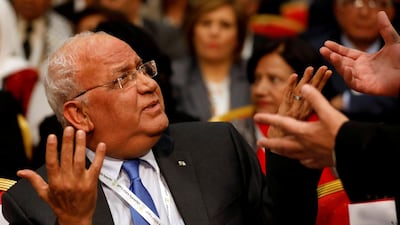
Palestinian chief negotiator Saeb Erekat gestures during the Palestinian National Council meeting in Ramallah, in the occupied West Bank on April 30, 2018. Reuters -
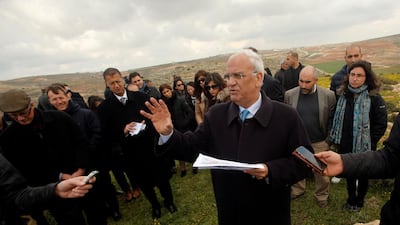
Palestinian chief negotiator Saeb Erekat gestures as he speaks to foreign diplomats during a tour near Jewish settlements in the West Bank village of Jaloud near Nablus on March 16, 2017. Reuters -

Palestinian chief negotiator Saeb Erekat holds a map as he speaks to media about the Israeli plan to appropriate land, in Jordan Valley near the West Bank city of Jericho, on January 20, 2016. Reuters -
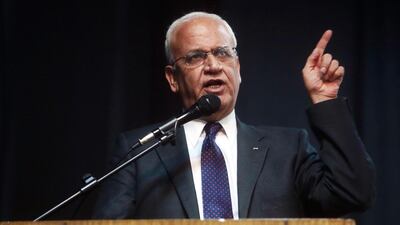
Palestinian chief negotiator Saeb Erekat delivers an address at the Arab School in Santiago de Chile, Chile, on August 14, 2015. EPA -

Saeb Erekat, the Palestinian Authority's chief negotiator, speaks at an Institute for National Security Studies forum in Tel Aviv, Israel on November 2, 2011. Reuters -

Saeb Erekat, the Palestinian Authority's chief negotiator, speaks during a rally held upon his return from Cairo to the West Bank city of Jericho on January 25, 2011. Reuters -

US Middle East envoy George Mitchell and chief Palestinian negotiator Saeb Erekat wave before Mitchell's meeting with Palestinian President Mahmoud Abbas in the West Bank city of Ramallah on October 1, 2010. Reuters -
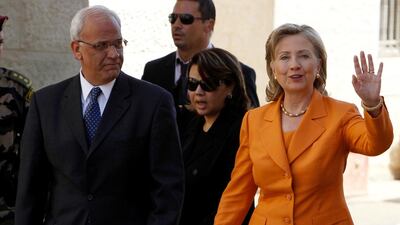
US Secretary of State Hillary Clinton waves as she walks with chief Palestinian negotiator Saeb Erekat upon her arrival for a meeting with Palestinian President Mahmoud Abbas in the West Bank city of Ramallah on September 16, 2010. Reuters -

Former US Secretary of State Madeleine Albright and Senior Palestinian negotiator Saeb Erekat wave before meeting Palestinian President Mahmoud Abbas in the West Bank city of Ramallah on December 6, 2007. Reuters -

US Secretary of State Condoleezza Rice waves as she stands next to Saeb Erekat, a senior aide to Palestinian President Mahmoud Abbas, upon her arrival for a meeting with Abbas in the West Bank city of Ramallah on October 17, 2007. Reuters -

Palestinian President Mahmoud Abbas and senior Palestinian negotiator Saeb Erekat meet Hamas leader Khaled Meshaal and Hamas politburo deputy chief Moussa Abu Marzouk in Damascus on January 21, 2007. Reuters -

Israeli Deputy Prime Minister and Vice Premier Shimon Peres attends a meeting with Palestinian Authority negotiator Saeb Erekat in Tel Aviv on October 14, 2005. Reuters -
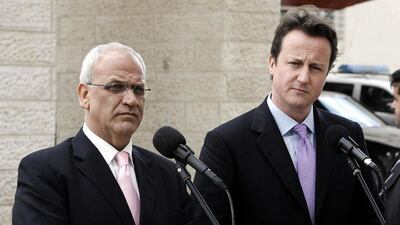
Leader of the Conservative Party David Cameron and Chief Palestinian spokesman Saeb Erekat listen as a journalist asks a question in Ramallah, Palestine on the last day of his two-day tour of the area on March 2, 2007. Reuters -
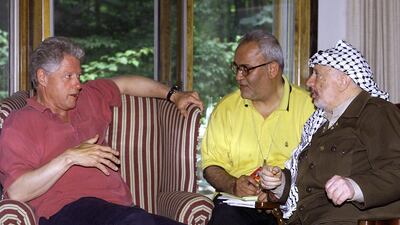
US President Bill Clinton meets with Palestinian President Yassar Arafat and Chief Palestinian negotiator Saeb Erekat during the third day of a Middle East summit at Camp David, July 14, 2000. Reuters -
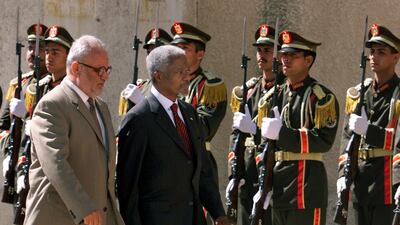
United Nations General Secretary Kofi Annan walks with Palestinian Peace Negotiator Saeb Erekat on his way to meet with Palestinian President Yasser Arafat in Ramallah on June 22, 2000. Reuters -

Palestinian leader Yasser Arafat, seated right, consults with Saeb Erekat, right, as Israeli Prime Minister Ehud Barak, seated left, sign a land-for-security agreement in the Egyptian resort town of Sharm el-Sheikh as US Secretary of State Madeleine Albright, background right, Egyptian President Hosni Mubarak, center background, and Jordan's King Abdullah II, left background, look on on September 5, 1999. AP Photo -
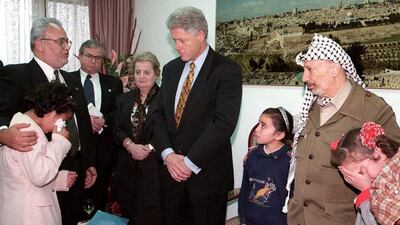
Palestinian chief negotiator Saeb Erekat comforts a Palestinian girl whose father is being held in an Israeli jail as she tells her story to Secretary of State Madeleine Albright, US President Bill Clinton, and Palestinian President Yasser Arafat on December 14, 1998. Reuters -
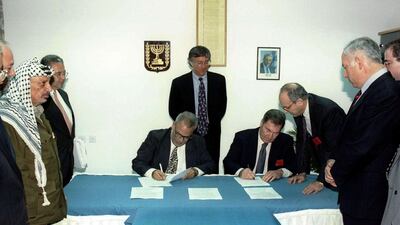
US special envoy Dennis Ross looks on as Saeb Erekat, the chief Palestinian negotiator, and Dan Shomron, the chief Israeli negotiator, initial the documents that bring to a conclusion the long-delayed and overdue Israeli troop redeployment in the West Bank city of Hebron, early January 15, 1997. Reuters


Erekat participated in key peace negotiations with Israel, including the 1991 Madrid conference, the Oslo talks of the 1990s, and the Camp David summit in 2000 hosted by then US president Bill Clinton.
He was a vocal critic of Israeli settlement building on occupied land and pushed for a two-state solution with a viable independent Palestinian state.
Such aspirations seemed increasingly out of reach towards the end of Erekat’s life, with Israeli-Palestinian talks stalled and US government policy under President Donald Trump perceived as biased towards Israel.
"Our right to self-determination has been systematically denied by Israel, now with the support of the US," Erekat told The National this year.
The Trump administration has taken a series of controversial steps which broke with decades of international consensus, including recognition of Jerusalem as Israel’s capital and moving the US embassy to the city.
“It's our inalienable, sacred, long overdue and internationally recognised right to be free,” said Erekat, who was born in Jerusalem and before he was taken to hospital lived in the West Bank city of Jericho.
He came across as affable and self-deprecating in the Palestine Papers, leaked documents mainly from his own office that chronicled the workings of the negotiations from the 1990s until 2010.
But he was also a central figure in the ageing leadership, which many Palestinians accused of nepotism and failure to see their aspirations realised.
Erekat was nonetheless admired by many at home and abroad. Former Israeli foreign minister Tzipi Livni was among the hundreds who paid tributes.
“Saeb dedicated his life to his people,” she wrote on Twitter. “Being sick, he texted me: ‘I’m not finished with what I was born to do’.”
Ayman Odeh, head of the Arab-led Joint List in Israeli parliament, said Erekat “will not live to see his people freed from the chains of the occupation”.
“But generations of Palestinians will remember him as one of the giants who dedicated his life for their independence.”
There have been more than 70,000 confirmed cases of coronavirus in the Palestinian Territories and 521 deaths.

