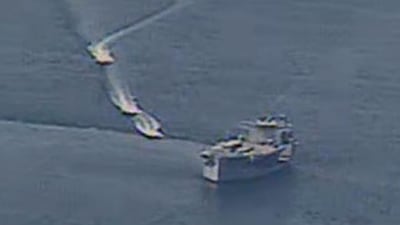
A file image from 2019 shows Islamic Republic of Iran Navy frigate Jamaran during Iran-Russia-China joint naval drills in the Indian Ocean and the Gulf of Oman. AFP

Iranian navy vessel 'mistakenly hits another with missile' killing 19


  • English
  • Arabic

Iran's army said on Monday that 19 people were killed in an "accident" involving a warship hit by a friendly fire missile during exercises in the Gulf of Oman.
"On Sunday afternoon, during an exercise by a number of the navy's vessels in Jask and Chabahar waters, the Konarak light support vessel had an accident," the army said on its website.
"The number of this accident's martyrs is 19 and 15 have also been injured," it said. The vessel had been towed to port.

IRAN-FRIENDLY-FIRE 2.png

The port of Jask is about 1,270 kilometres south-east of Tehran, on the coast of Iran's Hormozgan province.

Iranian TV said a missile hit a ship that was too close to a target during a firing exercise. Iranian authorities did not name the other ship involved but semi-official media identified it as the frigate Jamaran.

The Iranian military said the incident was being investigated.

A senior military capabilities analyst at Jane's, Reed Foster, said that although the loss of the ship was unlikely to affect Iran's navy significantly, "a replacement will likely take years to come into service".

Overhauled in 2018 and capable of launching missiles, the Dutch-made, 47-metre ship has been in service since 1988 and usually carried a crew of 20. With Iran under stringent US sanctions targeting its military and economy, its navy will be forced to rely on indigenous naval construction to replace lost vessels.

Mr Foster said the accident had damaged the credibility of the Iranian military further, noting that "this is the second high-profile incident in less than half a year where mistakes in missile targeting have resulted in significant loss of life".

Iran mistakenly shot down a Ukrainian airliner shortly after it took off from Tehran on January 8, amid soaring tensions between the Islamic republic and Washington, but only admitted to it days later.

Mr Foster said Tehran has been keen to present the IRGC and the armed forces as defenders of the people "against all threats foreign and domestic", but the Konarak incident is likely to undo some of the work done to restore public trust after the downing of Ukrainian Airlines flight 752.

Iran regularly holds exercises in the area where the friendly fire took place, which is close to the Strait of Hormuz, the narrow mouth of the Arabian Gulf through which 20 per cent of the world’s oil passes.

The accident came amid heightened tensions in the Gulf.

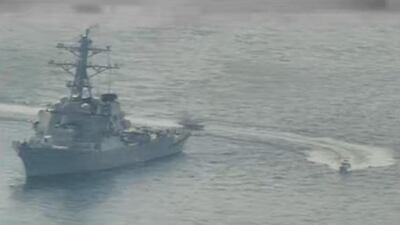
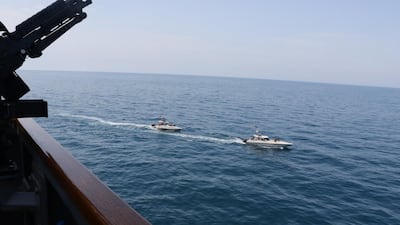
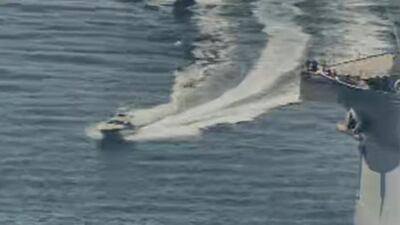
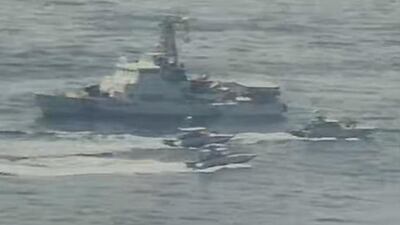
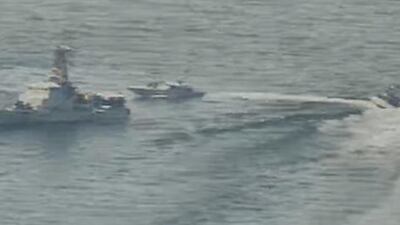
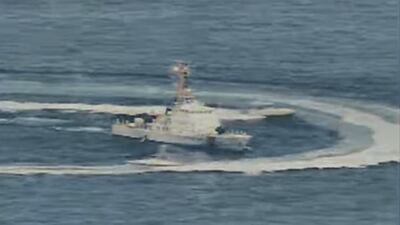
Last month the US accused Iranian fast boats of conducting “dangerous and harassing” manoeuvres near American warships in the northern Arabian Gulf. The Revolutionary Guard denied the accusation, saying the its boats faced "provocative and unprofessional actions" from the US ships while they were conducting drills.

Private security companies claimed the Revolutionary Guard was responsible armed men seizing a Hong Kong-flagged tanker off the Iranian coast near the Strait of Hormuz for a short time. Iran has not acknowledged the incident.

  • Iranian Islamic Revolutionary Guard Corps Navy (IRGCN) vessels near US Military ships at close range. EPA
    Iranian Islamic Revolutionary Guard Corps Navy (IRGCN) vessels near US Military ships at close range. EPA
  • Iranian Islamic Revolutionary Guard Corps Navy (IRGCN) vessels near US Military ships at close range. EPA
    Iranian Islamic Revolutionary Guard Corps Navy (IRGCN) vessels near US Military ships at close range. EPA
  • The US Navy accuses Iran of conducting 'unsafe' actions close to US warships. EPA
    The US Navy accuses Iran of conducting 'unsafe' actions close to US warships. EPA
  • Iranian Islamic Revolutionary Guard Corps Navy (IRGCN) vessels near US Military ships at close range. EPA
    Iranian Islamic Revolutionary Guard Corps Navy (IRGCN) vessels near US Military ships at close range. EPA
  • The US Navy accuses Iran of conducting 'unsafe' actions close to US warships. EPA
    The US Navy accuses Iran of conducting 'unsafe' actions close to US warships. EPA
  • A handout photo made available by the US Naval Forces Central Command / US 5th Fleet via the Defense Visual Information Distribution Service (DVIDS) shows Iranian Islamic Revolutionary Guard Corps Navy (IRGCN) vessels near US Military ships. EPA
    A handout photo made available by the US Naval Forces Central Command / US 5th Fleet via the Defense Visual Information Distribution Service (DVIDS) shows Iranian Islamic Revolutionary Guard Corps Navy (IRGCN) vessels near US Military ships. EPA
  • The US Navy accuses Iran of conducting 'unsafe' actions close to US warships. EPA
    The US Navy accuses Iran of conducting 'unsafe' actions close to US warships. EPA
UK's plans to cut net migration

Under the UK government’s proposals, migrants will have to spend 10 years in the UK before being able to apply for citizenship.

Skilled worker visas will require a university degree, and there will be tighter restrictions on recruitment for jobs with skills shortages.

But what are described as "high-contributing" individuals such as doctors and nurses could be fast-tracked through the system.

Language requirements will be increased for all immigration routes to ensure a higher level of English.

Rules will also be laid out for adult dependants, meaning they will have to demonstrate a basic understanding of the language.

The plans also call for stricter tests for colleges and universities offering places to foreign students and a reduction in the time graduates can remain in the UK after their studies from two years to 18 months.

Mercer, the investment consulting arm of US services company Marsh & McLennan, expects its wealth division to at least double its assets under management (AUM) in the Middle East as wealth in the region continues to grow despite economic headwinds, a company official said.

Mercer Wealth, which globally has $160 billion in AUM, plans to boost its AUM in the region to $2-$3bn in the next 2-3 years from the present $1bn, said Yasir AbuShaban, a Dubai-based principal with Mercer Wealth.

Within the next two to three years, we are looking at reaching $2 to $3 billion as a conservative estimate and we do see an opportunity to do so,” said Mr AbuShaban.

Mercer does not directly make investments, but allocates clients’ money they have discretion to, to professional asset managers. They also provide advice to clients.

“We have buying power. We can negotiate on their (client’s) behalf with asset managers to provide them lower fees than they otherwise would have to get on their own,” he added.

Mercer Wealth’s clients include sovereign wealth funds, family offices, and insurance companies among others.

From its office in Dubai, Mercer also looks after Africa, India and Turkey, where they also see opportunity for growth.

Wealth creation in Middle East and Africa (MEA) grew 8.5 per cent to $8.1 trillion last year from $7.5tn in 2015, higher than last year’s global average of 6 per cent and the second-highest growth in a region after Asia-Pacific which grew 9.9 per cent, according to consultancy Boston Consulting Group (BCG). In the region, where wealth grew just 1.9 per cent in 2015 compared with 2014, a pickup in oil prices has helped in wealth generation.

BCG is forecasting MEA wealth will rise to $12tn by 2021, growing at an annual average of 8 per cent.

Drivers of wealth generation in the region will be split evenly between new wealth creation and growth of performance of existing assets, according to BCG.

Another general trend in the region is clients’ looking for a comprehensive approach to investing, according to Mr AbuShaban.

“Institutional investors or some of the families are seeing a slowdown in the available capital they have to invest and in that sense they are looking at optimizing the way they manage their portfolios and making sure they are not investing haphazardly and different parts of their investment are working together,” said Mr AbuShaban.

Some clients also have a higher appetite for risk, given the low interest-rate environment that does not provide enough yield for some institutional investors. These clients are keen to invest in illiquid assets, such as private equity and infrastructure.

“What we have seen is a desire for higher returns in what has been a low-return environment specifically in various fixed income or bonds,” he said.

“In this environment, we have seen a de facto increase in the risk that clients are taking in things like illiquid investments, private equity investments, infrastructure and private debt, those kind of investments were higher illiquidity results in incrementally higher returns.”

The Abu Dhabi Investment Authority, one of the largest sovereign wealth funds, said in its 2016 report that has gradually increased its exposure in direct private equity and private credit transactions, mainly in Asian markets and especially in China and India. The authority’s private equity department focused on structured equities owing to “their defensive characteristics.”

Race 3

Produced: Salman Khan Films and Tips Films
Director: Remo D’Souza
Cast: Salman Khan, Anil Kapoor, Jacqueline Fernandez, Bobby Deol, Daisy Shah, Saqib Salem
Rating: 2.5 stars

The burning issue

The internal combustion engine is facing a watershed moment – major manufacturer Volvo is to stop producing petroleum-powered vehicles by 2021 and countries in Europe, including the UK, have vowed to ban their sale before 2040. The National takes a look at the story of one of the most successful technologies of the last 100 years and how it has impacted life in the UAE.

Read part three: the age of the electric vehicle begins

Read part two: how climate change drove the race for an alternative 

Read part one: how cars came to the UAE

Global Fungi Facts

• Scientists estimate there could be as many as 3 million fungal species globally
• Only about 160,000 have been officially described leaving around 90% undiscovered
• Fungi account for roughly 90% of Earth's unknown biodiversity
• Forest fungi help tackle climate change, absorbing up to 36% of global fossil fuel emissions annually and storing around 5 billion tonnes of carbon in the planet's topsoil