• A Syrian child poses for a picture at a camp for displaced Syrians near the town of Kafr Lusin by the border with Turkey, in Syria's rebel-held northwestern province of Idlib. AFP
    A Syrian child poses for a picture at a camp for displaced Syrians near the town of Kafr Lusin by the border with Turkey, in Syria's rebel-held northwestern province of Idlib. AFP
  • A drone picture taken on December 15, 2020 shows a camp for displaced Syrians near the town of Kafr Lusin by the border with Turkey. AFP
    A drone picture taken on December 15, 2020 shows a camp for displaced Syrians near the town of Kafr Lusin by the border with Turkey. AFP
  • A child sits outside a tent at the flooded Mukhayyam Al Khair camp near the village of Kafr Uruq in the north of Idlib province on December 17, 2020. AFP
    A child sits outside a tent at the flooded Mukhayyam Al Khair camp near the village of Kafr Uruq in the north of Idlib province on December 17, 2020. AFP
  • Children standing together holding hands in circles in a rainwater pond at the flooded Mukhayyam Al Khair camp near the village of Kafr Uruq in the north of Idlib province. AFP
    Children standing together holding hands in circles in a rainwater pond at the flooded Mukhayyam Al Khair camp near the village of Kafr Uruq in the north of Idlib province. AFP
  • A girl standing outside a tent at the flooded Mukhayyam Al Khair camp near the village of Kafr Uruq in the north of Idlib province. AFP
    A girl standing outside a tent at the flooded Mukhayyam Al Khair camp near the village of Kafr Uruq in the north of Idlib province. AFP
  • The flooded Mukhayyam Al Khair camp near the village of Kafr Uruq in the north of Idlib province. AFP
    The flooded Mukhayyam Al Khair camp near the village of Kafr Uruq in the north of Idlib province. AFP
  • Children standing outside a tent at the flooded Mukhayyam Al Khair camp near the village of Kafr Uruq in the north of Idlib province. AFP
    Children standing outside a tent at the flooded Mukhayyam Al Khair camp near the village of Kafr Uruq in the north of Idlib province. AFP
  • Two girls sit inside a flooded tent at the flooded Mukhayyam Al Khair camp near the village of Kafr Uruq in the north of Idlib province on December 17, 2020. AFP
    Two girls sit inside a flooded tent at the flooded Mukhayyam Al Khair camp near the village of Kafr Uruq in the north of Idlib province on December 17, 2020. AFP
  • The flooded Mukhayyam Al Khair camp near the village of Kafr Uruq in the north of Idlib province. AFP
    The flooded Mukhayyam Al Khair camp near the village of Kafr Uruq in the north of Idlib province. AFP
  • Members of the displaced Syrian family of Tareq Abu Ziad, from the town of Ariha in the southern countryside of the Idlib province, breaking their fast together for the sunset "iftar" meal during Ramadan. AFP
    Members of the displaced Syrian family of Tareq Abu Ziad, from the town of Ariha in the southern countryside of the Idlib province, breaking their fast together for the sunset "iftar" meal during Ramadan. AFP

In Idlib, Syria, linking Covid-19 and the conflict could be catastrophic


  • English
  • Arabic


In the ragged displacement camps of northern Syria, where families huddle together under tattered tarps to try to keep warm, few say they worry about getting Covid-19, much less a vaccine.

Omar Kurde, 39, is one of 900,000 people displaced by the Syrian war in rebel-held Idlib. Having fled his home town of Aleppo, he now lives in a camp near the Turkish border in the Harem district.

For him, the hardships of surviving the day are more worrying than a virus he can do little about.

"I, and many Syrians, do not care about the virus killing me here with my family. Starvation and poverty are our daily struggle and may kill us faster than Covid-19," he tells The National.

But one message is clear – after years of Russian support for Bashar Al Assad's regime, those in the last rebel-held region are reluctant to take a vaccine delivered by Moscow.

After years of war, many in theregion find it hard to separate the geopolitics of the conflict from the Covid-19 pandemic.

When asked, Omar says he would consider taking the Russian vaccine only if he was "on the verge of death".

Syria is yet to secure a vaccine for Covid-19. If and when it does, it is unclear if there will be a unified national campaign or whether the divided country will end up with parallel systems.

In October, Russia said it would supply Damascus with its Sputnik V and EpiVacCorona vaccines. But there has been no announcement on how this could be distributed or when it may arrive.

Damascus could launch one drive while in the rebel-held areas of Syria’s north-west, drugs could be brought in through the Turkish border town of Gaziantep.

But people would refuse to take a Russian-made vaccine, two doctors and a humanitarian worker in Idlib tell The National.

This sentiment is a worry to local doctors and to bodies such as the World Health Organisation who are concerned Idlib residents are downplaying the risks of Covid-19.

“When your house is bombarded, [people are] losing limbs, or you experience a long period of hospitalisation or even suffering due to bad weather and seeing that most people with Covid-19 are recovering or asymptomatic, you begin feeling that the coronavirus is just a flu, undermining the true severity of it,” says Mahmoud Daher from the WHO office in Gaziantep.

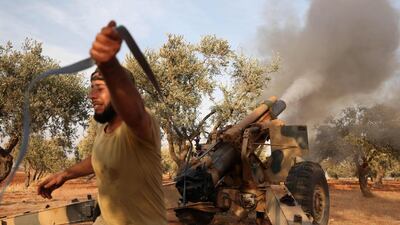
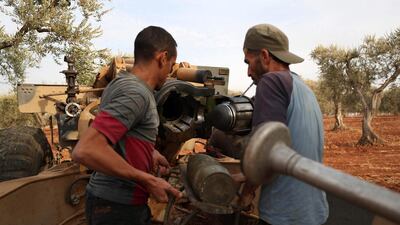
  • Members of Syria's opposition National Liberation Front load a 155mm gun before firing toward positions of Russian and regime forces in retaliation to a Russian air strike on a training camp two days before. AFP
    Members of Syria's opposition National Liberation Front load a 155mm gun before firing toward positions of Russian and regime forces in retaliation to a Russian air strike on a training camp two days before. AFP
  • The air strikes by Damascus regime ally Russia killed 78 Turkey-backed rebels in north-west Syria on October 26. AFP
    The air strikes by Damascus regime ally Russia killed 78 Turkey-backed rebels in north-west Syria on October 26. AFP
  • A fighter with the Turkey-backed Faylaq Al Sham rebel faction in Syria shoots in the air during the funeral of 10 of the faction's fighters. AFP
    A fighter with the Turkey-backed Faylaq Al Sham rebel faction in Syria shoots in the air during the funeral of 10 of the faction's fighters. AFP
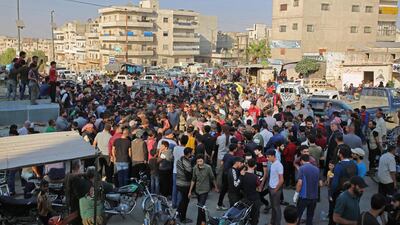
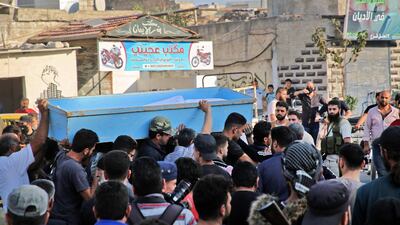
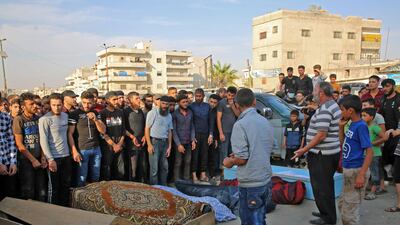
  • Syrians take part in the funeral of 10 fighters with the Turkey-backed Faylaq Al Sham rebel faction in Syria. AFP
    Syrians take part in the funeral of 10 fighters with the Turkey-backed Faylaq Al Sham rebel faction in Syria. AFP
  • Syrians take part in the funeral of 10 fighters with the Turkey-backed Faylaq Al Sham rebel faction in Syria. AFP
    Syrians take part in the funeral of 10 fighters with the Turkey-backed Faylaq Al Sham rebel faction in Syria. AFP
  • Syrians take part in the funeral of 10 fighters with the Turkey-backed Faylaq Al Sham rebel faction in Syria. AFP
    Syrians take part in the funeral of 10 fighters with the Turkey-backed Faylaq Al Sham rebel faction in Syria. AFP
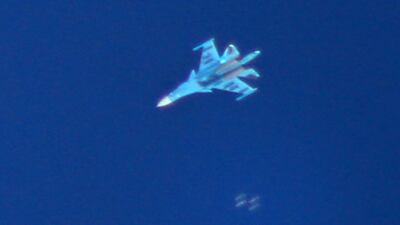
  • A Russian Sukhoi Su-34 fighter jet drops bombs over the Syrian village of Kafr Ain in the southern countryside of Idlib province. AFP, file
    A Russian Sukhoi Su-34 fighter jet drops bombs over the Syrian village of Kafr Ain in the southern countryside of Idlib province. AFP, file
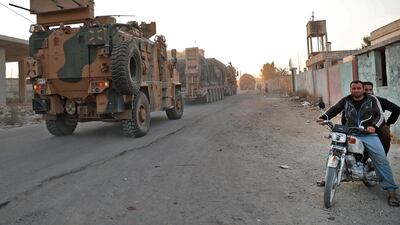
  • A Turkish military convoy drives through the village of Iblin, near Ariha in Syria's rebel-held north-west Idlib province. AFP
    A Turkish military convoy drives through the village of Iblin, near Ariha in Syria's rebel-held north-west Idlib province. AFP
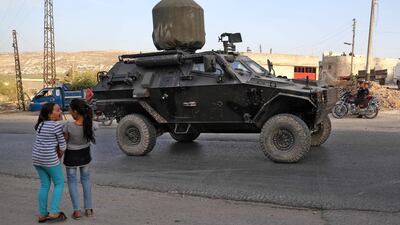
  • An armoured vehicle drives as part of a Turkish military convoy drives through the village of Iblin, near Ariha in Syria's rebel-held north-west Idlib province. AFP
    An armoured vehicle drives as part of a Turkish military convoy drives through the village of Iblin, near Ariha in Syria's rebel-held north-west Idlib province. AFP

Mr Daher says that for many, it is hard to separate the geopolitics of the Syrian war from their view of the virus and a cure.

“Linking the sources of the vaccines with those who contributed to their suffering, and taking prevailing political dimensions into consideration, means people are affiliated with different countries across Syria and link their support to vaccine manufacturers with their political alliances,” Mr Daher says.

Dr Mahmoud Shahem, an internist specialist who works at Idlib national hospital’s quarantine unit, echoes the view.

“People feel that there’s no way that the same pro-regime Russians would provide them with a vaccine that could save them from the virus,” he said.

With a shattered health system in north-east Syria, Covid-19 is already taking a toll.

The Assistance Co-ordination Unit (ACU), a Syrian opposition NGO funded in part by USAID and the UK’s DFID, is one of the few sources of data on the coronavirus situation in north-west Syria.

They reported 18,774 cases in north-west Syria alone as of December 14 even though the whole country officially has only 9,302 cases.

A situation where many choose to shun a vaccine could be catastrophic.

With what the WHO describes as a decimated healthcare sector, only half of north-west Syria’s healthcare facilities are working and, more starkly still, about 1,000 doctors cater to the area’s population of four million.

While the civilian population there struggles to reconcile with a reality where an effective Russian vaccine could be a viable option, some of the few frontline workers in north-west Syria believe that medical solutions should be perceived apolitically.

Harem Hospital’s Dr Hosam Mohammad puts it succinctly.

"I think that medication should be neutral and not subjected or drawn into political labelling or shaming since its ultimate goal is to heal and help, which is what north Syria needs most," he says.


A timeline of the Historical Dictionary of the Arabic Language
  • 2018: Formal work begins
  • November 2021: First 17 volumes launched 
  • November 2022: Additional 19 volumes released
  • October 2023: Another 31 volumes released
  • November 2024: All 127 volumes completed
How to protect yourself when air quality drops

Install an air filter in your home.

Close your windows and turn on the AC.

Shower or bath after being outside.

Wear a face mask.

Stay indoors when conditions are particularly poor.

If driving, turn your engine off when stationary.

Long read

Mageed Yahia, director of WFP in UAE: Coronavirus knows no borders, and neither should the response

The President's Cake

Director: Hasan Hadi

Starring: Baneen Ahmad Nayyef, Waheed Thabet Khreibat, Sajad Mohamad Qasem 

Rating: 4/5

Another way to earn air miles

In addition to the Emirates and Etihad programmes, there is the Air Miles Middle East card, which offers members the ability to choose any airline, has no black-out dates and no restrictions on seat availability. Air Miles is linked up to HSBC credit cards and can also be earned through retail partners such as Spinneys, Sharaf DG and The Toy Store.

An Emirates Dubai-London round-trip ticket costs 180,000 miles on the Air Miles website. But customers earn these ‘miles’ at a much faster rate than airline miles. Adidas offers two air miles per Dh1 spent. Air Miles has partnerships with websites as well, so booking.com and agoda.com offer three miles per Dh1 spent.

“If you use your HSBC credit card when shopping at our partners, you are able to earn Air Miles twice which will mean you can get that flight reward faster and for less spend,” says Paul Lacey, the managing director for Europe, Middle East and India for Aimia, which owns and operates Air Miles Middle East.

Infiniti QX80 specs

Engine: twin-turbocharged 3.5-liter V6

Power: 450hp

Torque: 700Nm

Price: From Dh450,000, Autograph model from Dh510,000

Available: Now

MATCH INFO

Mainz 0

RB Leipzig 5 (Werner 11', 48', 75', Poulsen 23', Sabitzer 36')

Man of the Match: Timo Werner (RB Leipzig)

Six large-scale objects on show
  • Concrete wall and windows from the now demolished Robin Hood Gardens housing estate in Poplar
  • The 17th Century Agra Colonnade, from the bathhouse of the fort of Agra in India
  • A stagecloth for The Ballet Russes that is 10m high – the largest Picasso in the world
  • Frank Lloyd Wright’s 1930s Kaufmann Office
  • A full-scale Frankfurt Kitchen designed by Margarete Schütte-Lihotzky, which transformed kitchen design in the 20th century
  • Torrijos Palace dome

Mercer, the investment consulting arm of US services company Marsh & McLennan, expects its wealth division to at least double its assets under management (AUM) in the Middle East as wealth in the region continues to grow despite economic headwinds, a company official said.

Mercer Wealth, which globally has $160 billion in AUM, plans to boost its AUM in the region to $2-$3bn in the next 2-3 years from the present $1bn, said Yasir AbuShaban, a Dubai-based principal with Mercer Wealth.

Within the next two to three years, we are looking at reaching $2 to $3 billion as a conservative estimate and we do see an opportunity to do so,” said Mr AbuShaban.

Mercer does not directly make investments, but allocates clients’ money they have discretion to, to professional asset managers. They also provide advice to clients.

“We have buying power. We can negotiate on their (client’s) behalf with asset managers to provide them lower fees than they otherwise would have to get on their own,” he added.

Mercer Wealth’s clients include sovereign wealth funds, family offices, and insurance companies among others.

From its office in Dubai, Mercer also looks after Africa, India and Turkey, where they also see opportunity for growth.

Wealth creation in Middle East and Africa (MEA) grew 8.5 per cent to $8.1 trillion last year from $7.5tn in 2015, higher than last year’s global average of 6 per cent and the second-highest growth in a region after Asia-Pacific which grew 9.9 per cent, according to consultancy Boston Consulting Group (BCG). In the region, where wealth grew just 1.9 per cent in 2015 compared with 2014, a pickup in oil prices has helped in wealth generation.

BCG is forecasting MEA wealth will rise to $12tn by 2021, growing at an annual average of 8 per cent.

Drivers of wealth generation in the region will be split evenly between new wealth creation and growth of performance of existing assets, according to BCG.

Another general trend in the region is clients’ looking for a comprehensive approach to investing, according to Mr AbuShaban.

“Institutional investors or some of the families are seeing a slowdown in the available capital they have to invest and in that sense they are looking at optimizing the way they manage their portfolios and making sure they are not investing haphazardly and different parts of their investment are working together,” said Mr AbuShaban.

Some clients also have a higher appetite for risk, given the low interest-rate environment that does not provide enough yield for some institutional investors. These clients are keen to invest in illiquid assets, such as private equity and infrastructure.

“What we have seen is a desire for higher returns in what has been a low-return environment specifically in various fixed income or bonds,” he said.

“In this environment, we have seen a de facto increase in the risk that clients are taking in things like illiquid investments, private equity investments, infrastructure and private debt, those kind of investments were higher illiquidity results in incrementally higher returns.”

The Abu Dhabi Investment Authority, one of the largest sovereign wealth funds, said in its 2016 report that has gradually increased its exposure in direct private equity and private credit transactions, mainly in Asian markets and especially in China and India. The authority’s private equity department focused on structured equities owing to “their defensive characteristics.”

Why seagrass matters
  • Carbon sink: Seagrass sequesters carbon up to 35X faster than tropical rainforests
  • Marine nursery: Crucial habitat for juvenile fish, crustations, and invertebrates
  • Biodiversity: Support species like sea turtles, dugongs, and seabirds
  • Coastal protection: Reduce erosion and improve water quality
Farage on Muslim Brotherhood

Nigel Farage told Reform's annual conference that the party will proscribe the Muslim Brotherhood if he becomes Prime Minister.
"We will stop dangerous organisations with links to terrorism operating in our country," he said. "Quite why we've been so gutless about this – both Labour and Conservative – I don't know.
“All across the Middle East, countries have banned and proscribed the Muslim Brotherhood as a dangerous organisation. We will do the very same.”
It is 10 years since a ground-breaking report into the Muslim Brotherhood by Sir John Jenkins.
Among the former diplomat's findings was an assessment that “the use of extreme violence in the pursuit of the perfect Islamic society” has “never been institutionally disowned” by the movement.
The prime minister at the time, David Cameron, who commissioned the report, said membership or association with the Muslim Brotherhood was a "possible indicator of extremism" but it would not be banned.