
Berthe Badehi, who hid from the Nazis as a child during the Second World War, has become one of the many Holocaust survivors confined in their homes to evade the coronavirus.
“It’s not easy, but we do it to stay alive,” Ms Badehi, 88, said of her current self-isolation at home in Israel.
“One thing I learnt during the war was how to take care of myself.”
Movement and travel restrictions in place to contain the pandemic have forced this week’s Holocaust Remembrance Day – Yom HaShoah in Hebrew – to be exclusively digital for the first time.
In a normal year, in common with the UN’s memorial day on January 27, symbolic events are organised, notably with survivors at the sites in Europe where the Nazis built concentration and extermination camps.
This year, testimonials from survivors will be streamed online and featured in a pre-recorded ceremony to be broadcast in Israel by Jerusalem’s Yad Vashem Holocaust memorial centre, when Yom HaShoah begins on Monday evening.
The limitations on organising events this year served as a reminder that in the not-too-distant future, ceremonies with survivors will no longer be possible because the last of them will have passed away.
“We have talked a lot about what happens when survivors are not here,” said Stephen Smith, who heads the Shoah Foundation at the University of Southern California.
This week’s scaled-back commemorations “made us realise what the future might be like,” Smith told AFP.
“It is a test of our resolve...”
“Maybe it is an opportunity to say... we won’t get 10,000 people at Auschwitz, but maybe we can get a million people (watching) online,” he said, referring to the Nazi concentration and extermination camp in Poland.
-
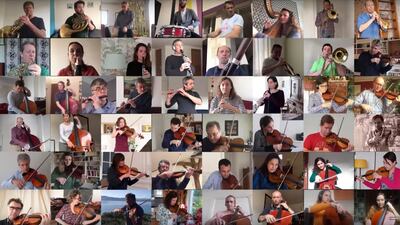
FRANCE: In this handout photo provided by the National Orchestra of France on April 1, 2020, musicians are shown in the screenshot as a patchwork, each performing parts of "Bolero" alone in lockdown. National Orchestra of France via AP -

NETHERLANDS: A salesperson in a converted ice cream parlour, sells his FFP2 face masks at 9 euros a piece, or 3 for 25 euros, as protection against the coronavirus in Amsterdam, on April 19, 2020. AP Photo -
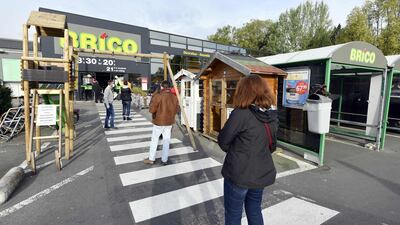
BELGIUM: Customers wait in line outside a Brico hardware store in Brussels, on April 18, 2020, on the first day of it's re-opening. From April 18, onwards gardening and hardware stores are allowed to receive costumers, as Belgium is in its fifth week of lockdown to stop the spread of coronavirus. AFP -

LITHUANIA: A dog looks at cats through the window of the "Cat Cafe" which remains closed in Vilnius, Lithuania on April 19, 2020. In Lithuania, cafes and restaurants were closed to limit the spread of coronavirus. AFP -

SLOVENIA: People ride their bicycles as a photograph by local photographer Ciril Jazbec is projected on a facade in Ljubljana on April 16, 2020, amid the outbreak of coronavirus. Galleries are closed due to the outbreak, so a group of photographers decided to exhibit their works in a slideshow projected on facades and other public spaces. AFP -
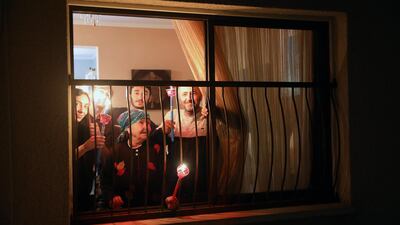
CYPRUS: A family hold lighten candles symbolizing the Holy Light at the window of their apartment, as people are not allowed to attend the Orthodox Easter midnight mass, in Nicosia, on April 19, 2020. EPA -

CROATIA: Two girls watch online on their computer streaming live a global concert 'One World Together at home' in Zagreb, on April 18, 2020. EPA -

GERMANY: People hold a banner reading: "Everything prohibited except working" as they protest for the evacuation of refugees from camps in Greece, as the spread of coronavirus continues in Berlin, on April 19, 2020. Reuters -
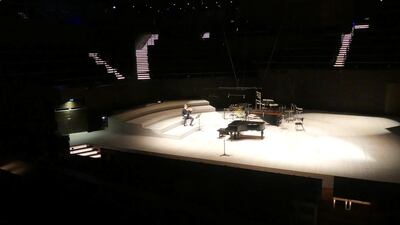
FINLAND: Violinist Teppo Ali-Mattila performs in an empty concert hall during the coronavirus outbreak, in Helsinki, on April 14, 2020. Reuters -

SWEDEN: Erik Nyrenius during a training session with his football team in Lerum, Sweden, on April 18, 2020. Sweden has adopted more relaxed measures in response to the coronavirus outbreak in comparison to other areas of the EU. EPA -

ITALY: Migrants are being transferred form the NGO boat Aita Mari to the Italian ship Rubattino, to be quarantined because of the coronavirus outbreak, off the coast of Palermo, on April 19, 2020. Reuters -
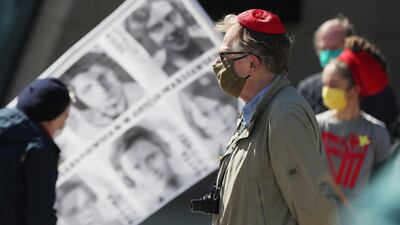
POLAND: A man wears a face mask in Warsaw, on April 19, 2020, during an anniversary ceremony for the ill-fated struggle of the 1943 Warsaw Ghetto Uprising. AP Photo -
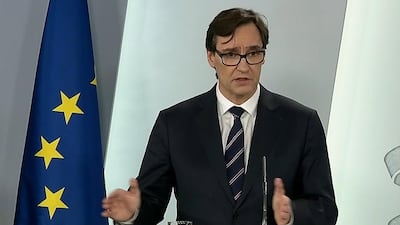
SPAIN: A handout photo from the Spanish Government showing Spanish Health Minister Salvador Illa speaking during a press conference at Moncloa Presidential Palace in Madrid on April 19, 2020. EPA -
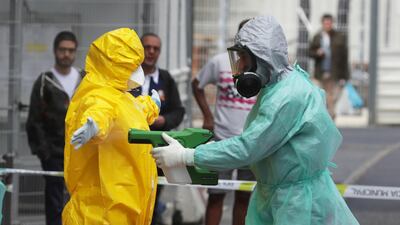
PORTUGAL: Members of the National Institute for Medical Emergency and the Public Security Police (PSP) conduct an evacuation operation at a hostel in Lisbon, on April 19, 2020. EPA -

FRANCE: The Ukrainian Antonov An-225 Mriya aeroplane lands at Paris-Vatry airport from China to deliver 8,6 million face masks and 150 tonnes of sanitary equipment ordered by a private customer, in Bussy Lettree, on April 19, 2020. AFP


For survivors such as Badehi, any comparison between Covid-19 isolation and Nazi-era confinement in ghettos and camps is inappropriate.
“In France, during the war, we lived in fear, we hid our identity and we lost contact with our parents...”
“Today, we may be locked inside, but we have contact with our children and grandchildren through the phone and internet,” said Badehi, who volunteered at Yad Vashem until it closed because of the virus.
Dov Landau, a 91-year-old Auschwitz survivor, said it was “indecent” to make comparisons between the two eras.
“Today we are neither hungry nor thirsty. Men, women and children are unlikely to be burned alive. Sure, I’m bored... but it’s nothing serious,” he told AFP.
He regularly travelled from Israel to Auschwitz to speak to school groups, but those trips came to a halt because of the pandemic.
Beyond cancellation of educational events, Covid-19 has posed a particularly grave threat to Holocaust survivors, given their age.
The virus “is absolutely attacking the memory of the Holocaust because it is attacking the elderly,” Smith said, adding that he is aware of several survivors who have died from coronavirus-related complications.
“It is also attacking our ability to (collect) these stories,” he said.
The Shoah Foundation has developed an augmented reality application to document the journey across Europe endured by many Holocaust survivors.
One woman whose experience was scheduled to be documented this year was Eva Schloss, whose mother married Anne Frank’s father Otto after the war.
Schloss “has an amazing story,” Smith said. “Very, very similar to Anne Frank, the only difference is that she survived.”
“She was literally in the kitchen watching Otto prepare the diary for publication,” he said.
Because of the pandemic, the foundation had to cancel plans to collect material with Ms Schloss in Vienna, Amsterdam and Auschwitz.
The foundation is partnering on the augmented reality project with The March of the Living, the prominent educational programme that brings young people to the sites of concentration camps.
Eli Rubenstein, a rabbi in Toronto who heads March of the Living Canada, said he has spoken to many survivors who insisted they will be available to give testimonials next year.
“They are very strong people, full of optimism,” he said.
But, he said, the delay forced by the pandemic “gives us a new sense of urgency.”

