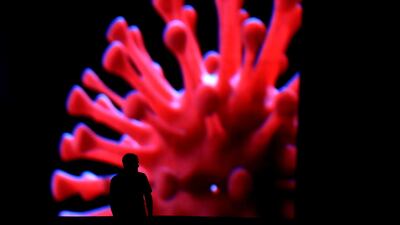
Health officials have called on people to be vigilant about identifying false information and avoid forwarding messages that could contain inaccurate medical advice. Reuters

Coronavirus: forwarding that 'advice' might do more harm than good, experts warn


  • English
  • Arabic

The message pings in from a family member, colleague or friend. The story is shocking, its facts reinforced in capitals and the source, it says, has access to high-level information. Exclamation mark.

This format, or variations of it, has been used to spread countless rumours across social media platforms, most recently in response to the outbreak of Covid-19.

One message, widely debunked by doctors, suggests people test for the virus by seeing whether they can hold their breath for more than 10 seconds without coughing. Others tout so-called “natural cures” like eating ginger and garlic or sipping hot water slowly.

At a time when reliable information is vital to navigate a global public health emergency, details on diagnosis and treatment are being crowded out by a flood of false narratives like these. On April Fools day, governments in Thailand, Germany, India, Taiwan and elsewhere, have issued stern warnings against potential pranksters looking to turn the situation into a joke, with several threatening fines or jail time.

Some of the most troubling and widely shared posts mix medical fact with misinformation. One, claiming a runny nose means a common cold and isn’t a symptom of coronavirus pneumonia, was shared more than 300,000 times on social media before it was amended, according to Tom Philips, an editor at Full Fact.

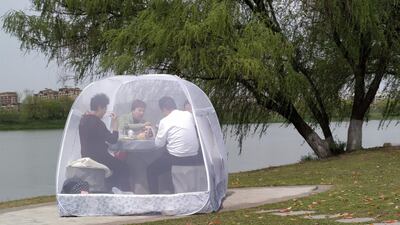
  • People enjoy a meal inside a tent, at a park in Nanjing, Jiangsu province, China. Reuters
    People enjoy a meal inside a tent, at a park in Nanjing, Jiangsu province, China. Reuters
  • French tenor Stephane Senechal sings at his window for the inhabitants of his street in Paris, France. EPA
    French tenor Stephane Senechal sings at his window for the inhabitants of his street in Paris, France. EPA
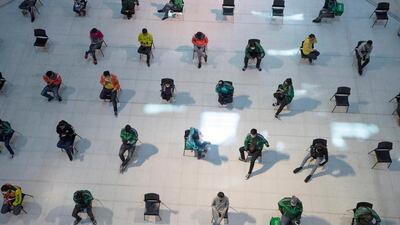
  • People practice social distancing as they sit on chairs spread apart in a waiting area for take-away food orders at a shopping mall in hopes of preventing the spread of the coronavirus in Bangkok, Thailand. AP Photo
    People practice social distancing as they sit on chairs spread apart in a waiting area for take-away food orders at a shopping mall in hopes of preventing the spread of the coronavirus in Bangkok, Thailand. AP Photo
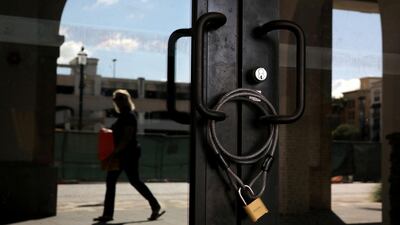
  • A restaurant is seen closed as a woman walks past at an empty commercial area after local authorities restricted the activities of restaurants, bars, gyms, movie theaters and other similar businesses in West Palm Beach, Florida, US. Reuters
    A restaurant is seen closed as a woman walks past at an empty commercial area after local authorities restricted the activities of restaurants, bars, gyms, movie theaters and other similar businesses in West Palm Beach, Florida, US. Reuters
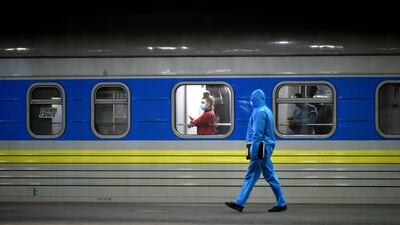
  • A passenger looks out the window as a medical worker walks past her carriage of a train with Ukrainians evacuated from Riga at a railway station in Kiev. AFP
    A passenger looks out the window as a medical worker walks past her carriage of a train with Ukrainians evacuated from Riga at a railway station in Kiev. AFP
  • People wearing face masks as a precautionary measure against covid-19 'elbow bump' as they stand in Greenwich in south London. AFP
    People wearing face masks as a precautionary measure against covid-19 'elbow bump' as they stand in Greenwich in south London. AFP
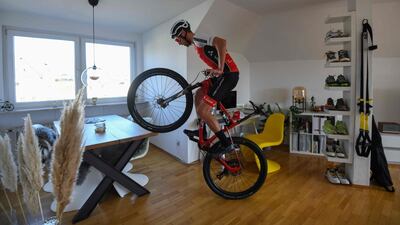
  • Ben Zwiehoff, the German national team's racing cyclist in the mountain bike cross-country discipline works on his balance on his bike in his flat, in Essen, western Germany. AFP
    Ben Zwiehoff, the German national team's racing cyclist in the mountain bike cross-country discipline works on his balance on his bike in his flat, in Essen, western Germany. AFP
  • Gonzaga Yiga, a 49-year-old community chairperson, appeals to residents through a speaker from the tallest building of the area, in Kampala, Uganda. AFP
    Gonzaga Yiga, a 49-year-old community chairperson, appeals to residents through a speaker from the tallest building of the area, in Kampala, Uganda. AFP
  • A nurse anesthetist gestures during the disinfection of ambulances, in Brest, western France. AFP
    A nurse anesthetist gestures during the disinfection of ambulances, in Brest, western France. AFP
  • A general view shows Serbian military personal setting up beds inside a hall at the Belgrade Fair to accommodate people suffering from mild symptoms of the coronavirus disease. AFP
    A general view shows Serbian military personal setting up beds inside a hall at the Belgrade Fair to accommodate people suffering from mild symptoms of the coronavirus disease. AFP
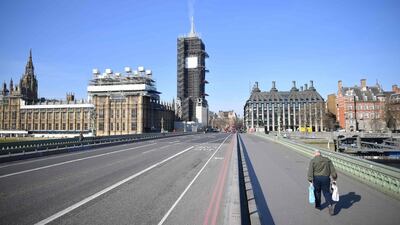
  • A picture shows the Houses of Parliament at the end of an empty Westminster Bridge in central London, the morning after Britain ordered a lockdown to slow the spread of the novel coronavirus. AFP
    A picture shows the Houses of Parliament at the end of an empty Westminster Bridge in central London, the morning after Britain ordered a lockdown to slow the spread of the novel coronavirus. AFP
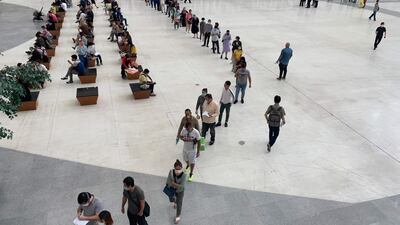
  • People queue at the Immigration Office in Bangkok, as Thailand moves to close its borders after a spike in the number of coronavirus cases in the past week. AFP
    People queue at the Immigration Office in Bangkok, as Thailand moves to close its borders after a spike in the number of coronavirus cases in the past week. AFP
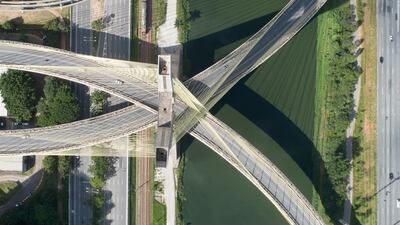
  • An aerial view of empty Octavio Frias de Oliveira bridge, a cable-stayed bridge, on the first day of lockdown imposed by state government in Sao Paulo, Brazil. Reuters
    An aerial view of empty Octavio Frias de Oliveira bridge, a cable-stayed bridge, on the first day of lockdown imposed by state government in Sao Paulo, Brazil. Reuters
  • A man passes by an LED outdoor screen during the coronavirus outbreak in Brasilia, Brazil. Reuters
    A man passes by an LED outdoor screen during the coronavirus outbreak in Brasilia, Brazil. Reuters
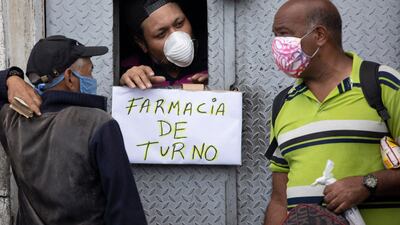
  • A man attends customers through an opening from which hangs a handwritten sign that reads in Spanish: "Pharmacy on duty," in Caracas, Venezuela. AP Photo
    A man attends customers through an opening from which hangs a handwritten sign that reads in Spanish: "Pharmacy on duty," in Caracas, Venezuela. AP Photo
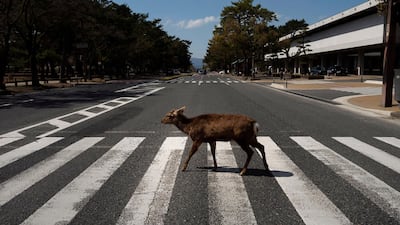
  • A deer walks across a pedestrian crossing in Nara, Japan. AP Photo
    A deer walks across a pedestrian crossing in Nara, Japan. AP Photo

The UK-based fact checking agency, which has seen a number of false claims in social media posts shared "tens or even hundreds of thousands of times," recently published a step-by-step guide to help people identify misinformation.

"Bad information ruins lives. In the case of the new coronavirus, misinformation poses a serious threat to people's health," Mr Philips told The National. "Amid the current outbreak, the stakes are high — members of the public depend on news outlets and political leaders when making potentially life-saving decisions."

Conspiracy theories have also multiplied, stoking political tensions and fuelling racism. Erroneous claims about the origins of the virus — a US bioweapon, a Chinese lab — contribute to the alarm surrounding an already-frightening situation.

“We’re not just fighting an epidemic; we’re fighting an infodemic,” World Health Organisation Director-General Tedros Adhanom Ghebreyesus said in February.

Since then, calls from health experts and government officials to contain the barrage of disinformation have become increasingly urgent as the coronavirus affects more people, and death tolls rise in countries around the world.

In the UK, MPs have called on the public to send in evidence of fake news about the coronavirus. Irish Prime Minister Leo Varadkar has urged people “to please stop sharing unverified info on WhatsApp groups. These messages are scaring and confusing people and causing real damage.”

Gulf states have taken a tough stance. Oman has charged a number of people with disseminating rumours related to the virus and UAE attorney general Dr Hamad Saif Al Shamsi warned last month that "spreading fake information and rumours is a crime punishable by law."

Kuwaiti academics said that circulating rumours could undermine efforts to handle the pandemic in the country, which has also launched legal proceedings against people accused of spreading misinformation about the virus.

“The state has to be firm, especially during the current delicate time,” Massouma al Mubarak, professor of political science at the Kuwait University said in a report published by state news agency Kuna on Sunday.

Even posts that appear harmless — like a message purporting to be from Bill Gates encouraging people to reflect positively on their lives during the crisis — can have a detrimental impact.

“When we’re basing our beliefs and behaviours on false information, even seemingly innocuous false claims, that itself can have serious ramifications,” Ellen Judson, researcher at the Centre for the Analysis of Social Media at the think tank Demos, said.

"Misinformation, which can often go viral, may also be shared much more than true information, meaning that it risks crowding out true information and undermining how well the correct information can get through to the people who need to see it," she told The National.

The World Health Organisation now has a myth-busting list that answers queries including, "are hand dryers effective in killing the new coronavirus" and "can spraying alcohol or chlorine all over your body kill the new coronavirus."

Social media platforms have also stepped up efforts to monitor and remove misleading posts. Twitter has broadened its definition of harmful tweets “to address content that goes directly against guidance from authoritative sources of global and local public health information.”

Facebook has adjusted its algorithms to promote official accounts and removed false content about coronavirus, including a video by Brazilian leader Jair Bolsonaro that promoted the use of anti-malaria drug hydroxychloroquine and criticised social distancing measures in the country.

But a significant proportion of the false narratives surrounding coronavirus are being forwarded on WhatsApp, which is harder to monitor. “Messages are private, so it is only through people not sharing, or challenging these messages either on or off the platform that the rumours can be dissipated,” Dr Samantha Vanderslott, social sciences researcher at the Oxford Vaccine Group, said.

For users, there are various indicators that a post could be wholly or partially fake.

"If the story appears to claim a much higher level of certainty in its advice and arguments than other stories, this is questionable. People will be seeking certainty in a time of high uncertainty, anxiety and panic. So it is only natural to more readily accept information that resolves, reassures and provides easy solutions – unfortunately, often in a false way," she told The National.

Full Fact also warns against the provocative tendencies of false news. “We advise people to be especially wary of information which elicits a strong emotional reaction.” Mr Philips said. “Often, malicious actors can manipulate our emotions in order to spread misinformation.”

The agency’s checklist points to “little clues” common to messages pedalling fake narratives, including phony URLs, bad spelling, awkward layouts, strange articles and Twitter handles that don’t match the name on the account.

“Covid-19 is still a new disease and there is a lot we don’t yet know about it, and so be wary of anything that seems to be making a definite claim about the illness without clear evidence,” the list warns.

It also advises people to consider the origins of the post.

"If it comes from an unnamed source like a friend of a friend or a colleague's uncle then you should be wary and go looking for more information,” Mr Philips continued.

“It’s natural to want to share information that we think might keep our family and friends safe. But if we share bad information, we may end up putting them at greater risk.”


The Birkin bag is made by Hermès. 
It is named after actress and singer Jane Birkin
Noone from Hermès will go on record to say how much a new Birkin costs, how long one would have to wait to get one, and how many bags are actually made each year.

Infiniti QX80 specs

Engine: twin-turbocharged 3.5-liter V6

Power: 450hp

Torque: 700Nm

Price: From Dh450,000, Autograph model from Dh510,000

Available: Now

Business Insights
  • As per the document, there are six filing options, including choosing to report on a realisation basis and transitional rules for pre-tax period gains or losses. 
  • SMEs with revenue below Dh3 million per annum can opt for transitional relief until 2026, treating them as having no taxable income. 
  • Larger entities have specific provisions for asset and liability movements, business restructuring, and handling foreign permanent establishments.
EMIRATES'S%20REVISED%20A350%20DEPLOYMENT%20SCHEDULE
%3Cp%3E%3Cstrong%3EEdinburgh%3A%3C%2Fstrong%3E%20November%204%20%3Cem%3E(unchanged)%3C%2Fem%3E%3C%2Fp%3E%0A%3Cp%3E%3Cstrong%3EBahrain%3A%3C%2Fstrong%3E%20November%2015%20%3Cem%3E(from%20September%2015)%3C%2Fem%3E%3B%20second%20daily%20service%20from%20January%201%3C%2Fp%3E%0A%3Cp%3E%3Cstrong%3EKuwait%3A%3C%2Fstrong%3E%20November%2015%20%3Cem%3E(from%20September%2016)%3C%2Fem%3E%3C%2Fp%3E%0A%3Cp%3E%3Cstrong%3EMumbai%3A%3C%2Fstrong%3E%20January%201%20%3Cem%3E(from%20October%2027)%3C%2Fem%3E%3C%2Fp%3E%0A%3Cp%3E%3Cstrong%3EAhmedabad%3A%3C%2Fstrong%3E%20January%201%20%3Cem%3E(from%20October%2027)%3C%2Fem%3E%3C%2Fp%3E%0A%3Cp%3E%3Cstrong%3EColombo%3A%3C%2Fstrong%3E%20January%202%20%3Cem%3E(from%20January%201)%3C%2Fem%3E%3C%2Fp%3E%0A%3Cp%3E%3Cstrong%3EMuscat%3A%3C%2Fstrong%3E%3Cem%3E%20%3C%2Fem%3EMarch%201%3Cem%3E%20(from%20December%201)%3C%2Fem%3E%3C%2Fp%3E%0A%3Cp%3E%3Cstrong%3ELyon%3A%3C%2Fstrong%3E%20March%201%20%3Cem%3E(from%20December%201)%3C%2Fem%3E%3C%2Fp%3E%0A%3Cp%3E%3Cstrong%3EBologna%3A%3C%2Fstrong%3E%20March%201%20%3Cem%3E(from%20December%201)%3C%2Fem%3E%3C%2Fp%3E%0A%3Cp%3E%3Cem%3ESource%3A%20Emirates%3C%2Fem%3E%3C%2Fp%3E%0A

Mercer, the investment consulting arm of US services company Marsh & McLennan, expects its wealth division to at least double its assets under management (AUM) in the Middle East as wealth in the region continues to grow despite economic headwinds, a company official said.

Mercer Wealth, which globally has $160 billion in AUM, plans to boost its AUM in the region to $2-$3bn in the next 2-3 years from the present $1bn, said Yasir AbuShaban, a Dubai-based principal with Mercer Wealth.

Within the next two to three years, we are looking at reaching $2 to $3 billion as a conservative estimate and we do see an opportunity to do so,” said Mr AbuShaban.

Mercer does not directly make investments, but allocates clients’ money they have discretion to, to professional asset managers. They also provide advice to clients.

“We have buying power. We can negotiate on their (client’s) behalf with asset managers to provide them lower fees than they otherwise would have to get on their own,” he added.

Mercer Wealth’s clients include sovereign wealth funds, family offices, and insurance companies among others.

From its office in Dubai, Mercer also looks after Africa, India and Turkey, where they also see opportunity for growth.

Wealth creation in Middle East and Africa (MEA) grew 8.5 per cent to $8.1 trillion last year from $7.5tn in 2015, higher than last year’s global average of 6 per cent and the second-highest growth in a region after Asia-Pacific which grew 9.9 per cent, according to consultancy Boston Consulting Group (BCG). In the region, where wealth grew just 1.9 per cent in 2015 compared with 2014, a pickup in oil prices has helped in wealth generation.

BCG is forecasting MEA wealth will rise to $12tn by 2021, growing at an annual average of 8 per cent.

Drivers of wealth generation in the region will be split evenly between new wealth creation and growth of performance of existing assets, according to BCG.

Another general trend in the region is clients’ looking for a comprehensive approach to investing, according to Mr AbuShaban.

“Institutional investors or some of the families are seeing a slowdown in the available capital they have to invest and in that sense they are looking at optimizing the way they manage their portfolios and making sure they are not investing haphazardly and different parts of their investment are working together,” said Mr AbuShaban.

Some clients also have a higher appetite for risk, given the low interest-rate environment that does not provide enough yield for some institutional investors. These clients are keen to invest in illiquid assets, such as private equity and infrastructure.

“What we have seen is a desire for higher returns in what has been a low-return environment specifically in various fixed income or bonds,” he said.

“In this environment, we have seen a de facto increase in the risk that clients are taking in things like illiquid investments, private equity investments, infrastructure and private debt, those kind of investments were higher illiquidity results in incrementally higher returns.”

The Abu Dhabi Investment Authority, one of the largest sovereign wealth funds, said in its 2016 report that has gradually increased its exposure in direct private equity and private credit transactions, mainly in Asian markets and especially in China and India. The authority’s private equity department focused on structured equities owing to “their defensive characteristics.”

FIXTURES

Thursday
Dibba v Al Dhafra, Fujairah Stadium (5pm)
Al Wahda v Hatta, Al Nahyan Stadium (8pm)

Friday
Al Nasr v Ajman, Zabeel Stadium (5pm)
Al Jazria v Al Wasl, Mohammed Bin Zayed Stadium (8pm)

Saturday
Emirates v Al Ain, Emirates Club Stadium (5pm)
Sharjah v Shabab Al Ahli Dubai, Sharjah Stadium (8pm)

The specs: 2018 Kia Picanto

Price: From Dh39,500

Engine: 1.2L inline four-cylinder

Transmission: Four-speed auto

Power: 86hp @ 6,000rpm

Torque: 122Nm @ 4,000rpm

Fuel economy, combined: 6.0L / 100km

Jeff Buckley: From Hallelujah To The Last Goodbye
By Dave Lory with Jim Irvin

Name: Peter Dicce

Title: Assistant dean of students and director of athletics

Favourite sport: soccer

Favourite team: Bayern Munich

Favourite player: Franz Beckenbauer

Favourite activity in Abu Dhabi: scuba diving in the Northern Emirates 


AI traffic lights to ease congestion at seven points to Sheikh Zayed bin Sultan Street

The seven points are:

Shakhbout bin Sultan Street

Dhafeer Street

Hadbat Al Ghubainah Street (outbound)

Salama bint Butti Street

Al Dhafra Street

Rabdan Street

Umm Yifina Street exit (inbound)

Virtuzone GCC Sixes

Date and venue Friday and Saturday, ICC Academy, Dubai Sports City

Time Matches start at 9am

Groups

A Blighty Ducks, Darjeeling Colts, Darjeeling Social, Dubai Wombats; B Darjeeling Veterans, Kuwait Casuals, Loose Cannons, Savannah Lions; Awali Taverners, Darjeeling, Dromedary, Darjeeling Good Eggs