
Three Iraqi children and two women from the same family were killed on Monday when a rocket aimed at Baghdad airport – where US troops are stationed – hit their home, the army said.
It is the latest in a string of assaults on American interests in Iraq.
The attack occurred after Washington threatened to close its embassy and withdraw its troops from the country unless the missiles stop.
Attacks in the past year have caused relatively few casualties, and Monday’s incident was notable for the number of civilians killed.
It also wounded two children, the army said.
Twitter accounts supporting US arch enemy Iran regularly praise such attacks, but that was not the case on Monday, when no group immediately claimed responsibility.
-

Damaged military vehicles in the aftermath of US air strikes at a militarised zone in the Jurf Al Sakhr area in Iraq's Babylon province controlled by Kataib Hezbollah. AFP -
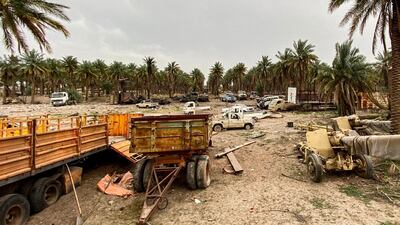
US air strikes targeting pro-Iranian military factions in Iraq killed one civilian and five security personnel early on March 13, the Iraqi military said. AFP -
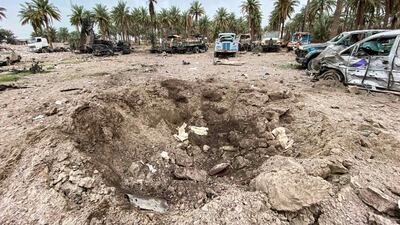
The Pentagon said the strikes were in retaliation for rocket fire against an Iraqi base the night of March 12 that killed one British and two US military personnel in the deadliest such attack in years. AFP -
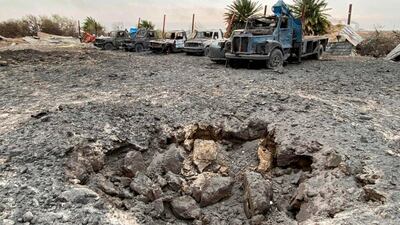
An impact crater in the aftermath of US military air strikes at a militarized zone in the Jurf Al Sakhr area in Iraq's Babylon province. AFP -
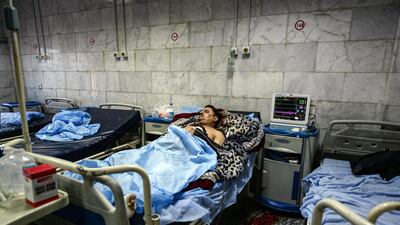
A member of the Hashed Al Shaabi paramilitaries injured in an area targeted by US military air strikes, receives treatment while lying on a bed at Hilla General Teaching Hospital in Iraq's central city of Hilla on March 13, 2020. AFP -
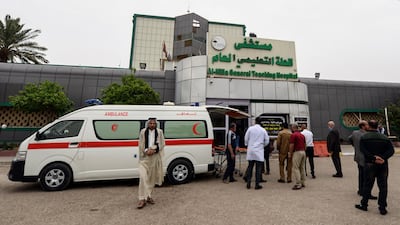
An ambulance that transported members of the Hashed Al Shaabi paramilitaries, injured in an area targeted by US military air strikes, arrives at Hilla General Teaching Hospital. AFP -
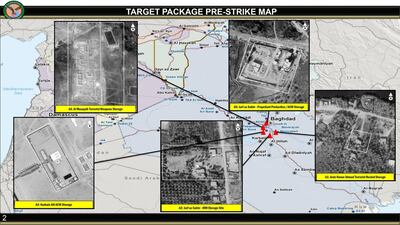
This annotated image provided by the US Department of Defense showing aerial images of sites targeted in airstrikes on Friday, March 13, 2020. US Department of Defense via AP -
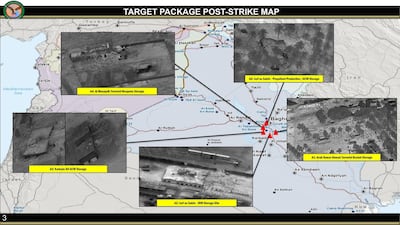
This annotated image provided by the US Department of Defense showing aerial images of sites targeted in airstrikes on Friday, March 13, 2020. US Department of Defense via AP -
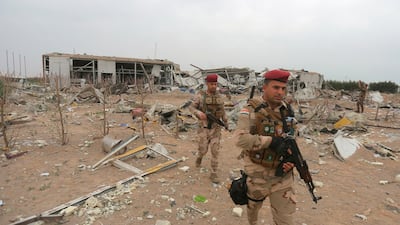
Iraqi army soldiers inspect the destruction at an airport complex under construction in Karbala. AP -

Marine Corps Gen Kenneth F McKenzie, commander of US Central Command, talks to journalists about the military response to rocket attacks that killed two US and one UK service members in Iraq. Getty Images via AFP -
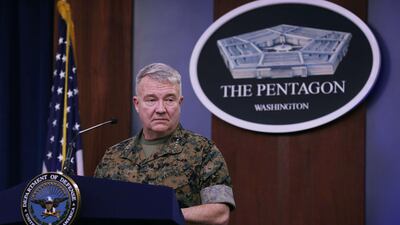
Marine Corps Gen Kenneth F McKenzie, commander of US Central Command, talks to journalists about the military response to rocket attacks that killed two US and one UK service members in Iraq. Getty Images via AFP


Half a dozen previously unknown factions have claimed similar attacks in recent months under the banner of “Islamic resistance” against the “American occupier”.
But experts say they are a smokescreen, and include former members of pro-Iranian factions of the Popular Mobilisation Forces paramilitary alliance, a state-sponsored network close to Tehran.
Civilian deaths could put the group responsible in an uncomfortable position with a public exhausted by years of violence by various militias.
The Iraqi army on Monday accused “criminal gangs and groups of outlaws” of seeking to “create chaos and terrorise people”.
Between October and July, at least 39 rocket attacks were launched on US interests in Iraq. Almost the same number has taken place since.
In total, four soldiers – two British, one Iraqi and one American – have been killed in the attacks, as have a US and an Iraqi contractor. Several civilians have been wounded.
Iraqi intelligence sources have blamed the attacks on a small group of hardline Iran-backed paramilitary factions.
Senior American officers today see pro-Iran armed groups as a greater threat than ISIS, which once held a third of Iraq.
Washington has demanded that Baghdad take decisive action. But Iraq must play a delicate balancing act with US influence and that of neighbouring Iran, which arms, finances and supports various armed Shiite factions.
US Secretary of State Mike Pompeo called Iraqi President Barham Salih this month and threatened to close the American embassy in Baghdad, Iraqi and foreign officials have said.
That was seen as a new blow to Prime Minister Mustafa Al Kadhimi, who took office in May.
While he is seen as western-leaning, US officials have accused him of not doing enough against pro-Iran groups.
One Iraqi official told AFP: “The honeymoon is over.”
The American ultimatum was followed by threats of sanctions against senior political and military figures.
Populist Shiite cleric and politician Moqtada Al Sadr has called for a commission of inquiry into the rocket attacks, a proposal backed by Mr Al Kadhimi.
The PMF paramilitary alliance has dismissed several commanders accused of links to attacks on western interests, while denying responsibility for the acts of groups claiming PMF links and “carrying out illegal military acts against foreign interests”. But more hardline groups have stepped up the anti-US rhetoric.
One western official said: “If Washington follows through and withdraws its people, these groups will be able to brag that they kicked the Americans out of Iraq at little cost.”

