Allowing the coronavirus to spread in the hope of achieving herd immunity is "unethical", the World Health Organisation chief said on Monday.
Dr Tedros Adhanom Ghebreyesus cautioned against calls in some countries to let the pandemic run its course until enough people develop the immunity to naturally halt its spread.
"Herd immunity is a concept used for vaccination, in which a population can be protected from a certain virus if a threshold of vaccination is reached," Dr Tedros said.
For measles, it is estimated that if 95 per cent of the population is vaccinated, the remaining 5 per cent will also be protected from the spread of the virus.
For polio, the threshold is estimated at 80 per cent.
"Herd immunity is achieved by protecting people from a virus, not by exposing them to it," Dr Tedros said.
"Never in the history of public health has herd immunity been used as a strategy for responding to an outbreak, let alone a pandemic."
The new coronavirus has killed almost 1.1 million and infected more than 37.5 million since it first surfaced in China late last year.
Relying on naturally obtaining herd immunity in such a situation would be "scientifically and ethically problematic", Dr Tedros said.
"Allowing a dangerous virus that we don't fully understand to run free is simply unethical. It's not an option."
He spoke of the lack of information on the development of immunity to Covid-19, including how strong the immune response is and how long antibodies remain in the body.
-

A man wearing face masks to protect against the spread of the new coronavirus walk at pier of Yokohama, near Tokyo. AP Photo -
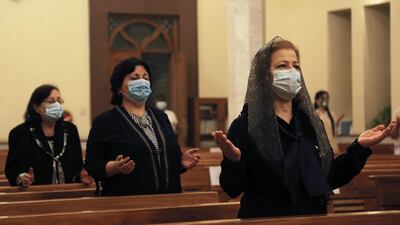
Iraqi Christians attend a Sunday service in one of the Chaldean churches that reopened after months of closure due to the coronavirus disease outbreak, in Baghdad, Iraq. REUTERS -
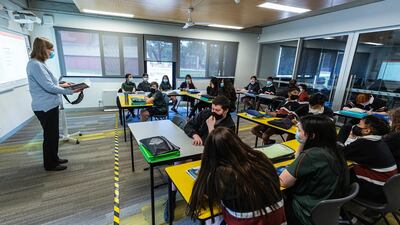
Yellow and black tape marks an area on the floor for teachers to be socially distanced from students in class at Melba Secondary College in Melbourne, Australia. All primary and high school students in Melbourne are able to return to their classrooms as of today, as part of Victoria's second step in the government's roadmap to reopening. Victoria's coronavirus restrictions were eased slightly across Melbourne from Monday 28 September. Metropolitan Melbourne has been subject to Stage 4 restrictions since 2 August 2020 in response to the re-emergence of COVID-19 in the community. Getty Images -

A 'Covid-19 Awareness Project' volunteer measures the body temperature to check on a patient infected with leprosy as part of a general health checkup for all inmates at the Gandhi Leprosy Seva Sangh rehabilitation centre, in Ahmedabad. AFP -
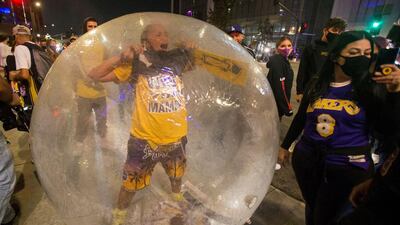
Los Angeles Lakers fans celebrate their team winning the 2020 NBA Championship against the Miami Heat, during the outbreak of Coronavirus disease in Los Angeles, California, U.S. REUTERS -

People attend a 'No Mask' protest rally 'Marcia della Liberazione' in Rome, Italy. The sit-in protest action is held against mandatory usage of face masks in public and in general against the government's management of the coronavirus Covid19 pandemic. EPA -

A man wearing a mask walks outside Seoul City Hall in Seoul, South Korea. The South Korean government decided to lower its social distancing guidelines to the lowest level on 11 October amid a noticeable slowdown in new coronavirus cases. EPA -

Officials wearing personal protective equipments (PPE) pray for the bodies of people who died due to the coronavirus disease at a crematorium in Bangli, Bali, Indonesia. REUTERS -

A Garuda Indonesia Boeing 373-800 NG with a new face mask design as part of a campaign to promote the wearing of face masks amid the Covid-19 coronavirus, is parked at the airport in Tangerang. AFP -

A COVID-19-infected patient is seen at the Intensive Care Unit, in the Emilio Ribas hospital in Sao Paulo, Brazil. On October 10, Brazil passed the bleak marker of 150,000 deaths from Covid-19, the health ministry said, as the rate of coronavirus infections continues to slow in the South American country. AFP -
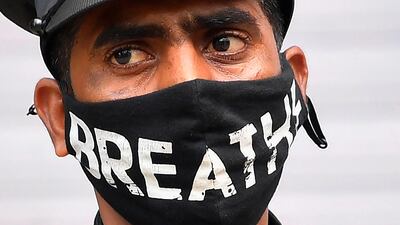
A security guard wearing a facemask as a preventive measure against the Covid-19 coronavirus is pictured in Mumbai. India's coronavirus cases surged past seven million on October 11, taking it ever closer to overtaking the United States as the world's most infected country. AFP -

Dr. Moatasem Muheisen, right and his staff throw a birthday party for their colleague Dr. Abdulbaset Zieneddin, 42, second right, in a COVID-19 testing center, at the Ramallah Recreational Complex, in the West Bank city of Ramallah. The Palestinian ministry of health transformed a sports facility into a COVID-19 testing center where health care workers provide support for residents who come forward for a consultation or a COVID-19 test during the pandemic. AP Photo -

Medical staff discuss data on a screen at the coronavirus ward of the Rambam Health Care Campus, initially built as an underground medical facility before being converted to a car park, then to a center to receive patients as COVID-19 cases surge, in the northern Israeli city of Haifa. Israel opened a new coronavirus treatment facility co-run by the army's medical corps, an unprecedented move for the military unit, aimed at bolstering an embattled healthcare system. The Jewish state currently has one of the world's highest daily coronavirus infection rates per capita, with the number of seriously ill patients steadily rising. The army-backed unit at the Rambam Hospital in the northern city of Haifa includes a control room where patients are monitored via video and an underground coronavirus ward that used to be a car park. AFP


Dr Tedros referred to cases where people are believed to have been infected with the virus a second time.
He also warned about long-term health problems of infection, which researchers are only just beginning to understand.
Fewer than 10 per cent of the population in most countries are believed to have contracted the disease, meaning most countries remain susceptible, Dr Tedros said.
"Letting the virus circulate unchecked, therefore, means allowing unnecessary infections, suffering and death."
Overall, it is estimated that 0.6 per cent of people who contract Covid-19 die from the disease, Maria Van Kerkhove, the WHO's technical lead on the virus, told Monday's briefing.
"That may not sound like a lot," Ms Van Kerkhove said.
But she said it was a lot higher than for influenza and that "the infection-fatality ratio increases dramatically with age".
While the elderly and people with underlying health conditions are clearly most likely to become seriously ill with Covid-19, Dr Tedros said they were not the only ones at risk.
"People of all ages have died," he said.
The UN agency voiced optimism at the speed at which vaccines against the virus were being developed, with 40 potential treatments in clinical trials, including 10 in late-stage Phase-3 tests.
US President Trump has repeatedly promised that a Covid-19 vaccine would be ready before next month's US elections.
But WHO chief scientist Soumya Swaminathan said the vaccines in late-stage trials were not expected to produce enough data to request regulatory approval until December at "the earliest".
"Into the early part of 2021, we expect a number of trials to start providing data for regulators to look at," Dr Swaminathan said.
After that, regulators would need to go through the data before making their decisions.
"This is going to be a lot of data and also for the WHO," she said.
Last week, Dr Tedros said a Covid-19 vaccine could be available by the end of this year.
More than 160 countries have joined the WHO's Covax vaccine facility.

