


The UK government is racing to book 28,000 rooms across Britain in one day in an attempt to launch its hotel quarantine system.
Ministers confirmed on Thursday that mandatory hotel quarantine for UK citizens and permanent residents returning from the so-called red list of countries – where there is concern about new variants of the coronavirus – will start on February 15.
The UAE is among the 33 countries on the list, which also includes all of South America and South Africa.
The start date for the system was confirmed three weeks after the policy was first floated.
Thursday’s announcement followed a day of chaos after the boss of Britain’s largest airport hotel chain said the industry had been “kept in the dark” over how the system would work.
Paul Charles, chief executive of travel consultancy The PC Agency, told The National that the policy still needed to have a clear end date.
"It's very easy for governments to put measures like this in place, removing them is another story," he said.
"Governments tend to leave border controls in place much longer than is necessary - and what's worrying the travel and aviation sectors is that there is no exit plan. We don't know the end date for this."
The opposition Labour party questioned why the system could not be established immediately and called for hotel quarantine to apply to all travellers.
The government, however, said it needed time to speak to transport operators and the hotel industry on the logistics of the scheme.
The government also held talks with Australian and New Zealand counterparts on the design of the system in those countries, which have been in place since March last year.
“We need time to prepare, we need time to make sure that this works,” foreign minister James Cleverly told Sky News on Friday.
“That’s why we’ve given the hotel industry notice, to give them time to train staff and get their rooms ready for a very different type of offer.”
Shadow finance minister Anneliese Dodds said the government’s reasoning didn’t wash, with coronavirus first detected in the UK a year ago.
The South African variant was confirmed to be in Britain 50 days ago, she said.
"We do need far quicker action," she told the Today programme on BBC Radio 4 .
“We would argue that this also needs to be far more comprehensive. Very sadly we know these new variants are coming from a variety of different countries, and we are in a race against time here. Unless we can get a much larger proportion of our population vaccinated, having the presence of these variants in the UK will make the fightback against Covid very difficult.”
The Health Department said it asked hotels near ports and airports for proposals on how they could support the system before formal contracts were awarded.
Authorities are trying to block-book 28,000 hotel rooms to meet the February 15 deadline, The Telegraph reported.
The scheme, which will run until at least March 31, will cost about £55 million ($75 million) and involve more than 60 companies in the hotel and travel industries.
The government will pay hotels and recoup the cost from travellers, who will have to pay up to £800 per person for 11 nights.
The government has asked hotel bosses to be ready to accommodate up to 1,425 passengers per day.
Hotel staff will also be asked to work with government-appointed security staff. The security guards will stay on-site and patrol both indoors and outdoors, preventing travellers from leaving the hotel early.
Hotels will have to provide three meals per day through room service, from a menu that isn’t repetitive.
Rooms will be located close to key airports and other entry points, such as Heathrow, Manchester and the Eurostar terminal in central London.
The government stopped short of asking all travellers to isolate in hotels, which countries such as Singapore, Australia and New Zealand did, emerging with dramatically lower virus death tolls than the UK.
“Blanket coverage would mean we’d be enforcing these measures on countries with very low case numbers and that would be counter-productive,” Mr Cleverly said.
In pictures - coronavirus in the UK
-
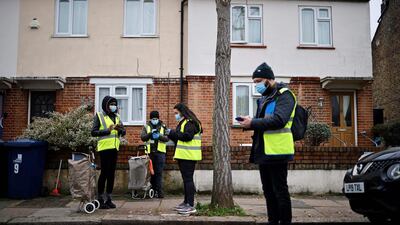
Volunteers prepare to deliver coronavirus test kits as part of surge testing for the South African variant of Covid-19, to residents in West Ealing, London. AFP -
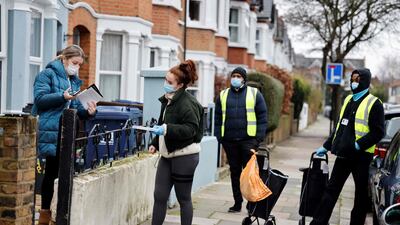
Volunteers collect completed coronavirus tests from a local resident in West Ealing. AFP -
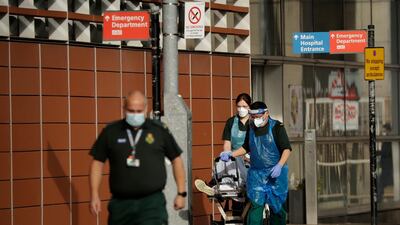
A patient is wheeled on a trolley after arriving in an ambulance outside the Royal London Hospital in east London. AP Photo -
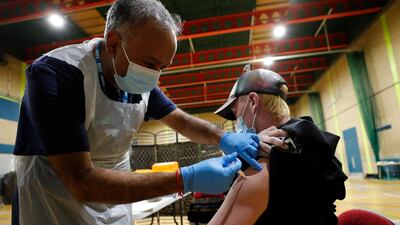
Doctor Anil Mehta gives the Oxford/AstraZeneca vaccine to a homeless person at the homeless accommodation YMCA in Romford, east London. AP Photo -

A pedestrian walks past a coronavirus information poster near a temporary testing facility at the Walsall Arena & Arts Centre in Walsall. AFP -

A member of the public takes a swab for a coronavirus test, part of surge testing for the South African variant of Covid-19, in West Ealing. AFP -
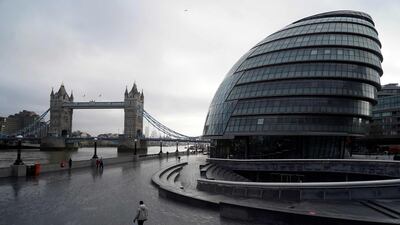
Pedestrians walk along a quiet Thames river embankment near Tower Bridge in central London. AFP -
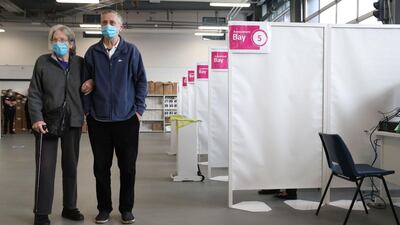
Southampton residents Peter and Margaret Brownsea wait to receive the Oxford/AstraZeneca Covid-19 vaccine at a temporary vaccine centre set up at Basingstoke Fire Station. AFP -

People queue as they wait to receive the vaccine at Crystal Palace Football Club vaccination centre in London. Reuters -
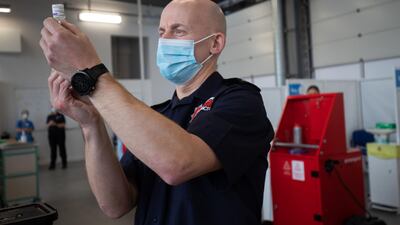
A member of the Hampshire Fire and Rescue Service prepares a dose of a AstraZeneca/Oxford Covid-19 vaccine at Basingstoke Fire Station. AFP


