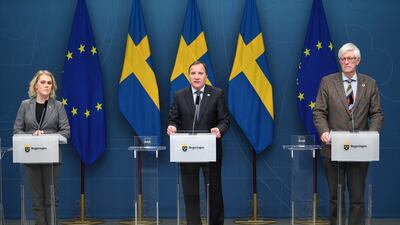
For much of the past year, Swedes relied on their own intelligence and self-awareness to combat the Covid-19 pandemic. But today that has all changed with the government imposing special powers to bring a raging wave of infection under control.
Emergency powers adopted by parliament limit private and public gatherings to no more than eight people and gives officials power to order the closure of shopping centres and shops, as well as halt public transport and other assemblies.
The move means Sweden has come some distance since early spring, when it had a non-coercive approach to prevent the spread of the disease. This worked for a time. In the summer, the country’s infection rate was higher than its Nordic neighbours Finland and Norway, but it eschewed the strict lockdowns crippling other European countries.
The Swedish model was held up by some as an example of how to avoid lockdowns and their dire economic consequences. Advocates argued an enlightened population could generally abide by the rules and still socialise, work and function. The pioneer of the strategy, Anders Tegnell, was hailed as a visionary.
Face masks were largely dismissed as unnecessary, schools stayed open and society functioned almost normally. As late as mid-October, there was still no real cause concern. The average daily infection rate was around 1,000, but this was manageable.
Then the days got colder and shorter. People went to work, shopped, ate out and stayed indoors a lot more. A month later, the infection rate shot up to 5,000 a day and it is likely to rise.
With its hands-off approach under pressure and the death toll surging from three to 60 a day, the Swedish government led by Stefan Lofven had to act. Before Christmas, public gatherings of more than eight were banned and people were asked to severely limit socialising. Danes fed up with their own strict lockdown who had flocked to Stockholm were barred, and last month, a one-year ‘pandemic law’ was proposed that hinted at a pending lockdown.
That has since been rushed through Sweden’s parliament and passed on Friday, two months before schedule. Emergency laws come into force on Sunday, giving the government powers to close down shops, gyms and public transport, and making face masks mandatory during rush-hour commuting. Those caught breaking the restrictions will be fined.
What is also apparent is that after a significant dip in infections and deaths reported over Christmas, the government is bracing itself for another wave of Covid-19 that could threaten to overwhelm its health service.
"Swedish people had the discipline, understanding and intelligence to self-impose restrictions so they have not been locked down like in Britain and they've been able to be quite sensible about it," Geert van der Vossen, a Dutchman who moved to Sweden eight years ago, told The National. "But if you look at the numbers, I don't know if Sweden is that successful and it is not one of the best countries in holding the numbers down."
Mr van der Vossen, a mechanical engineer who builds special metal flowers for each of Sweden’s pandemic victims (there have been 9,262 so far), understood that after the drop-off during festive break, the country braced for an increase. “They said in advance that the numbers would be strange because of the way the statistics work and that they have not been putting out data for a number of days.”
The Swedish establishment also faces a public backlash. In his annual Christmas address last month, King Carl XVI Gustaf said the country had failed. “We have a large number who have died and that is terrible. It is something we all have to suffer with,” he said.
His words perhaps reflect that Sweden reported more than 2,000 coronavirus deaths in the past month and 535 in the past week alone. In contrast, Norway has suffered only 465 deaths during the entire pandemic, albeit with half of Sweden’s population.
Trust in senior figures eroded after Mr Lofven had to defend his visit to a shopping centre to buy a Christmas present for his wife, despite Swedish authorities repeatedly urging people to avoid doing so. “I fully understand if people think it’s weird,” Mr Lofven told Swedish broadcaster SVT.
Then came the resignation of Dan Eliasson, who headed the government’s public safety agency that sent out text messages to millions in Sweden urging them not to travel, who quit after it was revealed he went on holiday to Spain’s Canary Islands over Christmas.
While Britain is enduring a horrific wave of infections and deaths, it is in a strict national lockdown, a potential fate that awaits Sweden and other European countries.
“Cleary, we in Britain are not in a wonderful position to be criticising Sweden but it is clear that without people having that trust in the government, and being able to comply with basic rules, irrespective of lockdown, there's going to be problems,” said Dr llan Kelman, professor of disasters and health at the University of London. “There is confusion in terms of what lockdown actually means, but Sweden is definitely moving towards European countries that are locked down.”
He also said the country was caught out by its initial liberal approach. “Sweden was very fortunate. It was during summer when they spend a lot of time outdoors and they had strong advantages in the first lockdown. But then we got into autumn and winter and, of course, people are going to spend more time indoors and less time outdoors. Unfortunately, both for UK and Sweden, that has led to the awful spikes that we're seeing.”
Any post-pandemic inquiry will analyse the words of Sweden’s high-profile chief epidemiologist Ander Tegnell, who appeared to encourage herd immunity and defended Sweden’s lax approach.
He is now preparing the country for hard times ahead. “The Swedish curve has risen more slowly, but is now almost on par with other countries,” he said earlier this week. “Considering what the spread of infection looks like, we'll probably have to reckon with there being a high number of deaths this and next week.”
His comments pave the way for a national lockdown and reinforces that Covid-19 respects neither the liberal nor the authoritarian.

How to register as a donor
1) Organ donors can register on the Hayat app, run by the Ministry of Health and Prevention
2) There are about 11,000 patients in the country in need of organ transplants
3) People must be over 21. Emiratis and residents can register.
4) The campaign uses the hashtag #donate_hope
The story in numbers
18
This is how many recognised sects Lebanon is home to, along with about four million citizens
450,000
More than this many Palestinian refugees are registered with UNRWA in Lebanon, with about 45 per cent of them living in the country’s 12 refugee camps
1.5 million
There are just under 1 million Syrian refugees registered with the UN, although the government puts the figure upwards of 1.5m
73
The percentage of stateless people in Lebanon, who are not of Palestinian origin, born to a Lebanese mother, according to a 2012-2013 study by human rights organisation Frontiers Ruwad Association
18,000
The number of marriages recorded between Lebanese women and foreigners between the years 1995 and 2008, according to a 2009 study backed by the UN Development Programme
77,400
The number of people believed to be affected by the current nationality law, according to the 2009 UN study
4,926
This is how many Lebanese-Palestinian households there were in Lebanon in 2016, according to a census by the Lebanese-Palestinian dialogue committee
Who has lived at The Bishops Avenue?
- George Sainsbury of the supermarket dynasty, sugar magnate William Park Lyle and actress Dame Gracie Fields were residents in the 1930s when the street was only known as ‘Millionaires’ Row’.
- Then came the international super rich, including the last king of Greece, Constantine II, the Sultan of Brunei and Indian steel magnate Lakshmi Mittal who was at one point ranked the third richest person in the world.
- Turkish tycoon Halis Torprak sold his mansion for £50m in 2008 after spending just two days there. The House of Saud sold 10 properties on the road in 2013 for almost £80m.
- Other residents have included Iraqi businessman Nemir Kirdar, singer Ariana Grande, holiday camp impresario Sir Billy Butlin, businessman Asil Nadir, Paul McCartney’s former wife Heather Mills.
Hunting park to luxury living
- Land was originally the Bishop of London's hunting park, hence the name
- The road was laid out in the mid 19th Century, meandering through woodland and farmland
- Its earliest houses at the turn of the 20th Century were substantial detached properties with extensive grounds
Who's who in Yemen conflict
Houthis: Iran-backed rebels who occupy Sanaa and run unrecognised government
Yemeni government: Exiled government in Aden led by eight-member Presidential Leadership Council
Southern Transitional Council: Faction in Yemeni government that seeks autonomy for the south
Habrish 'rebels': Tribal-backed forces feuding with STC over control of oil in government territory
A cryptocurrency primer for beginners
Cryptocurrency Investing for Dummies – by Kiana Danial
There are several primers for investing in cryptocurrencies available online, including e-books written by people whose credentials fall apart on the second page of your preferred search engine.
Ms Danial is a finance coach and former currency analyst who writes for Nasdaq. Her broad-strokes primer (2019) breaks down investing in cryptocurrency into baby steps, while explaining the terms and technologies involved.
Although cryptocurrencies are a fast evolving world, this book offers a good insight into the game as well as providing some basic tips, strategies and warning signs.
Begin your cryptocurrency journey here.
Available at Magrudy’s , Dh104
Specs%20
%3Cp%3E%3Cstrong%3EPower%20train%3A%20%3C%2Fstrong%3E4.0-litre%20twin-turbo%20V8%20and%20synchronous%20electric%20motor%3Cbr%3E%3Cstrong%3EMax%20power%3A%20%3C%2Fstrong%3E800hp%3Cbr%3E%3Cstrong%3EMax%20torque%3A%20%3C%2Fstrong%3E950Nm%3Cbr%3E%3Cstrong%3ETransmission%3A%20%3C%2Fstrong%3EEight-speed%20auto%3Cbr%3E%3Cstrong%3EBattery%3A%20%3C%2Fstrong%3E25.7kWh%20lithium-ion%3Cbr%3E0-100km%2Fh%3A%203.4sec%3Cbr%3E0-200km%2Fh%3A%2011.4sec%3Cbr%3E%3Cstrong%3ETop%20speed%3A%20%3C%2Fstrong%3E312km%2Fh%3Cbr%3E%3Cstrong%3EMax%20electric-only%20range%3A%3C%2Fstrong%3E%2060km%20(claimed)%3Cbr%3E%3Cstrong%3EOn%20sale%3A%3C%2Fstrong%3E%20Q3%3Cbr%3E%3Cstrong%3EPrice%3A%20%3C%2Fstrong%3EFrom%20Dh1.2m%20(estimate)%3Cbr%3E%3Cbr%3E%3C%2Fp%3E%0A
UAE currency: the story behind the money in your pockets
Jetour T1 specs
Engine: 2-litre turbocharged
Power: 254hp
Torque: 390Nm
Price: From Dh126,000
Available: Now
The low down on MPS
What is myofascial pain syndrome?
Myofascial pain syndrome refers to pain and inflammation in the body’s soft tissue. MPS is a chronic condition that affects the fascia (connective tissue that covers the muscles, which develops knots, also known as trigger points).
What are trigger points?
Trigger points are irritable knots in the soft tissue that covers muscle tissue. Through injury or overuse, muscle fibres contract as a reactive and protective measure, creating tension in the form of hard and, palpable nodules. Overuse and sustained posture are the main culprits in developing trigger points.
What is myofascial or trigger-point release?
Releasing these nodules requires a hands-on technique that involves applying gentle sustained pressure to release muscular shortness and tightness. This eliminates restrictions in connective tissue in orderto restore motion and alleviate pain. Therapy balls have proven effective at causing enough commotion in the tissue, prompting the release of these hard knots.
Company profile
Date started: 2015
Founder: John Tsioris and Ioanna Angelidaki
Based: Dubai
Sector: Online grocery delivery
Staff: 200
Funding: Undisclosed, but investors include the Jabbar Internet Group and Venture Friends
First Person
Richard Flanagan
Chatto & Windus
The smuggler
Eldarir had arrived at JFK in January 2020 with three suitcases, containing goods he valued at $300, when he was directed to a search area.
Officers found 41 gold artefacts among the bags, including amulets from a funerary set which prepared the deceased for the afterlife.
Also found was a cartouche of a Ptolemaic king on a relief that was originally part of a royal building or temple.
The largest single group of items found in Eldarir’s cases were 400 shabtis, or figurines.
Khouli conviction
Khouli smuggled items into the US by making false declarations to customs about the country of origin and value of the items.
According to Immigration and Customs Enforcement, he provided “false provenances which stated that [two] Egyptian antiquities were part of a collection assembled by Khouli's father in Israel in the 1960s” when in fact “Khouli acquired the Egyptian antiquities from other dealers”.
He was sentenced to one year of probation, six months of home confinement and 200 hours of community service in 2012 after admitting buying and smuggling Egyptian antiquities, including coffins, funerary boats and limestone figures.
For sale
A number of other items said to come from the collection of Ezeldeen Taha Eldarir are currently or recently for sale.
Their provenance is described in near identical terms as the British Museum shabti: bought from Salahaddin Sirmali, "authenticated and appraised" by Hossen Rashed, then imported to the US in 1948.
- An Egyptian Mummy mask dating from 700BC-30BC, is on offer for £11,807 ($15,275) online by a seller in Mexico
- A coffin lid dating back to 664BC-332BC was offered for sale by a Colorado-based art dealer, with a starting price of $65,000
- A shabti that was on sale through a Chicago-based coin dealer, dating from 1567BC-1085BC, is up for $1,950
The Gentlemen
Director: Guy Ritchie
Stars: Colin Farrell, Hugh Grant
Three out of five stars
