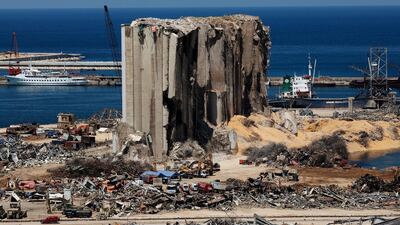
A German Bundestag member has called on the European Union to ban the Iran-backed militia Hezbollah following the devastating explosion in Beirut.
Bijan Djir-Sarai, a foreign policy spokesman for the centre-right Free Democratic Party (FDP), has said Brussels needs to “face reality” especially amid the fallout from the August 4 explosion in Beirut’s port, which killed at least 177 people.
"The explosion drew attention to the role of foreign, non-state actors within the fragile fabric of Lebanon," Mr Djir-Sarai wrote in the German newspaper Die Welt.
“It is well known that both the port of Beirut and the airport are under the control of the Tehran-controlled Shiite Hezbollah militia. The Islamist organisation has a firm grip on the country,” he added.
Germany banned all activity by Hezbollah on its soil and designated the group a terrorist organisation in April this year.
The EU, however, has differentiated between Hezbollah’s military and political wings in its dealings with the group.
In 2012 Brussels placed a ban on Hezbollah’s military activities after a suicide bombing that killed six people. The bloc did not impose sanctions on the group as a whole.
Politicians and experts across Europe have insisted there is no distinction between Hezbollah’s political and military activities while others have expressed concerns that such a ban could harm diplomatic relations with the Lebanon.
“It would be a mistake not to use this window of international attention and leave Lebanon to its fate, its failure” Mr Djir-Sarai, who grew up in Iran, wrote.
“It is also now time to promote Hezbollah's classification as a terrorist organisation at EU level,” he added.
Hezbollah has denied a role in the Beirut explosion. However, much public anger following the blast has been aimed at the Islamist group and Lebanon’s political elite.
On Tuesday a special tribunal in the Netherlands established that a Hezbollah member was responsible for the 2005 killing of former Lebanese prime minister Rafik Hariri. However the court did not find evidence of Hezbollah leadership’s involvement.

Ten tax points to be aware of in 2026
1. Domestic VAT refund amendments: request your refund within five years
If a business does not apply for the refund on time, they lose their credit.
2. E-invoicing in the UAE
Businesses should continue preparing for the implementation of e-invoicing in the UAE, with 2026 a preparation and transition period ahead of phased mandatory adoption.
3. More tax audits
Tax authorities are increasingly using data already available across multiple filings to identify audit risks.
4. More beneficial VAT and excise tax penalty regime
Tax disputes are expected to become more frequent and more structured, with clearer administrative objection and appeal processes. The UAE has adopted a new penalty regime for VAT and excise disputes, which now mirrors the penalty regime for corporate tax.
5. Greater emphasis on statutory audit
There is a greater need for the accuracy of financial statements. The International Financial Reporting Standards standards need to be strictly adhered to and, as a result, the quality of the audits will need to increase.
6. Further transfer pricing enforcement
Transfer pricing enforcement, which refers to the practice of establishing prices for internal transactions between related entities, is expected to broaden in scope. The UAE will shortly open the possibility to negotiate advance pricing agreements, or essentially rulings for transfer pricing purposes.
7. Limited time periods for audits
Recent amendments also introduce a default five-year limitation period for tax audits and assessments, subject to specific statutory exceptions. While the standard audit and assessment period is five years, this may be extended to up to 15 years in cases involving fraud or tax evasion.
8. Pillar 2 implementation
Many multinational groups will begin to feel the practical effect of the Domestic Minimum Top-Up Tax (DMTT), the UAE's implementation of the OECD’s global minimum tax under Pillar 2. While the rules apply for financial years starting on or after January 1, 2025, it is 2026 that marks the transition to an operational phase.
9. Reduced compliance obligations for imported goods and services
Businesses that apply the reverse-charge mechanism for VAT purposes in the UAE may benefit from reduced compliance obligations.
10. Substance and CbC reporting focus
Tax authorities are expected to continue strengthening the enforcement of economic substance and Country-by-Country (CbC) reporting frameworks. In the UAE, these regimes are increasingly being used as risk-assessment tools, providing tax authorities with a comprehensive view of multinational groups’ global footprints and enabling them to assess whether profits are aligned with real economic activity.
Contributed by Thomas Vanhee and Hend Rashwan, Aurifer
The%20Emperor%20and%20the%20Elephant
%3Cp%3E%3Cstrong%3EAuthor%3A%20%3C%2Fstrong%3ESam%20Ottewill-Soulsby%3C%2Fp%3E%0A%3Cp%3E%3Cstrong%3EPublisher%3A%20%3C%2Fstrong%3EPrinceton%20University%20Press%3C%2Fp%3E%0A%3Cp%3E%3Cstrong%3EPages%3A%20%3C%2Fstrong%3E392%3C%2Fp%3E%0A%3Cp%3E%3Cstrong%3EAvailable%3A%20%3C%2Fstrong%3EJuly%2011%3C%2Fp%3E%0A
