Despite vaccine concerns, the roadmap to easing restrictions in England continued as planned with stage two taking effect on Monday. On roads and pavements throughout the country, it seems more people than ever were taking two wheels en route to long-overdue haircut appointments and refreshing meetings with friends and family at outdoor establishments.
That's not just down to the spring weather. Recent research suggests the more frequent decision to cycle is actually a result of government spending projects. According to a paper published earlier this month in PNAS, provisional or 'pop-up' infrastructure implemented due to Covid-19 increased cycling by up to 48 per cent on average in cities across Europe and the UK early in the pandemic, a trend which continues.
-

Cyclists ride across Tower Bridge during the evening rush hour in London, England, in July 2020. Getty Images -
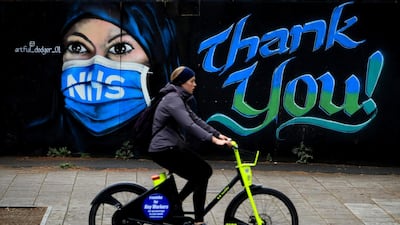
A woman cycles past a piece of street art thanking the NHS in London, England. Getty Images -

A cyclist passes along Oxford Street where barriers have been installed to widen the pavement to enable social distancing in London, England. Getty Images -

A cyclist negotiates a cycle-friendly roundabout in Cambridge, England. The roundabout was unveiled in July 2020 and is the first of its kind in the UK. Getty Images -

A cyclist rides past the Eiffel Tower on one of the 20,000 Velib rental bikes available in Paris, France. Getty Images -

Paris authorities have encouraged cycling as a safer, and more environmentally friendly form of transport away from crowded buses and metro trains as they continue to try to halt the spread of Covid-19. Getty Images -

A cyclist rides past the building site of VenTo, a 679km cycle path linking Venice to Turin and other major cities of Northern Italy. Getty Images -

King Willem-Alexander of The Netherlands and Queen Maxima ride on bicycles as they visit ECOstyle, Biosintrum and EcoMinutypark. Getty Images -

Bike mechanics work in customized bikes store "8bar" in Berlin, Germany. As Covid-19 discourages the use of buses and subways, demand on bikes is on the rise. Getty Images -
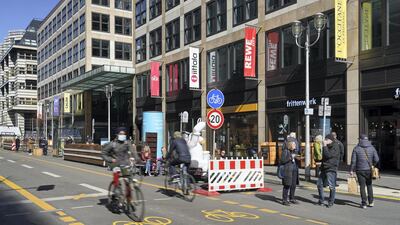
People cycle on Friedrichstrasse shopping street in Berlin, Germany, which has been turned into a bicycle street free of cars. Getty Images


“The benefits of cycling are manifold,” said Sebastian Kraus, a policy analyst at the Mercator Research Institute on Global Commons and Climate Change, who led the study. “It is a very efficient means of transport. It’s healthy, and the infrastructure is very cheap.”
On the municipal government level it just makes economic sense, he argued. “Compared to buying a bus or building a metro, it’s as efficient as it gets. You don’t see traffic jams of cyclists."
It seems cycling is a practice in which many European governments have been happy to invest. The European Cyclist Federation said almost €1.7 billion ($2.03bn) has been allocated for pandemic-era cycling infrastructure with more than 1,400 kilometres of cycle lanes created.
Jill Warren, chief executive of the ECF, sees the investments made during Covid as necessary for the present and promising for the future. “In the first lockdown in spring 2020, streets across the continent were tranquil and deserted. Citizens took advantage of this to cycle more, or even cycle for the first time.
“Cities realised people would need a healthy and socially distanced means of commuting and exercising post-lockdown, and moved swiftly to enable more and safer cycling with pop-up cycle lanes and other measures.”
Cycling lanes, which take up less space per capita than most other forms of transportation, pay for themselves. Mr Kraus said that new pop-up lanes would likely generate significant health benefits – with projected annual savings for European health care of between $1bn and $7bn should the increase in cycling stick. That doesn’t even include benefits from reduced emissions and avoided Covid-19 transmissions.
Ms Warren hopes these gains will be maintained in future. “In a post-Covid Europe, more cycling will make an essential contribution to climate neutrality, to improved public health and citizens’ well-being, to more liveable public spaces and to more vibrant local economies.”
A new normal?
As Britain eases cautiously out of lockdown, much of Europe is weaving through a third wave of infections. For many essential workers without a car, cycling remains a necessary safety measure. Eventually, the pandemic will end. But will the cycling boom continue?
“We know that mobility behaviour doesn’t change so easily, but once people change their habits, then they stick to new habits,” Mr Kraus said.
Behavioural research into public transport seems to concur. A study, published in the Quarterly Journal of Economics in 2017, found that a two-day London tube strike in February 2014 forced commuters to reconsider their usual routes – and that a significant number stuck with their new commute permanently. Ms Warren thinks the pandemic might have an even greater effect.
“Cycling levels have increased markedly, and cities and countries are already making investments and commitments to build more permanent cycling infrastructure. This makes me very optimistic that many of the gains made in cycling will be maintained in future and that we will continue to shift our entire mobility system towards much more cycling and active mobility.”

Contemporary data support her optimism. UK cycling is near pre-pandemic levels, and was above normal in the week preceding Easter. Elsewhere in Europe the story is similar, as urban dwellers grow accustomed to a new, convenient mode of getting around. Late last year, Munich residents campaigned against a proposed reduction of of pop-up bike lanes – with the result that some were kept.
Roadblocks
The nature of transport has fundamentally changed during Covid-19, and not always for the better. Britons are driving more now than earlier in lockdown, according to government data, while London tube and bus passenger levels are around 30 per cent and 50 per cent of normal, respectively. Commuters still seem spooked by public transport, a pandemic habit that may prove difficult to break.
The possibility of a new normal where individual modes of transport, like cycling and driving, are more prevalent would mean mixed outcomes for society. Ultimately though, if governments are paying attention to the data, they will see cycling as a worthwhile investment – one that Mr Kraus argues should be encouraged even after the pandemic ends.
“If you look at it from an economist’s point of view, there’s nothing better than building a cycle lane and getting people on bikes.”

