

The European Union has vowed to intensify efforts to save the 2015 Iran nuclear deal, after Tehran took another step towards being able to develop an atom bomb.
Brussels noted “with deep concern” Iran’s decision to begin enriching uranium to levels not seen since the 2015 pact with world powers, the bloc’s foreign affairs spokesman Peter Stano said.
He said the move at the underground Fordo facility "will have serious implications when it comes to nuclear non-proliferation".
"We will redouble our efforts to preserve the agreement and return to its full implementation by all parties," Mr Stano said.
Iran breached the limits set out by the agreement – officially known as the Joint Comprehensive Plan of Action – in 2019 after US President Donald Trump withdrew the US from the deal the year before and enacted heavy sanctions on Tehran.
The other parties to the accord, such as the EU, UK, France and Germany have been desperately trying to keep it alive.
Last week, Iran informed the UN’s nuclear watchdog that it intended to begin enriching uranium to 20 per cent purity – higher than the 3.67 per cent limit allowed under the pact, but significantly lower than the 90 per cent required for an atom bomb.
The development came after troops from Iran's Islamic Revolutionary Guard Corps seized a South Korean vessel on Monday in the Arabian Gulf.
-
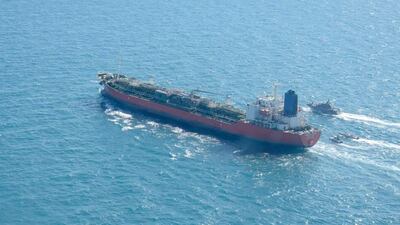
Iranian attack boats guide the Hankuk Chemi toward the Iranian port of Bandar Abbas on January 4, 2021, in aerial images published by Iranian authorities. AFP / Tasnim News -
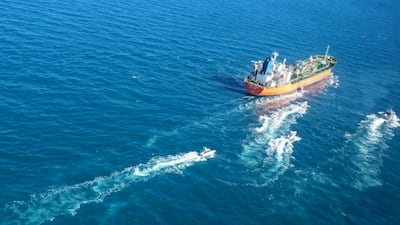
Iranian state television claim the South Korean-flagged vessel was responsible for 'environmental pollution' - but the seizure was widely seen as the latest harassment of a merchant vessel by Tehran's government. AFP / Tasnim News -

A US Marine watches an Iranian fast attack craft from the deck of the USS John P Murtha in the Strait of Hormuz in July, 2019. The US and its allies routinely patrol the narrow 30km strait as Tehran continues to harass maritime oil and gas tankers. US Navy via Reuters -
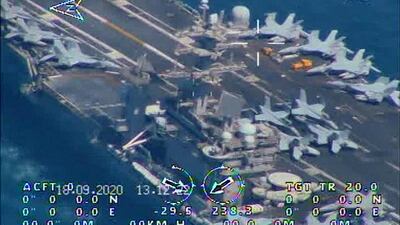
Iran has published a series of mock-up attacks and threats against US forces. This handout photo from Iran's Revolutionary Guard Corps (IRGC) shows it apparently targeting the USS Nimitz in September, 2020. AFP / Iran's Revolutionary Guard -
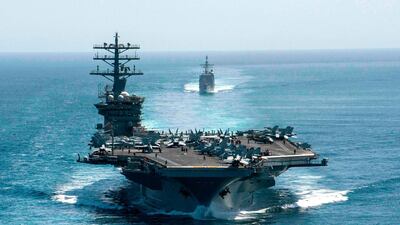
The USS Nimitz and the guided-missile cruiser USS Philippine Sea pass through the Strait of Hormuz on September 18, 2020. The aircraft carrier's deployment was extended on January 3, 2021 in the wake of threats from Iran on the first anniversary of the killing of Iranian military leader Qasem Soleimani. AP -
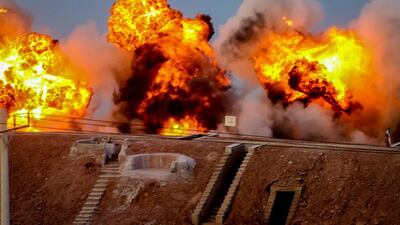
Iranian media shows a series of explosions during Iranian military exercises near the Strait of Hormuz in July, 2020. AFP -
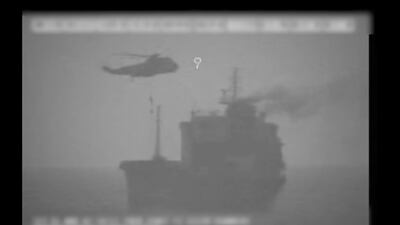
Iranian commandos fast-rope down from a helicopter onto the MV Wila in the Gulf of Oman on August 12, 2020. The Liberian-flagged oil tanker was held for five hours before being released in an operation designed to harass maritime vessels. US Military Central Command via AP -

The Royal Navy's HMS Montrose escorts two vessels through the Strait of Hormuz in July, 2019. AFP -
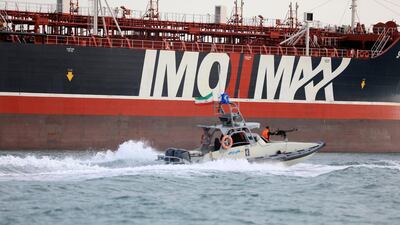
The Stena Impero tanker was seized by Iran in July 2019 and held for two months in the Iranian port of Bandar Abbas, before being released. AP -
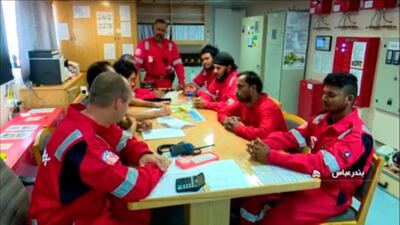
Iranian state media shows the crew of the Stena Impero while held captive in July, 2019. It was released in September, 2019. AFP -
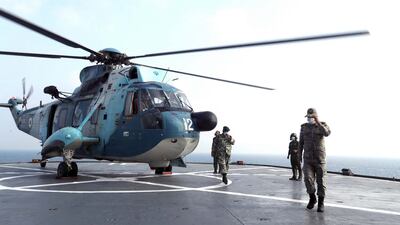
A handout photo made available by Iranian Army website shows an Iranian helicopter lands on a warship during a military exercise in the Arabian Gulf in September, 2020. EPA -
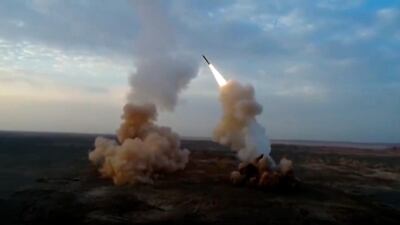
Underground ballistic missiles fired by the Iranian Revolutionary Guard during a military exercise involving a mock-up aircraft carrier in the Strait of Hormuz. AP


“It is vital that freedom of navigation is maintained and that trade is able to safely pass through international waters in this region, including the Strait of Hormuz, one of the world’s busiest and most important waterways,” said a spokesperson from the UK’s Foreign, Commonwealth and Development Office.
Tensions between Tehran and Seoul have heightened in recent months over Iranian funds frozen in South Korean banks because of US sanctions.
Iran has increased pressure on South Korea to unlock around $7 billion, which it says was earned before the US widened sanctions on Tehran's oil exports.

