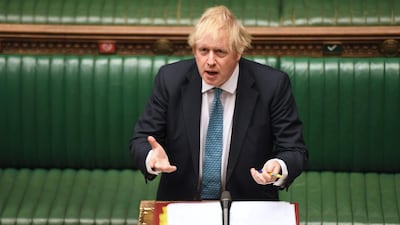
Boris Johnson, the British prime minister, has been called to account for deaths in UK care homes during the Covid-19 outbreak and grilled over his government’s advice during the pandemic as recriminations grow across Europe over why it is the worst hit region.
In an uncharacteristically subdued and socially distanced House of Commons, Mr Johnson was asked by opposition leader Keir Starmer for the government's view on the 10,000 "unexplained" excess deaths in care homes in April.
"This year the number of deaths in care homes for April was a staggering 26,000 - that's three times the average - 18,000 additional deaths this April,” Mr Starmer said.
"Using the government's figures only 8,000 are recorded as Covid deaths, that leaves 10,000 additional and unexplained care home deaths this April.”
The leader of the UK’s centre-left opposition Labour party questioned the British prime minister over his government’s advice to care homes when it claimed in March that it was “very unlikely” people in care homes would become infected.
-
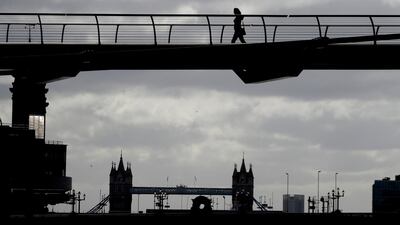
A pedestrian walks across the Millennium Bridge over the River Thames in London, the day after Prime Minister Boris Johnson announced plans to let more people go to work. AP -
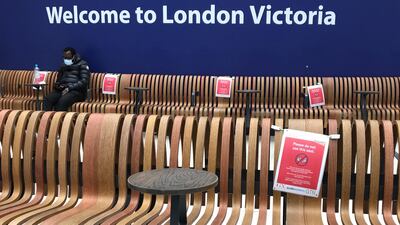
Seats display social-distancing signs at London's Victoria Station, one of the capital's busiest transport centres. AP -

Pedestrians cross the road on Southwark Bridge during the morning rush hour. AP -
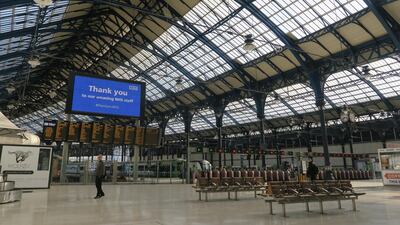
In Brighton, on the South Coast, the usually busy commuter rail station was very quiet. Getty -
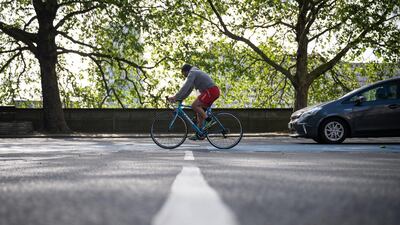
Commuters use cycle lanes as they travel into London. Getty Images -

Traffic flows on the Embankment during the morning rush hour in London. AP -
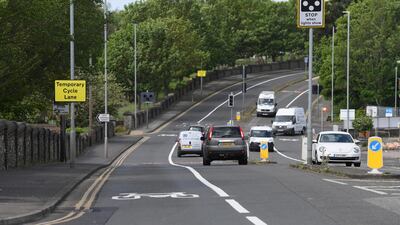
A temporary cycle lane has been created in Brighton to help persuade people to not use public transport Getty


Mr Johnson defended his record on care homes saying they had been locked down long before nationwide restrictions had been imposed.
After prime minister’s questions were over, Downing Street hit out Mr Starmer briefing saying he had "inaccurately and selectively" quoted from official guidance.
Mr Johnson and his government have come been heavily criticised for their handling of the coronavirus outbreak. Britain now has the highest number of fatalities from the disease in Europe and the second highest death toll in the world after the United States.
Mr Starmer also questioned why the government had stopped making comparisons between Britain’s Covid-19 deaths and fatalities in other countries, implying that the contrast put the UK in an unfavourable light.
Britain, as has been the case in other European nations, announced a modest relaxation of its lockdown measures.
The European Union pushed on Wednesday for a gradual reopening of borders within the bloc shut by the coronavirus.
The EU commission urged a return to "unrestricted free movement" within Europe, with plans that include requiring face masks on airplanes and social distancing on trains.
"Our thoughts are now turning toward summer and to the places that we love to travel," said Executive Vice President of the European Commission Margrethe Vestager, who presented the proposals. "That means taking gradual, careful steps to help travel restart in line with what science tells us."
However, different European nations have been resistant to opening borders. Austria, for instance has resisted reopening borders with Italy – one of the world's hardest-hit countries, with more than 220,000 infections and 30,000 plus deaths.
Austria said its border with Germany would reopen fully on June 15, and that border checks would be reduced starting Friday. Chancellor Sebastian Kurz said Austria was aiming for similar agreements with Switzerland, Liechtenstein and its eastern neighbours "as long as the infection figures allow".
Sweden, which has imposed notably relaxed internal lockdown measures, has said it will not reopen its borders until July 15.
In Germany, which has been held up as a model for dealing with the coronavirus outbreak, Chancellor Angela Merkel said it was her goal to reopen borders across the Schengen area from June 15.
"The goal is, if the occurrence of infections allows it - I want to say that again - that from June 15, border controls in the Schengen area can be completely eliminated," Mrs Merkel said.
She also urged Germans not to rush back to normal life too fast even as plans for some border reopenings were announced.
“Corona remains a danger for everyone of us," Mrs Merkel explained. "It would be depressing if we have to return to restrictions that we want to leave behind us because we want too much too soon."

