The British Prime Minister's office said it was "very likely" a Brexit trade deal would not be secured without significant changes in Brussels' position, after Boris Johnson spoke to EU chief Ursula von der Leyen.
"The Prime Minister underlined that the negotiations were now in a serious situation," Downing Street said.
"Time was very short and it now looked very likely that agreement would not be reached unless the EU position changed substantially."
Ms von der Leyen said on Twitter there had been "substantial progress" during the call, but admitted challenges remain.
Negotiations will continue tomorrow, she said.
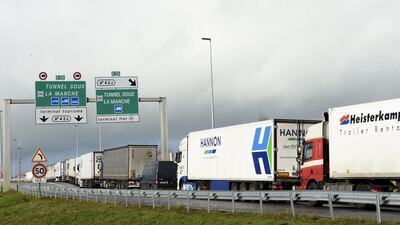
Meanwhile, a rush of lorries heading to the UK from France before Brexit has created gridlock at the Channel Tunnel at Calais.
Traders are hurrying to move goods across the border as the trade deal between the UK and the EU hangs in the balance.
The UK is set to leave the EU’s single market on December 31 after the transition period ends.
EU chief negotiator Michel Barnier said “good progress” had been made despite the remaining sticking points.
But European Parliament leaders said they would need to see the text of a deal by Sunday for it to be ratified by the end of the year.
If a deal were not struck by December 31, the UK would have to trade with its largest trading partner on World Trade Organisation rules, with taxes on goods bought and sold between the two sides, possibly inflating prices.
Also a problem are the tailbacks at the border as lorries undergo Customs checks, creating delays.
In a sign of what could be to come, there were more than 5 kilometres of lorries queueing to access the tunnel on Thursday.
Officials have repeatedly warned of difficult weeks ahead, with the Channel the centre of trade between Britain and Europe.
Usually November is the peak month as traders prepare for Christmas, but this year it is December as businesses on both sides stockpile before Britain's exit from the single market.
Problems have also been exacerbated by disruptions to the supply chain, brought on by coronavirus.
"Yesterday (Wednesday) was the all-time record," said Francois Schira, the senior local official in charge of Brexit preparations.
Mr Schira said that on Wednesday, 9,000 heavy goods vehicles had arrived to cross to England, compared with the normal 5,000 to 6,000.
"The traffic is only increasing," he said. "Many heavy goods vehicles could not board yesterday, parked near by and rushed to try to board this morning.
"This immediately created a traffic jam and we could not regulate the influx. This morning the situation is very complex to manage."
-
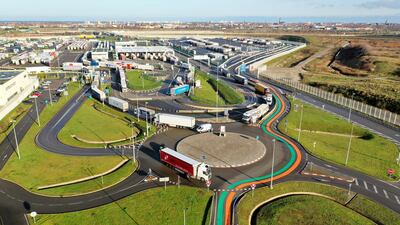
Orange and green lanes for entry into France and the EU are painted on the road as new customs infrastructure forms in case of "no deal" Brexit at Eurotunnel terminal in Coquelles, near Calais. Reuters -

Trucks queue on the A26 highway in Nort-Leulinghem, near Calais, northern France, as Britain prepares to leave the European Union. Reuters -
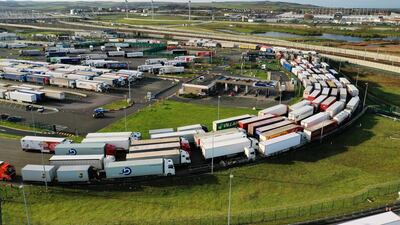
Trucks queue to embark aboard the freight shuttle at Eurotunnel terminal in Coquelles near Calais, France. Reuters -
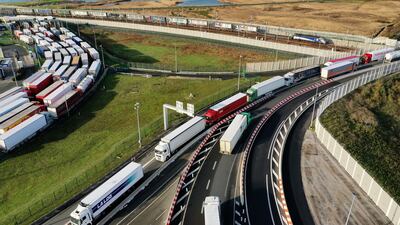
Trucks queue at the Eurotunnel terminal in Coquelles near Calais. Reuters -
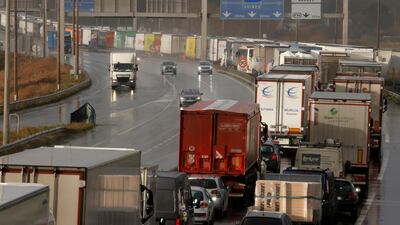
Trucks queue on the A16 highway to enter the Channel tunnel in Calais. Reuters -
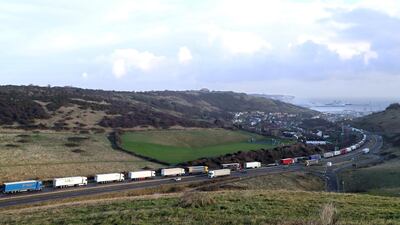
Lorries queue for the Port of Dover along the A20 in Kent, England. AP Photo -
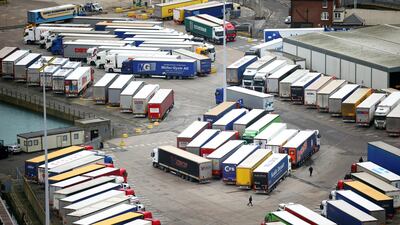
Lorries are parked up in the Port of Dover. Reuters -
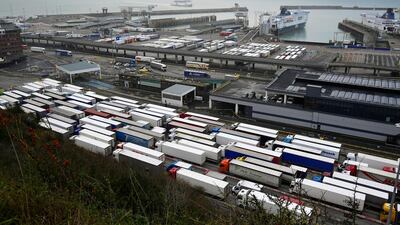
Lorries prepare to enter the Port of Dover to board ferries to Europe. Reuters


Sebastien Rivera, secretary general of the regional road transport federation, estimated there were "between 15 and 20 hours more waiting than usual" for a return trip.
Meanwhile, UK Cabinet Office Minister Michael Gove said the chance of Britain striking a deal before December 31 was “less than 50 per cent”.
Mr Barnier was more upbeat: "Good progress, but the last stumbling blocks remain. We will only sign a deal protecting EU interests and principles."

