


The world is facing a litany of challenges that are “piling up like cars in a chain-reaction crash”, UN Secretary General Antonio Guterres told the World Economic Forum in Davos.
In a rousing speech at the Swiss ski resort on Wednesday, he painted a bleak outlook for the world, which he said was “looking into the eye of a category 5 hurricane.”
The urgency of the fight against climate change, apart from the lack of action by governments and companies, is among the most concerning of issues at hand, he said.
The world’s lack of preparation for future pandemics, the war in Ukraine, geopolitical tension and the cost-of-living crisis are also contributing to what is a distressing concoction, the UN chief said.
Mr Guterres, 73, suggested that apathy among world leaders meant that the target of limiting global warming to 1.5ºC above pre-industrial levels appears to be “nearly going up in smoke”.
He said the world was heading towards a 2.8ºC increase in warming, the consequences of which would be “devastating”.

The 1.5ºC target was established in the 2015 Paris Climate Agreement, an accord that aims to “limit global warming to well below 2ºC, preferably to 1.5ºC degrees above pre-industrial levels.
Greenhouse gas emissions are at record levels and while companies are increasingly pledging to cut their pollution to as close as possible to zero, the benchmarks and criteria they use “are often dubious or murky”, Mr Guterres said.
“It leaves the door wide open to greenwashing,” he said, referring to unsubstantiated claims by some firms that their products are not harmful to the environment.
He urged business leaders in Davos to follow the principles outlined by the UN and the International Organisation for Standardisation to make “credible”, accountable net-zero pledges.
The guidelines were launched in November to become a reference text and help companies to come up with solid plans and avoid slogans, hype and obfuscation.
Mr Guterres urged the participants to “put forward credible and transparent transition plans on how to achieve net zero — and submit those plans before the end of this year”.
“The transition to net-zero must be grounded in real emissions cuts — and not rely on carbon credits and shadow markets,” he said.
And in a stark warning to decision makers, he said: “We are flirting with climate disaster. Every week brings a new climate horror story.
“The climate threat coming to a point of no return. There is lack of urgency among governments.”
Mr Guterres said “we have to confess that the battle is being lost” as he called on governments and the private sector to step up efforts in the fight against climate change.
He said the climate crisis and other challenges facing the world formed the “worst situation of my lifetime”.
On geopolitical divisions, he said there was a climate of mistrust among key players on the world stage.
He mentioned the West-East divide between the US and China as having far-reaching effects, while the North-South divide between rich and poor nations continued to grow bigger.
Mr Guterres urged the G20 to put forward a new plan to help developing countries on their paths to economic stability.
The “outlook is bleak” in terms of how the global economic crisis is affecting nations, and said women and girls stand to suffer the most, the UN chief said.
On health, he said Covid-19 was “still straining economies” and said it was regrettable that countries were failing to prepare for future pandemics because they had not learnt any lessons.
“We are nowhere near ready for the pandemics to come,” he said.
Global challenges are all interlinked, he said, and are “piling up like cars in a chain-reaction crash”.
“I am no here to sugar coat the scale of that challenge,” he said, adding that he was also not bemoaning “the sorry state of our world”.
“There are no perfect solutions in a perfect storm but we can work to control damage and to seize the opportunities available.”
World Economic Forum in Davos — in pictures
-
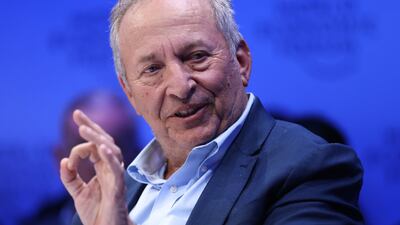
Lawrence Summers, president emeritus and professor at Harvard University, speaks during a panel session on day three of the World Economic Forum's Annual Meeting in Davos, Switzerland. Bloomberg -
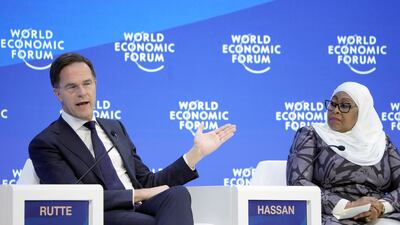
Netherlands Prime Minister Mark Rutte and Tanzanian President Samia Hassan during a panel discussion in Davos. AP -
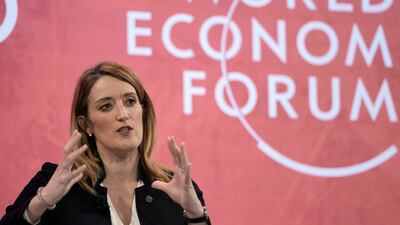
EU Parliament President Roberta Metsola speaks at the forum. AP -

Greek Prime Minister Kyriakos Mitsotakis, left, speaks to CNN journalist Fareed Zakaria at the Congress Centre in Davos. AFP -
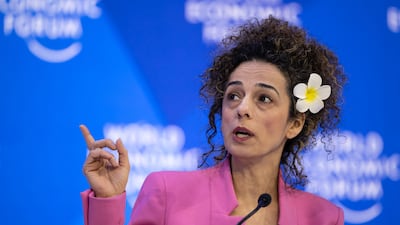
Iranian-American journalist and women's rights activist Masih Alinejad takes part in an interview with a TV news channel in Davos. AFP -
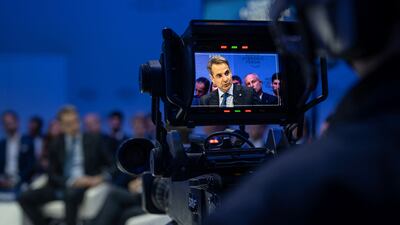
Mr Mitsotakis is seen on a TV camera viewfinder at the Congress Centre in Davos. AFP -
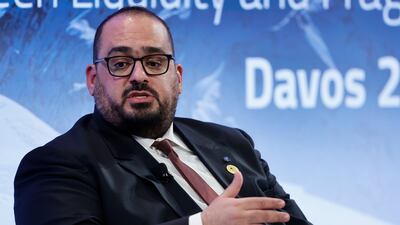
Faisal Alibrahim, Saudi Arabia's Economy and Planning Minister, speaks during a panel session in Davos. Bloomberg -

Climate activist Greta Thunberg addresses journalists in Davos. Reuters -
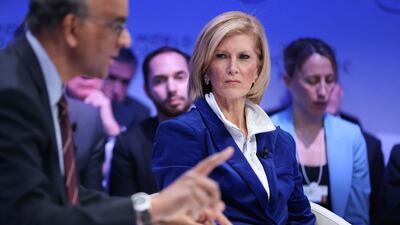
Mary Erdoes, chief executive of JP Morgan Chase's asset wealth management arm, listens during a panel session in Davos. Bloomberg -
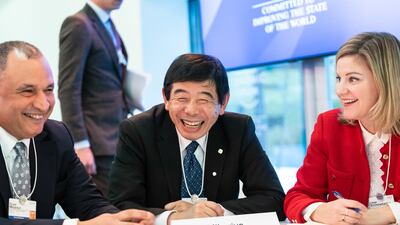
Officials take part in the World Economic Forum's Busting Business Barriers session. Photo: World Economic Forum -
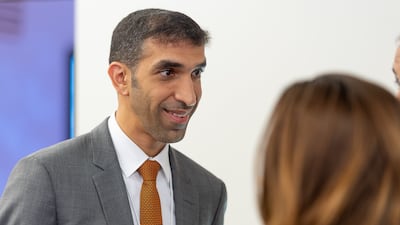
Dr Thani Al Zeyoudi, the UAE Minister of State for Foreign Trade, is among the senior officials in Davos. Photo: WEF -

Former US vice president Al Gore, who is also a member of board of trustees of the forum, at a session titled Leading the Charge through Earth's New Normal. Photo: WEF -
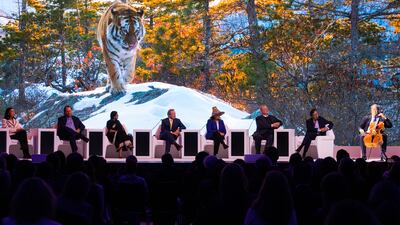
Famed cellist Yo-Yo Ma performs at the event. Photo: WEF -
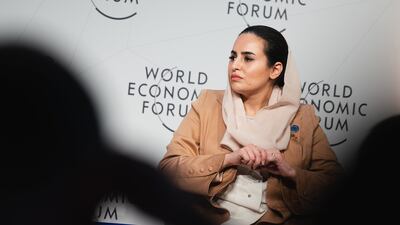
Deemah Al Yahya, secretary general of the Digital Co-operation Organisation in Saudi Arabia, at the forum's Turning Technologies into the Markets of Tomorrow session. Photo: WEF -
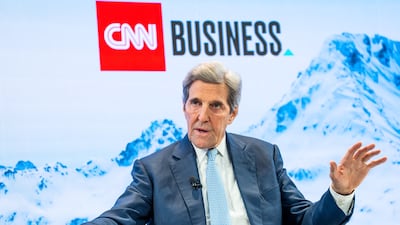
US climate change envoy John Kerry at the Keeping the Pace on Climate session. Photo: WEF -
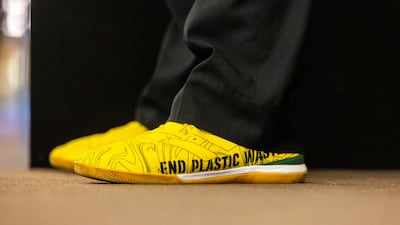
Shoes worn by Rodrigo Oliveira, founder of Brazilian group Green Mining, emphasise support for environmental initiatives. Photo: WEF -
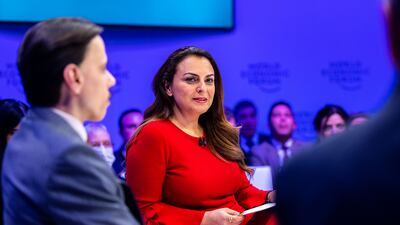
Mina Al-Oraibi, Editor in Chief of The National, moderates a session on the Middle East that featured Prince Faisal bin Farhan, Saudi Arabia's Minister of Foreign Affairs. Photo: WEF -
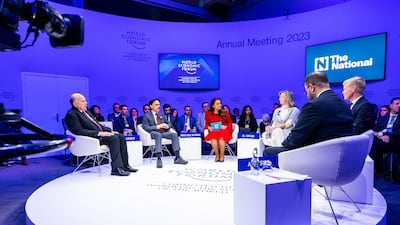
Officials and delegates take part in the Middle East: Meeting Point or Battleground? session. Photo: WEF -
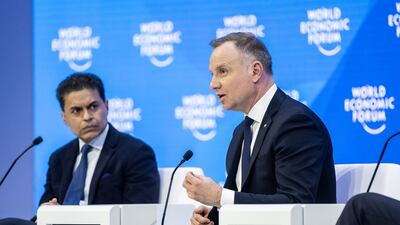
Polish President Andrzej Duda speaks at the Restoring Security and Peace session. Photo: WEF -
Mr Duda, Nato chief Jens Stoltenberg, Canada's Deputy Prime Minister Chrystia Freeland, Yuliia Svyrydenko, first deputy prime minister in Ukraine, and US Director of National Intelligence Avril Haines attend a session hosted by broadcaster Fareed Zakaria. Photo: WEF -
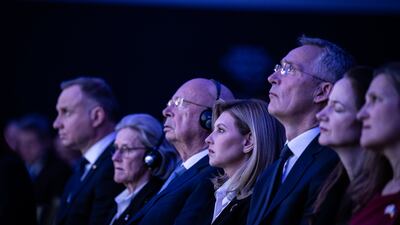
Olena Zelenska, Ukraine's first lady, watches as Ukrainian President Volodymyr Zelenskyy addresses the forum. Photo: WEF -
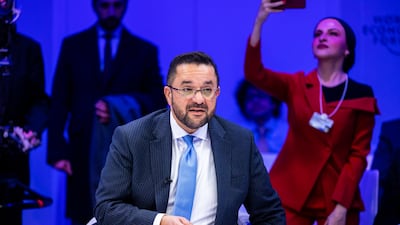
Mohamad Al Ississ, Jordan's Minister of Finance, takes part in the session titled The Middle East: Meeting Point or Battleground? Photo: WEF -
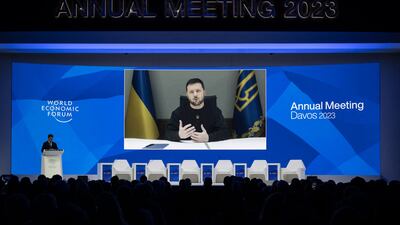
Mr Zelenskyy gives a video address to the forum in Davos. AFP -

Former US secretary of state Henry Kissinger appears on screen during the annual meeting of the World Economic Forum, in Davos. AP -

US governors Brian Kemp and JB Pritzker, senators Chris Coons, Joe Manchin and Kyrsten Sinema and representatives Maria Salazar and Mikie Sherrill take part in a panel discussion at Davos. AP -
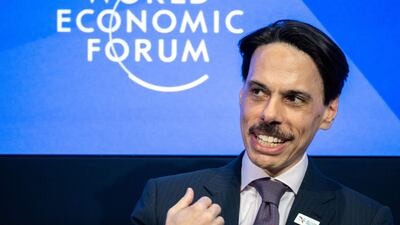
Saudi Foreign Minister Prince Faisal bin Farhan attends a session in Davos. AFP -
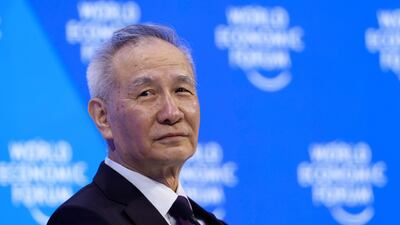
Chinese Vice Premier Liu He on the opening day of the forum. Bloomberg -
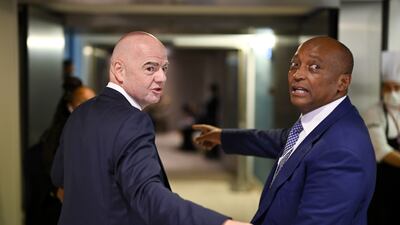
Fifa president Gianni Infantino, left, and Patrice Motsepe, billionaire founder of African Rainbow Minerals, arrive at the forum's venue in Davos. EPA -
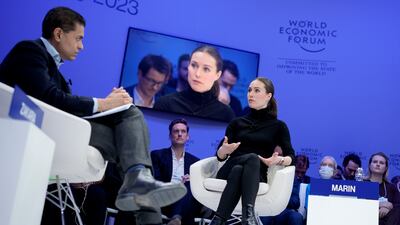
Finland's Prime Minister Sanna Marin, right, is interviewed by Fareed Zakaria in Davos. AP -
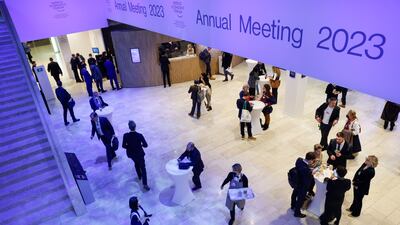
Delegates visit the refreshments area between sessions in Davos. Bloomberg -

Singer Angelique Kidjo performs in Davos. EPA -
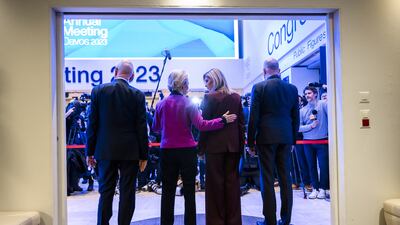
From left, WEF founder Klaus Schwab, European Commission President Ursula von der Leyen, Ukrainian first lady Olena Zelenska and Swiss President Alain Berset pose together during the 53rd annual meeting of the forum in Davos. EPA -
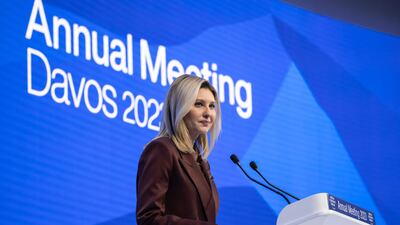
Ms Zelenska hit out at Russia and said 'we cannot allow a new Chernobyl to happen'. AFP -
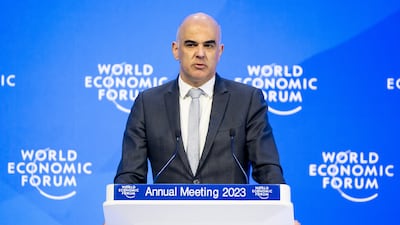
Mr Berset addresses delegates in Davos. EPA -
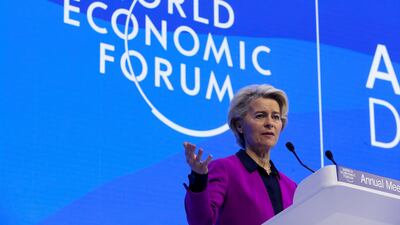
Ms von der Leyen said the 27-nation bloc would become much more forceful in countering unfair trading practices. Reuters -
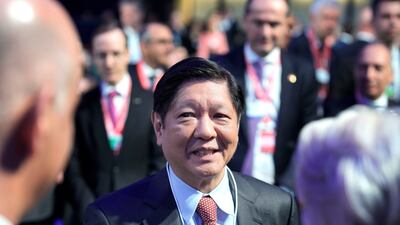
Ferdinand Marcos, President of the Philippines, arrives to attend a session in Davos. AP -
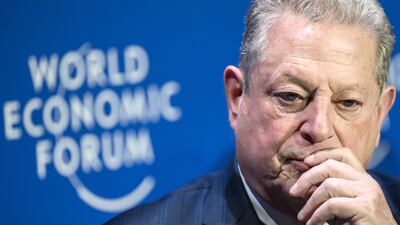
Former US vice president Al Gore is expected to discuss decarbonisation, as well as efforts to build clean energy infrastructure and ensure equitable growth. EPA -

From second left, WEF president Borge Brende, Carbon Direct vice chairwoman Nili Gilbert and US climate envoy John Kerry with other delegates in Davos. EPA -

Credit Suisse chairman Axel Lehmann speaks during the 53rd WEF Annual Meeting. EPA -
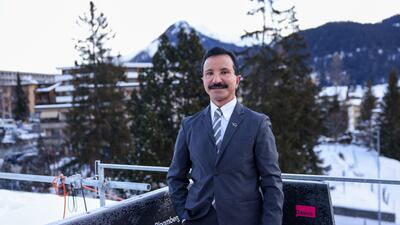
DP World chief executive Sultan bin Sulayem in Davos. Bloomberg -
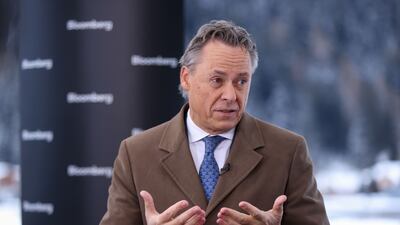
UBS chief executive Ralph Hamers speaks during a television interview on the opening day of the forum. Bloomberg -

From left, Hong Kong Exchanges & Clearing Ltd chairwoman Laura Cha, Banco de Portugal Governor Mario Centeno, Bloomberg TV anchor Francine Lacqua, Credit Suisse chairman Axel Lehmann and S&P Global president and chief executive Douglas Peterson during a panel session on the opening day of the forum. Bloomberg -

Mr Kerry delivers a speech at the Congress Centre in Davos. AFP -
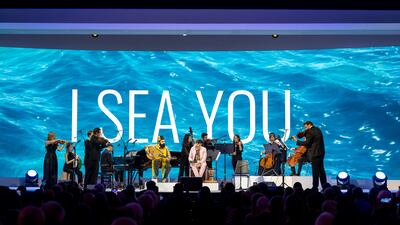
Musicians take part in a concert during the official opening of the forum. Photo: WEF -
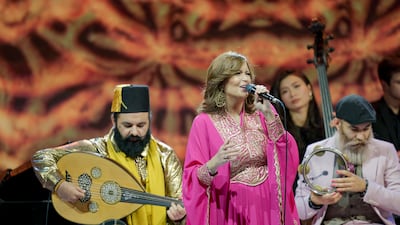
Jordanian vocalist Farah Siraj, centre, and Egyptian-Australian multi-instrumentalist Joseph Tawadros, left, perform during the I Sea You concert. Photo: WEF -
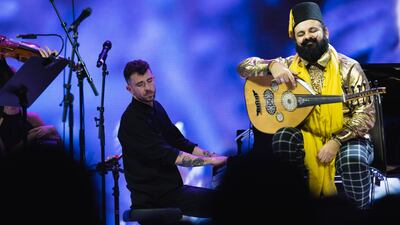
Tawadros is one of the world's leading oud performers and composers. Photo: WEF -
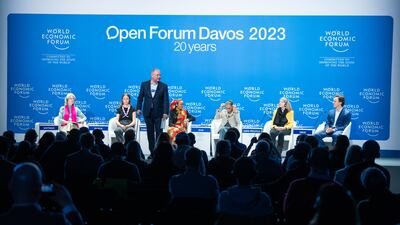
WEF managing director Alois Zwinggi speaks during a session called 'In Harmony with Nature'. Photo: WEF -
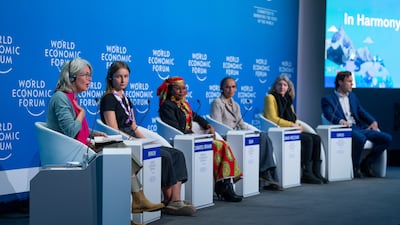
Gail Whiteman, left, a professor of sustainability at the University of Exeter Business School, speaks during the 'In Harmony with Nature' panel discussion. Photo: WEF -

Mr Schwab delivers a speech during the 'Crystal Award' ceremony in Davos. AFP -

Actor Idris Elba, right, and his wife Sabrina Dhowre Elba, left, smile on the podium during the Crystal Award ceremony. AP -

Kyiv Mayor Vitali Klitschko attends the Crystal Award ceremony. EPA -
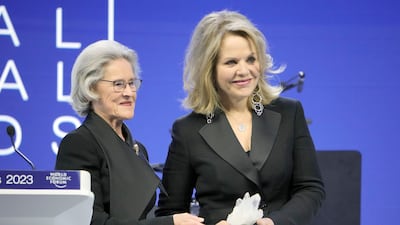
Singer Renee Fleming, right, receives a Crystal Award from Hilde Schwab, wife of WEF founder Klaus Schwab. AP -
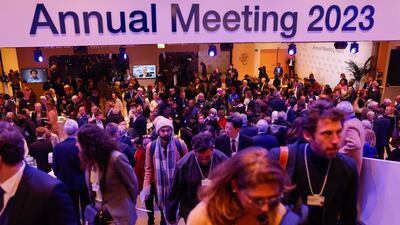
Delegates at the welcome reception before the official start of the forum. Bloomberg -
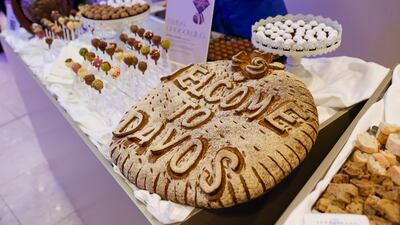
Food for attendees at the welcome reception. Bloomberg -
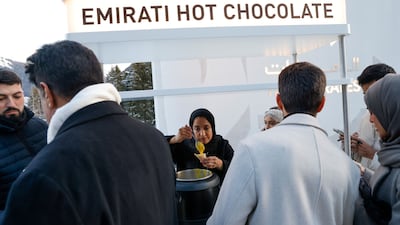
A kiosk serving hot chocolate from the UAE at the forum. Bloomberg -
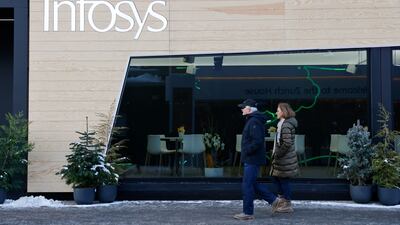
The Infosys pavilion at the forum. Bloomberg -
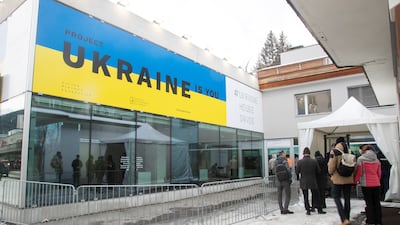
Ukraine's pavilion in Davos. Reuters -
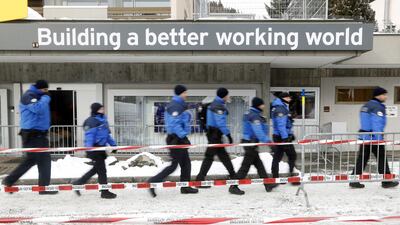
Swiss police officers on patrol in Davos. Reuters -
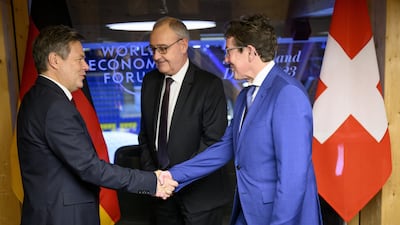
From left, German Vice Chancellor Robert Habeck with Swiss ministers Guy Parmelin and Albert Roesti before the start of a bilateral meeting in Davos. EPA -
A delegate passes a digital display in Davos. Bloomberg



