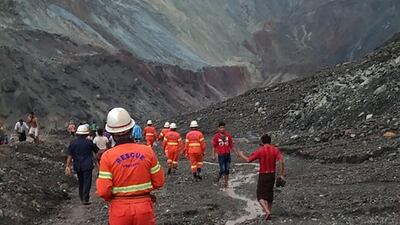
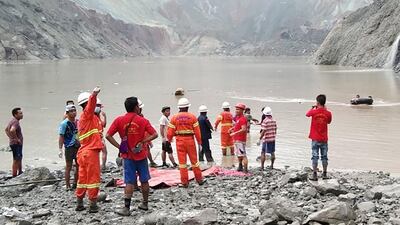
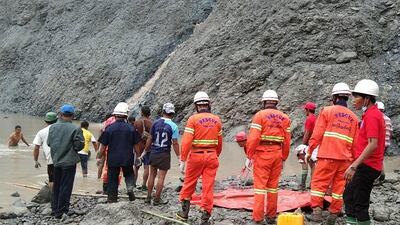
A landslide at a jade mine in northern Myanmar on Wednesday killed at least one person, injured 25 and left dozens missing, a member of the rescue team told AFP.
Scores die each year working in the country's lucrative but poorly regulated jade trade, which uses low-paid migrant workers to scrape out a gem highly coveted in neighbouring China.
The disaster struck at a mine in Hpakant township close to the Chinese border in Kachin state, where billions of dollars of the precious mineral is believed to be scoured from bare hillsides each year.
“About 70-100 people are missing” following the landslide that struck around 4:00am, said rescue team member Ko Nyi.
“We've sent 25 injured people to hospital while we've found one dead.”
Hundreds of diggers had returned to Hpakant during the rainy season to prospect in the treacherous open-cast mines, according to a local activist, despite a junta ban on digging until March 2022.
“They mine at night and in the morning they tip out the earth and rock,” said the activist, adding the added weight had caused the land to slip down into the lake.
Ko Nyi of the rescue team also said increased pressure from the weight of dumped soil and rock had pushed the ground downhill into the lake.
Around 200 rescuers were working to recover bodies, with some using boats to search for the dead in a nearby lake, he added.
Access to the mines in the remote north of the country is heavily restricted by the military and internet access is patchy.
Local outlet Kachin News Group said 20 miners had been killed in the landslide.
Myanmar's fire services said personnel from Hpakant and the nearby town of Lone Khin were involved in the rescue effort but gave no figures of dead or missing.
Deadly industry
Jade and other abundant natural resources in northern Myanmar, including timber, gold and amber, have helped to finance both sides of a decades-long civil war between ethnic Kachin insurgents and the military.
Civilians are frequently trapped in the middle of the fight for control of the mines and their lucrative revenues, with a rampant drug and arms trade adding to the conflict.
Last year heavy rainfall triggered a huge landslide in Hpakant that entombed nearly 300 miners.
Watchdog Global Witness estimated that the industry was worth some $31 billion in 2014.
But corruption means very little reaches state coffers.
A military coup in February also effectively extinguished any chance of reforms to the dangerous and unregulated industry initiated by ousted leader Aung San Suu Kyi's government, watchdog Global Witness said in a report this year.
The coup has also sparked fighting in Kachin state between local insurgents and the Myanmar military, Global Witness added.
In May, the military launched air strikes against the insurgents, who later told AFP they had shot down a helicopter gunship during fierce clashes in the country's far north.

Tamkeen's offering
- Option 1: 70% in year 1, 50% in year 2, 30% in year 3
- Option 2: 50% across three years
- Option 3: 30% across five years
Ruwais timeline
1971 Abu Dhabi National Oil Company established
1980 Ruwais Housing Complex built, located 10 kilometres away from industrial plants
1982 120,000 bpd capacity Ruwais refinery complex officially inaugurated by the founder of the UAE Sheikh Zayed
1984 Second phase of Ruwais Housing Complex built. Today the 7,000-unit complex houses some 24,000 people.
1985 The refinery is expanded with the commissioning of a 27,000 b/d hydro cracker complex
2009 Plans announced to build $1.2 billion fertilizer plant in Ruwais, producing urea
2010 Adnoc awards $10bn contracts for expansion of Ruwais refinery, to double capacity from 415,000 bpd
2014 Ruwais 261-outlet shopping mall opens
2014 Production starts at newly expanded Ruwais refinery, providing jet fuel and diesel and allowing the UAE to be self-sufficient for petrol supplies
2014 Etihad Rail begins transportation of sulphur from Shah and Habshan to Ruwais for export
2017 Aldar Academies to operate Adnoc’s schools including in Ruwais from September. Eight schools operate in total within the housing complex.
2018 Adnoc announces plans to invest $3.1 billion on upgrading its Ruwais refinery
2018 NMC Healthcare selected to manage operations of Ruwais Hospital
2018 Adnoc announces new downstream strategy at event in Abu Dhabi on May 13
Source: The National
At Eternity’s Gate
Director: Julian Schnabel
Starring: Willem Dafoe, Oscar Isaacs, Mads Mikkelsen
Three stars
Stuck in a job without a pay rise? Here's what to do
Chris Greaves, the managing director of Hays Gulf Region, says those without a pay rise for an extended period must start asking questions – both of themselves and their employer.
“First, are they happy with that or do they want more?” he says. “Job-seeking is a time-consuming, frustrating and long-winded affair so are they prepared to put themselves through that rigmarole? Before they consider that, they must ask their employer what is happening.”
Most employees bring up pay rise queries at their annual performance appraisal and find out what the company has in store for them from a career perspective.
Those with no formal appraisal system, Mr Greaves says, should ask HR or their line manager for an assessment.
“You want to find out how they value your contribution and where your job could go,” he says. “You’ve got to be brave enough to ask some questions and if you don’t like the answers then you have to develop a strategy or change jobs if you are prepared to go through the job-seeking process.”
For those that do reach the salary negotiation with their current employer, Mr Greaves says there is no point in asking for less than 5 per cent.
“However, this can only really have any chance of success if you can identify where you add value to the business (preferably you can put a monetary value on it), or you can point to a sustained contribution above the call of duty or to other achievements you think your employer will value.”
MATCH INFO
Uefa Champions League semi-finals, second leg:
Liverpool (0) v Barcelona (3), Tuesday, 11pm UAE
Game is on BeIN Sports
Top financial tips for graduates
Araminta Robertson, of the Financially Mint blog, shares her financial advice for university leavers:
1. Build digital or technical skills: After graduation, people can find it extremely hard to find jobs. From programming to digital marketing, your early twenties are for building skills. Future employers will want people with tech skills.
2. Side hustle: At 16, I lived in a village and started teaching online, as well as doing work as a virtual assistant and marketer. There are six skills you can use online: translation; teaching; programming; digital marketing; design and writing. If you master two, you’ll always be able to make money.
3. Networking: Knowing how to make connections is extremely useful. Use LinkedIn to find people who have the job you want, connect and ask to meet for coffee. Ask how they did it and if they know anyone who can help you. I secured quite a few clients this way.
4. Pay yourself first: The minute you receive any income, put about 15 per cent aside into a savings account you won’t touch, to go towards your emergency fund or to start investing. I do 20 per cent. It helped me start saving immediately.
The President's Cake
Director: Hasan Hadi
Starring: Baneen Ahmad Nayyef, Waheed Thabet Khreibat, Sajad Mohamad Qasem
Rating: 4/5
I Care A Lot
Directed by: J Blakeson
Starring: Rosamund Pike, Peter Dinklage
3/5 stars
MATCH INFO
Manchester City 6 Huddersfield Town 1
Man City: Agüero (25', 35', 75'), Jesus (31'), Silva (48'), Kongolo (84' og)
Huddersfield: Stankovic (43')
Who was Alfred Nobel?
The Nobel Prize was created by wealthy Swedish chemist and entrepreneur Alfred Nobel.
- In his will he dictated that the bulk of his estate should be used to fund "prizes to those who, during the preceding year, have conferred the greatest benefit to humankind".
- Nobel is best known as the inventor of dynamite, but also wrote poetry and drama and could speak Russian, French, English and German by the age of 17. The five original prize categories reflect the interests closest to his heart.
- Nobel died in 1896 but it took until 1901, following a legal battle over his will, before the first prizes were awarded.