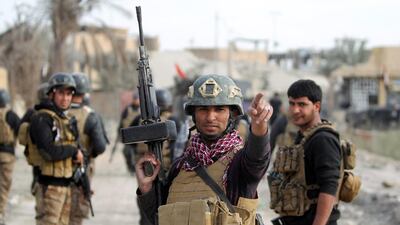
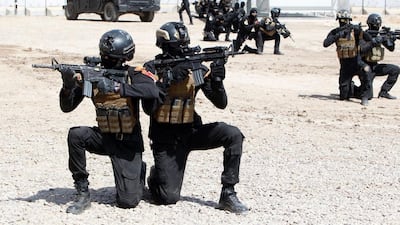
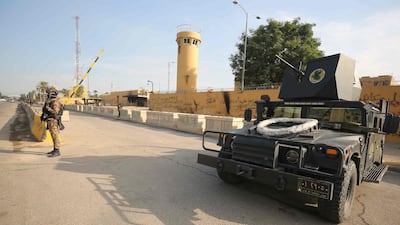
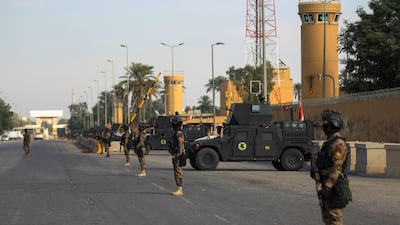
There may be no more than 500 ISIS fighters left in Iraq, a senior Iraqi general has said.
Gen Qais Al Mohamadawi said on Sunday that the group was confined to remote desert areas and struggling to attract recruits, a far cry from its peak when it controlled areas that were home to 10 million people across Iraq and Syria, and drew on adherents from at least 85 countries.
“According to information from intelligence agencies, the total number of ISIS members does not exceed 400 to 500 fighters, in three or four provinces,” Gen Al Mohamadawi told a press conference.
ISIS surged across northern Iraq and Syria in 2014, seizing the cities of Raqqa and Deir Ezzor in Syria, and Mosul in northern Iraq.
The group had gradually worn down Iraqi security forces in the preceding two years in Iraq, and rose to dominate a wider anti-government uprising in eastern Syria.
The reign of the group under Abu Bakr Al Baghdadi was characterised by extreme brutality characterised by the sexual slavery of female hostages, acts of genocide committed against the Yazidi minority group and the frequent torture and execution of hostages.
About 200 mass graves linked to ISIS atrocities have been found in northern Iraq following the group’s near total defeat there in 2017.
Estimates of the extremist group's strength have often varied widely. At its peak in 2014, the CIA estimated that ISIS had between 20,000 and 30,000 fighters, while Russia estimated a total force of more than 70,000.
The US military — which makes separate intelligence estimates from the CIA — said in December 2016 that the group had lost 50,000 men, which it said was a “conservative” estimate.
Of the 10,000 ISIS fighters still detained by Kurdish, Iraqi and US forces, about 5,000 are Syrian and 3,000 Iraqi, according to the US military.
With extremists maintaining sleeper cells and hiding among the population, insurgencies of this size can take years or even decades to defeat.
However, the group decided to fight pitched urban battles against a broad US-led coalition of 70 countries, including Iraqi security forces and Kurdish militias in Iraq and Syria.
Some experts said the rationale behind ISIS fighting intense battles — in which it suffered tens of thousands of casualties — instead of staging hit-and-run attacks was to hold on to towns and cities where it could collect tax revenue.
In some cases ISIS groups were surrounded and wiped out in bloody last stands, including the third battle of Fallujah in 2015, a desperate fight for West Mosul in 2017 and their last pitched battle at Baghouz in Syria in 2019.
The UN estimated in a report published last month that ISIS still had “5,000 to 7,000 members and supporters” across Iraq and neighbouring Syria, “roughly half of whom are fighters”.
Gen Al Mohamadawi said the group had “lost its ability to attract new recruits”. He pointed to a February 26 military operation that killed 22 of its fighters and destroyed a “training camp” in Al Anbar province.
The UN report last month said ISIS had been much depleted by “sustained counter-terrorism operations” in both countries.
It said the group still operates cells of about 15 to 30 fighters across Syria and continues “guerrilla warfare tactics” against government forces, other fighters and civilians.

ELIO
Starring: Yonas Kibreab, Zoe Saldana, Brad Garrett
Directors: Madeline Sharafian, Domee Shi, Adrian Molina
Rating: 4/5
Three ways to limit your social media use
Clinical psychologist, Dr Saliha Afridi at The Lighthouse Arabia suggests three easy things you can do every day to cut back on the time you spend online.
1. Put the social media app in a folder on the second or third screen of your phone so it has to remain a conscious decision to open, rather than something your fingers gravitate towards without consideration.
2. Schedule a time to use social media instead of consistently throughout the day. I recommend setting aside certain times of the day or week when you upload pictures or share information.
3. Take a mental snapshot rather than a photo on your phone. Instead of sharing it with your social world, try to absorb the moment, connect with your feeling, experience the moment with all five of your senses. You will have a memory of that moment more vividly and for far longer than if you take a picture of it.
How to keep control of your emotions
If your investment decisions are being dictated by emotions such as fear, greed, hope, frustration and boredom, it is time for a rethink, Chris Beauchamp, chief market analyst at online trading platform IG, says.
Greed
Greedy investors trade beyond their means, open more positions than usual or hold on to positions too long to chase an even greater gain. “All too often, they incur a heavy loss and may even wipe out the profit already made.
Tip: Ignore the short-term hype, noise and froth and invest for the long-term plan, based on sound fundamentals.
Fear
The risk of making a loss can cloud decision-making. “This can cause you to close out a position too early, or miss out on a profit by being too afraid to open a trade,” he says.
Tip: Start with a plan, and stick to it. For added security, consider placing stops to reduce any losses and limits to lock in profits.
Hope
While all traders need hope to start trading, excessive optimism can backfire. Too many traders hold on to a losing trade because they believe that it will reverse its trend and become profitable.
Tip: Set realistic goals. Be happy with what you have earned, rather than frustrated by what you could have earned.
Frustration
Traders can get annoyed when the markets have behaved in unexpected ways and generates losses or fails to deliver anticipated gains.
Tip: Accept in advance that asset price movements are completely unpredictable and you will suffer losses at some point. These can be managed, say, by attaching stops and limits to your trades.
Boredom
Too many investors buy and sell because they want something to do. They are trading as entertainment, rather than in the hope of making money. As well as making bad decisions, the extra dealing charges eat into returns.
Tip: Open an online demo account and get your thrills without risking real money.
Essentials
The flights
Etihad and Emirates fly direct from the UAE to Delhi from about Dh950 return including taxes.
The hotels
Double rooms at Tijara Fort-Palace cost from 6,670 rupees (Dh377), including breakfast.
Doubles at Fort Bishangarh cost from 29,030 rupees (Dh1,641), including breakfast. Doubles at Narendra Bhawan cost from 15,360 rupees (Dh869). Doubles at Chanoud Garh cost from 19,840 rupees (Dh1,122), full board. Doubles at Fort Begu cost from 10,000 rupees (Dh565), including breakfast.
The tours
Amar Grover travelled with Wild Frontiers. A tailor-made, nine-day itinerary via New Delhi, with one night in Tijara and two nights in each of the remaining properties, including car/driver, costs from £1,445 (Dh6,968) per person.
The five pillars of Islam
Read more from Aya Iskandarani
THE BIO
Favourite book: ‘Purpose Driven Life’ by Rick Warren
Favourite travel destination: Switzerland
Hobbies: Travelling and following motivational speeches and speakers
Favourite place in UAE: Dubai Museum
COMPANY%20PROFILE%20
%3Cp%3E%3Cstrong%3ECompany%3A%20%3C%2Fstrong%3EOlive%20Gaea%3Cbr%3E%3Cstrong%3EStarted%3A%3C%2Fstrong%3E%202021%3Cbr%3E%3Cstrong%3ECo-founders%3A%3C%2Fstrong%3E%20Vivek%20Tripathi%2C%20Jessica%20Scopacasa%3Cbr%3E%3Cstrong%3EBased%3A%3C%2Fstrong%3E%20Dubai%3Cbr%3E%3Cstrong%3ELicensed%20by%3A%20%3C%2Fstrong%3EDubai%20World%20Trade%20Centre%3Cbr%3E%3Cstrong%3EIndustry%3A%3C%2Fstrong%3E%20Climate-Tech%2C%20Sustainability%3Cbr%3E%3Cstrong%3EFunding%3A%20%3C%2Fstrong%3E%241.1%20million%3Cbr%3E%3Cstrong%3EInvestors%3A%20%3C%2Fstrong%3ECornerstone%20Venture%20Partners%20and%20angel%20investors%3Cbr%3E%3Cstrong%3ENumber%20of%20employees%3A%3C%2Fstrong%3E%208%3Cbr%3E%3C%2Fp%3E%0A
Who's who in Yemen conflict
Houthis: Iran-backed rebels who occupy Sanaa and run unrecognised government
Yemeni government: Exiled government in Aden led by eight-member Presidential Leadership Council
Southern Transitional Council: Faction in Yemeni government that seeks autonomy for the south
Habrish 'rebels': Tribal-backed forces feuding with STC over control of oil in government territory