

Russia's war in Ukraine has pushed the number of forcibly displaced people in the world to more than 100 million for the first time, the United Nations said Monday.
The UN refugee agency said the figure was “alarming” and should serve as a wake-up call to address the reasons behind record numbers of people fleeing their homes.
-
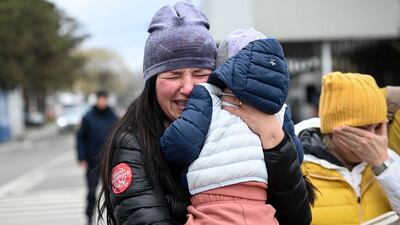
A Ukrainian refugee clings to her child, unable to hold back the despair of upheaval as she arrives at the Romanian border. The number of Ukrainian refugees who have fled has exceeded the 5 million mark as the war enters its ninth week, UN data has indicated. AFP -
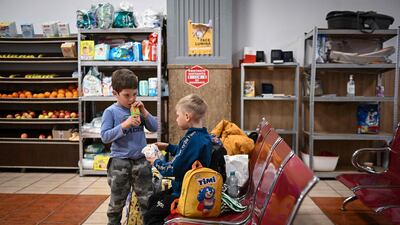
Children who fled the war take a break at a railway station in Bucharest, Romania, a country which has taken in more than 757,000 Ukrainian refugees to date. AFP -
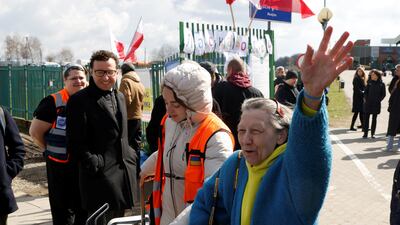
A woman gives a wave after crossing the border from Ukraine into Medyka, Poland. Reuters -

An Ukrainian refugee woman sews in Strasbourg, France, as part of a job scheme for people who have fled the war with Russia. AFP -
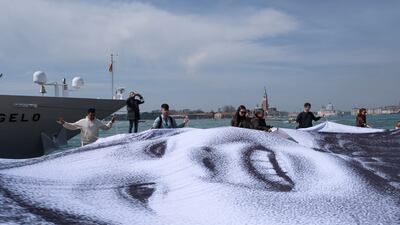
A giant photograph of a young refugee is unveiled as part of an art installation by French contemporary artist JR to show solidarity with Ukraine, in Venice, Italy. Reuters -
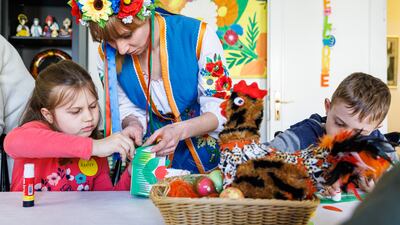
Vladimir and Avigeja Radionow with Kseniia Temcheniuk, who fled war-torn Ukraine, prepare an Easter basket at a cultural centre in Halle, Germany. Getty Images -

Refugees at the border crossing in Medyka, Poland, a country which has to date taken in more than 2,825,000 people from Ukraine. AP Photo -
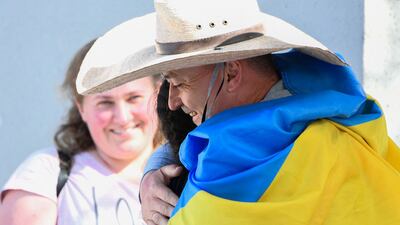
Oleksii Yeromin hugs a Ukrainian refugee at the US-Mexico border. AFP -
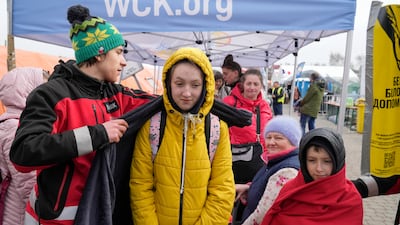
A volunteer covers a refugee with a blanket as she queues at the border crossing in south-eastern Poland. AP Photo


“The number of people forced to flee conflict, violence, human rights violations and persecution has now crossed the milestone of 100 million for the first time on record, propelled by the war in Ukraine and other deadly conflicts,” UNHCR said.
The numbers of forcibly displaced people rose towards 90 million by the end of 2021, spurred by violence in Ethiopia, Burkina Faso, Myanmar, Nigeria, Afghanistan and the Democratic Republic of the Congo, the agency said.
After Russia invaded Ukraine on February 24, more than eight million people have been displaced within the country, while more than six million refugees have fled across the borders.
“One hundred million is a stark figure — sobering and alarming in equal measure. It's a record that should never have been set,” said UNHCR chief Filippo Grandi.
UNHCR chief
“This must serve as a wake-up call to resolve and prevent destructive conflicts, end persecution, and address the underlying causes that force innocent people to flee their homes.”
The 100 million figure amounts to more than one per cent of the global population. Only 13 countries have a bigger population than the number of forcibly displaced people in the world.
The figures combine refugees, asylum seekers, as well as more than 50 million people displaced inside their own countries.

Mr Grandi said the international response to people fleeing war in Ukraine had been “overwhelmingly positive”.
“Compassion is alive and we need a similar mobilisation for all crises around the world. But ultimately, humanitarian aid is a palliative, not a cure.
“To reverse this trend, the only answer is peace and stability so that innocent people are not forced to gamble between acute danger at home or precarious flight and exile.”
UNHCR will outline the full data on forced displacement in 2021 in its annual Global Trends Report, scheduled for release on June 16.
Mr Grandi has called for countries to lift any remaining pandemic-related asylum restrictions, saying they contravene a fundamental human right.
“I am worried that measures enacted on the pretext of responding to Covid-19 are being used as cover to exclude and deny asylum to people fleeing violence and persecution,” he said on Friday.
A joint report last week by the Internal Displacement Monitoring Centre and the Norwegian Refugee Council (NRC) said that about 38 million new internal displacements were reported in 2021. Some of those were by people forced to flee several times during the year.
The figure marks the second-highest annual number of new internal displacements in a decade after 2020.
Last year, new internal displacements caused by conflict surged to 14.4 million — a 50 per cent increase from 2020, the report showed.
“It has never been as bad as this,” NRC chief Jan Egeland said.
“The world is falling apart.”
Natural disasters continued to account for most new internal displacement, forcing 23.7 million people to leave their homes in 2021.

