Meet the medics curing the 'incurable' children at London's Zayed Centre


Lemma Shehadi
  • English
  • Arabic

Children are disproportionately affected by rare diseases, and few sufferers make it past their fifth birthday.

Thankfully, today, there are more life-saving treatment opportunities than ever before. However, the challenges of applying them effectively are immense, Prof Claire Booth told The National.

The path to effective care is often innovative or groundbreaking and there are no guides to rely on, said Booth.

“When a child is going to be the first person in the world who gets this treatment, it’s a difficult decision for the families, even though we think it’s going to work,” said Booth, a paediatric consultant at Great Ormond Street Hospital.

She is a world expert in her field and leads clinical research at the London hospital where the Zayed Centre for Research into Rare Disease in Children - which includes an outpatient facility and a laboratory for cell and gene therapy - has recently been granted expanded treatment capabilities.

Zayed Centre for Research — which opened in 2019 — is dedicated to treating the world’s rarest diseases in children, from babies born without functioning immune systems to liver and metabolic disorders. It was built partly with a £60 million donation from Sheikha Fatima bint Mubarak, and is a partnership between Great Ormond Street Hospital, University College London and Great Ormond Street Hospital Children's Charity.

“They’re such devastating diseases that they tend to present themselves early in life,” said Booth, who revealed her team's work is, for most patients, their last hope to find a cure.

“A lot of families contact us directly,” said Booth. “The standard treatment [for their child’s condition] isn’t working, or, in some cases, there is no treatment.”

But recent breakthroughs in the field mean that more children with rare diseases will survive.

Cell and gene therapy was pioneered at Great Ormond Street Hospital, a little more than 20 years ago. It involves manipulating the genes, cells or tissues causing the disease, and serves as an alternative to a bone marrow transplant for some conditions.

“When people are born with a genetic condition that leads to a disease, it's usually because a gene in their DNA isn't working properly. Gene therapy is either repairing or replacing that gene,” said Booth, who specialises in genetic disorders affecting the immune and metabolic systems.

The Zayed Centre for Research was awarded a licence to manufacture drugs by the Medicines and Healthcare Products Regulatory Authority (MHRA) in February. Stem and gene therapy products were previously produced at two labs in another wing of the hospital but the new approvals will serve to accelerate the production of medicines and increase the number of clinical trials taking place across the UK.

Research has begun on new methods of gene therapy such as in vivo, where a virus containing the corrective gene is injected directly into the body. “We try and correct the cells while they're still inside the patient,” said Booth.

In vivo treatments are currently being used for liver, brain and neuromuscular disorders as well as some metabolic conditions. “We can inject the virus directly into the fluid inside the brain,” said Booth.

Inside the 140-bench laboratory — one of the largest in Europe — Booth’s team of researchers work on different stages of an experimental treatment. “We use samples of patients’ blood cells to test the therapies that we’re developing,” said Booth.

Large glass walls on the ground floor give visitors a bird’s eye view of the basement laboratory. This emphasises the hospital’s “bench to bedside” approach, which enables a close connection between patients and clinical researchers.

“As patients come in they can see the scientists and researchers working on something that will impact them,” said Booth.

The track record of the facility is already stellar. In 2021, a clinical trial for ADA-SCIDS, an inherited disease where babies are born without a functioning immune system, found that 48 of 50 patients no longer showed symptoms of the disorder after a single round of treatment.

Previously, patients with ADA-SCIDS had to have twice or weekly injections until they could find a donor for a bone marrow transplant. “All the patients are alive, and 96 per cent of them were essentially cured with a one-off gene therapy,” said Booth of the trial done in collaboration with the University of California, Los Angeles.

The centre’s Gene and Cell Therapy Facility is where the medicines are prepared in a delicate and fragile process overseen by a dedicated team working to tight timeframes. The facility head, Dr Barry Flutter told The National that medicines are designed to treat individual patients and have a shelf life of a few hours, making on-site manufacturing essential.

“We build on the research programmes of the hospital, and translate them into products which can be given to patients,” said Dr Flutter.

Inside, seven highly-protected and sterile laboratories are used for all stages of the preparation, and have increased capacity to manufacture gene therapy products by more than 300 per cent — from 40 products a year to 150, the centre estimates.

The simulation room, which is identical to the other labs, is used for early manufacturing stages and training.

“Now that we have the licence, we’re moving,” he said. Three of the labs, he explained, will be used to produce vectors — which are the vehicles used to transmit the working gene into the living cell — in partnership with Virocell Biologics, a commercial company. This will allow scientists to double the number of vectors the company currently produces for UK-wide clinical trials.

This will allow scientists to double the number of vectors currently produced, and will serve to increase the number of clinical trials taking place across the UK.

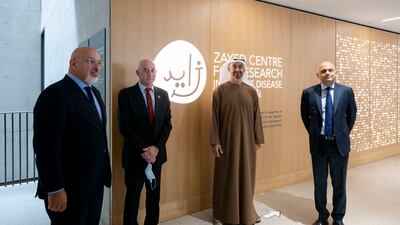
  • Sheikh Mohamed at the Zayed Centre in 2021 with the former UK health minister Sajid Javid, right, and former UK education minister Nadhim Zahawi, left. All photos: Ministry of Presidential Affairs
    Sheikh Mohamed at the Zayed Centre in 2021 with the former UK health minister Sajid Javid, right, and former UK education minister Nadhim Zahawi, left. All photos: Ministry of Presidential Affairs
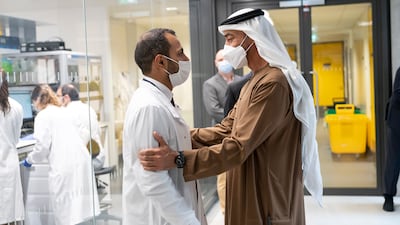
  • Sheikh Mohamed and Sheikh Hamdan bin Mohamed bin Zayed during the visit to the Zayed Centre for Research into Rare Disease in Children.
    Sheikh Mohamed and Sheikh Hamdan bin Mohamed bin Zayed during the visit to the Zayed Centre for Research into Rare Disease in Children.
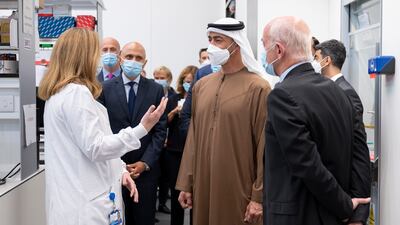
  • Sheikh Mohamed speaks with Mohamed Al Ameri, researcher and PhD candidate.
    Sheikh Mohamed speaks with Mohamed Al Ameri, researcher and PhD candidate.
  • Sheikh Mohamed visits the Zayed Centre for Research into Rare Disease in Children, located in London.
    Sheikh Mohamed visits the Zayed Centre for Research into Rare Disease in Children, located in London.
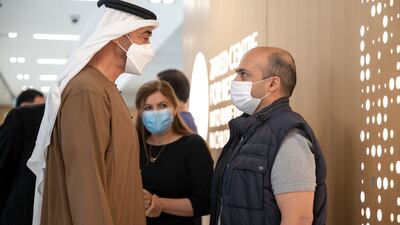
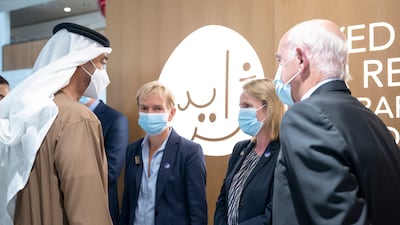
  • Sheikh Mohamed speaks with a family member of a patient at the centre.
    Sheikh Mohamed speaks with a family member of a patient at the centre.
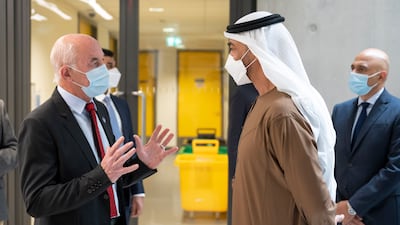
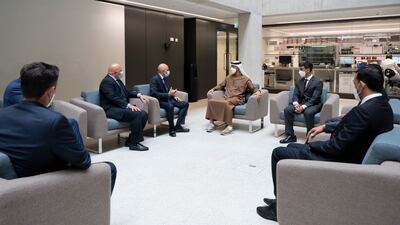
  • Sheikh Mohamed and Sheikh Hamdan hold a meeting with Mr Javid, the former UK health secretary, at the centre.
    Sheikh Mohamed and Sheikh Hamdan hold a meeting with Mr Javid, the former UK health secretary, at the centre.
  • Sheikh Hamdan attends a meeting with the former UK health secretary at the centre.
    Sheikh Hamdan attends a meeting with the former UK health secretary at the centre.
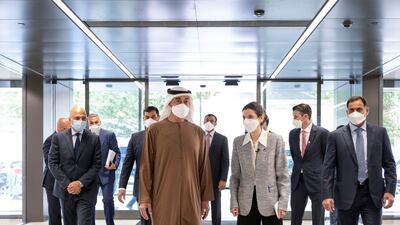
  • Sheikh Mohamed toured the centre, meeting researchers, professors and doctors working on pioneering research and life-saving treatments.
    Sheikh Mohamed toured the centre, meeting researchers, professors and doctors working on pioneering research and life-saving treatments.
  • Sheikh Mohamed visiting the centre in 2021, which will celebrate its fourth anniversary in October.
    Sheikh Mohamed visiting the centre in 2021, which will celebrate its fourth anniversary in October.
  • Sheikh Mohamed was briefed on the centre’s specialist facilities that have enabled it to play a vital role in the global response to Covid-19.
    Sheikh Mohamed was briefed on the centre’s specialist facilities that have enabled it to play a vital role in the global response to Covid-19.
  • Sheikh Mohamed tours the centre.
    Sheikh Mohamed tours the centre.
  • Sheikh Mohamed speaks with family members of a patient at the centre.
    Sheikh Mohamed speaks with family members of a patient at the centre.

Making each treatment can take up to six months, Flutter explained, but there are signs that this process could become easier in the future.

In December, the hospital announced it had treated a patient with a rare “incurable” form of leukaemia, using the latest gene-editing technology. The 13-year-old patient was in remission one year after treatment, having previously been given just months to live.

Annie Etuk, a scientist at the facility, explained that the technology could allow them to progress from the delicate task of making medicines uniquely designed for each patient, to creating “off-the-shelf” products for a wider range of people.

Despite these breakthroughs, gene and cell therapy research faces tremendous challenges. “For every patient that we do treat, there are many others that aren't eligible,” said Etuk.

Rare diseases struggle to get commercial investment. “The patient population is very small, we’re talking about 10 to 20 patients being treated in the world per year” said Booth. “So companies are pulling out.”

Booth added that their belief is misguided: “What you learn in rare diseases can often be applied to much more common diseases, and this can impact huge populations of patients.” This includes treatment for cancers and sickle cell anaemia.

The AGORA initiative, founded by Booth in September last year, explores not-for-profit and sustainable ways to increase access to rare disease treatments.

Among these are the commercial partnerships afforded by the MHRA licence. “The financial sustainability of that model with help the research here at Great Ormond Street,” said Booth.

Staff shortages within the NHS remain an issue, particularly when making medicines. “It can be quite challenging to find sufficient staff to manufacture your product from start to finish,” said Etuk.

Misinformation about gene and cell therapy is also a risk that researchers are assessing. Booth recalled a recent protest outside a summit that she attended in London, triggered by a Chinese trial which announced the successful gene editing of embryos.

“There’s a level of education and awareness that needs to change. We’re changing the genetic make-up of a person’s blood, liver or brain system where the diseases are,” she said, “not their genetic make-up or family line.”

To date, hesitancy about gene therapy has not been an issue for families seeking help from the London hospital. “The families come to us with a great deal of hope,” said Booth, “because they are looking for a cure.”


Ferrari 12Cilindri specs

Engine: naturally aspirated 6.5-liter V12

Power: 819hp

Torque: 678Nm at 7,250rpm

Price: From Dh1,700,000

Available: Now

Turkish Ladies

Various artists, Sony Music Turkey 

How will Gen Alpha invest?

Mark Chahwan, co-founder and chief executive of robo-advisory firm Sarwa, forecasts that Generation Alpha (born between 2010 and 2024) will start investing in their teenage years and therefore benefit from compound interest.

“Technology and education should be the main drivers to make this happen, whether it’s investing in a few clicks or their schools/parents stepping up their personal finance education skills,” he adds.

Mr Chahwan says younger generations have a higher capacity to take on risk, but for some their appetite can be more cautious because they are investing for the first time. “Schools still do not teach personal finance and stock market investing, so a lot of the learning journey can feel daunting and intimidating,” he says.

He advises millennials to not always start with an aggressive portfolio even if they can afford to take risks. “We always advise to work your way up to your risk capacity, that way you experience volatility and get used to it. Given the higher risk capacity for the younger generations, stocks are a favourite,” says Mr Chahwan.

Highlighting the role technology has played in encouraging millennials and Gen Z to invest, he says: “They were often excluded, but with lower account minimums ... a customer with $1,000 [Dh3,672] in their account has their money working for them just as hard as the portfolio of a high get-worth individual.”

At a glance

Fixtures All matches start at 9.30am, at ICC Academy, Dubai. Admission is free

Thursday UAE v Ireland; Saturday UAE v Ireland; Jan 21 UAE v Scotland; Jan 23 UAE v Scotland

UAE squad Rohan Mustafa (c), Ashfaq Ahmed, Ghulam Shabber, Rameez Shahzad, Mohammed Boota, Mohammed Usman, Adnan Mufti, Shaiman Anwar, Ahmed Raza, Imran Haider, Qadeer Ahmed, Mohammed Naveed, Amir Hayat, Zahoor Khan

Bio:

Favourite Quote: Prophet Mohammad's quotes There is reward for kindness to every living thing and A good man treats women with honour

Favourite Hobby: Serving poor people 

Favourite Book: The Alchemist by Paulo Coelho

Favourite food: Fish and vegetables

Favourite place to visit: London

The specs

Engine: 2.0-litre four-cylinder turbo

Power: 268hp at 5,600rpm

Torque: 380Nm at 4,800rpm

Transmission: CVT auto

Fuel consumption: 9.5L/100km

On sale: now

Price: from Dh195,000 

Pakistan v New Zealand Test series

Pakistan: Sarfraz (c), Hafeez, Imam, Azhar, Sohail, Shafiq, Azam, Saad, Yasir, Asif, Abbas, Hassan, Afridi, Ashraf, Hamza

New Zealand: Williamson (c), Blundell, Boult, De Grandhomme, Henry, Latham, Nicholls, Ajaz, Raval, Sodhi, Somerville, Southee, Taylor, Wagner

Umpires: Bruce Oxerford (AUS) and Ian Gould (ENG); TV umpire: Paul Reiffel (AUS); Match referee: David Boon (AUS)

Tickets and schedule: Entry is free for all spectators. Gates open at 9am. Play commences at 10am

Countries offering golden visas

UK
Innovator Founder Visa is aimed at those who can demonstrate relevant experience in business and sufficient investment funds to set up and scale up a new business in the UK. It offers permanent residence after three years.

Germany
Investing or establishing a business in Germany offers you a residence permit, which eventually leads to citizenship. The investment must meet an economic need and you have to have lived in Germany for five years to become a citizen.

Italy
The scheme is designed for foreign investors committed to making a significant contribution to the economy. Requires a minimum investment of €250,000 which can rise to €2 million.

Switzerland
Residence Programme offers residence to applicants and their families through economic contributions. The applicant must agree to pay an annual lump sum in tax.

Canada
Start-Up Visa Programme allows foreign entrepreneurs the opportunity to create a business in Canada and apply for permanent residence. 

Match info

Uefa Nations League Group B:

England v Spain, Saturday, 11.45pm (UAE)

UAE central contracts

Full time contracts

Rohan Mustafa, Ahmed Raza, Mohammed Usman, Chirag Suri, Mohammed Boota, Sultan Ahmed, Zahoor Khan, Junaid Siddique, Waheed Ahmed, Zawar Farid

Part time contracts

Aryan Lakra, Ansh Tandon, Karthik Meiyappan, Rahul Bhatia, Alishan Sharafu, CP Rizwaan, Basil Hameed, Matiullah, Fahad Nawaz, Sanchit Sharma

Boulder shooting victims

• Denny Strong, 20
• Neven Stanisic, 23
• Rikki Olds, 25
• Tralona Bartkowiak, 49
• Suzanne Fountain, 59
• Teri Leiker, 51
• Eric Talley, 51
• Kevin Mahoney, 61
• Lynn Murray, 62
• Jody Waters, 65

A Bad Moms Christmas
Dir: John Lucas and Scott Moore
Starring: Mila Kunis, Kathryn Hahn, Kristen Bell, Susan Sarandon, Christine Baranski, Cheryl Hines
Two stars

Where to apply

Applicants should send their completed applications - CV, covering letter, sample(s) of your work, letter of recommendation - to Nick March, Assistant Editor in Chief at The National and UAE programme administrator for the Rosalynn Carter Fellowships for Mental Health Journalism, by 5pm on April 30, 2020

Please send applications to nmarch@thenational.ae and please mark the subject line as “Rosalynn Carter Fellowship for Mental Health Journalism (UAE programme application)”.

The local advisory board will consider all applications and will interview a short list of candidates in Abu Dhabi in June 2020. Successful candidates will be informed before July 30, 2020. 

Ten tax points to be aware of in 2026

1. Domestic VAT refund amendments: request your refund within five years

If a business does not apply for the refund on time, they lose their credit.

2. E-invoicing in the UAE

Businesses should continue preparing for the implementation of e-invoicing in the UAE, with 2026 a preparation and transition period ahead of phased mandatory adoption. 

3. More tax audits

Tax authorities are increasingly using data already available across multiple filings to identify audit risks. 

4. More beneficial VAT and excise tax penalty regime

Tax disputes are expected to become more frequent and more structured, with clearer administrative objection and appeal processes. The UAE has adopted a new penalty regime for VAT and excise disputes, which now mirrors the penalty regime for corporate tax.

5. Greater emphasis on statutory audit

There is a greater need for the accuracy of financial statements. The International Financial Reporting Standards standards need to be strictly adhered to and, as a result, the quality of the audits will need to increase.

6. Further transfer pricing enforcement

Transfer pricing enforcement, which refers to the practice of establishing prices for internal transactions between related entities, is expected to broaden in scope. The UAE will shortly open the possibility to negotiate advance pricing agreements, or essentially rulings for transfer pricing purposes. 

7. Limited time periods for audits

Recent amendments also introduce a default five-year limitation period for tax audits and assessments, subject to specific statutory exceptions. While the standard audit and assessment period is five years, this may be extended to up to 15 years in cases involving fraud or tax evasion. 

8. Pillar 2 implementation 

Many multinational groups will begin to feel the practical effect of the Domestic Minimum Top-Up Tax (DMTT), the UAE's implementation of the OECD’s global minimum tax under Pillar 2. While the rules apply for financial years starting on or after January 1, 2025, it is 2026 that marks the transition to an operational phase.

9. Reduced compliance obligations for imported goods and services

Businesses that apply the reverse-charge mechanism for VAT purposes in the UAE may benefit from reduced compliance obligations. 

10. Substance and CbC reporting focus

Tax authorities are expected to continue strengthening the enforcement of economic substance and Country-by-Country (CbC) reporting frameworks. In the UAE, these regimes are increasingly being used as risk-assessment tools, providing tax authorities with a comprehensive view of multinational groups’ global footprints and enabling them to assess whether profits are aligned with real economic activity. 

Contributed by Thomas Vanhee and Hend Rashwan, Aurifer

Who was Alfred Nobel?

The Nobel Prize was created by wealthy Swedish chemist and entrepreneur Alfred Nobel.

  • In his will he dictated that the bulk of his estate should be used to fund "prizes to those who, during the preceding year, have conferred the greatest benefit to humankind".
  • Nobel is best known as the inventor of dynamite, but also wrote poetry and drama and could speak Russian, French, English and German by the age of 17. The five original prize categories reflect the interests closest to his heart.
  • Nobel died in 1896 but it took until 1901, following a legal battle over his will, before the first prizes were awarded.
Who's who in Yemen conflict

Houthis: Iran-backed rebels who occupy Sanaa and run unrecognised government

Yemeni government: Exiled government in Aden led by eight-member Presidential Leadership Council

Southern Transitional Council: Faction in Yemeni government that seeks autonomy for the south

Habrish 'rebels': Tribal-backed forces feuding with STC over control of oil in government territory

Updated: March 05, 2024, 11:50 AM