A group of astronauts are trapped in orbit around the Earth after their space ship suffers catastrophic damage.
A rescue ship is available to bring them home, but there is a catch. It has only four seats ― and there are seven of them.
It sounds like the nail-biting plot of a Hollywood film to rival the plight of Bruce Willis in Armageddon or George Clooney and Sandra Bullock in Gravity.
In fact, this is the real-life dilemma that could face astronauts on the International Space Station after a Russian Soyuz capsule was so badly damaged it may be beyond repair.
Russian cosmonauts Dmitry Petelin and Sergey Prokopyev and Nasa astronaut Frank Rubio arrived at the ISS in September on a Soyuz ship that was scheduled to take them home in March. Two weeks ago while docked at the ISS, the Soyuz sprang a huge coolant leak that some experts believe means it can no longer fly safely.
The only other spacecraft at the ISS is an American SpaceX Dragon, which carried a group of four astronauts, two from Nasa, a Canadian and a Russian, in October.
Plotting an escape route
If the ISS needed to be evacuated in an emergency, this group could escape in the Dragon. For the remaining three, though, there would be no way home.
Russia’s space agency Roscomos is still assessing the extent of the damage to the Soyuz, as well as the possible cause.

Video taken on December 14 showed coolant streaming from the ship into the vacuum of space from a hole in a pipe less than a millimetre wide, with temperatures inside the capsule already rising.
The damage is thought to be the result of a strike from either a micro-meteorite or a tiny piece of space debris. Either way, the risks of using the ship during the heat of re-entry are high.
Tommaso Sgobba, former head of spaceflight safety at the European Space Agency, believes the Soyuz is unusable. He told the website Space.com "I have to assume that the active coolant system of the Soyuz spacecraft was compromised and therefore, the Soyuz is no longer available for operation. It's my personal feeling, but if it's true, we have a big problem on the space station. We are missing the crew escape system.”
Any rescue will have to involve another Soyuz. Astronauts using the newer SpaceX Dragon ship wear made-to-measure customised suits, meaning those on the ISS who arrived in the Russian ship would not fit in a SpaceX capsule.
Solo flights to lead rescue
The most likely solution is for Russia to send up the next Soyuz capsule, due to blast off in March or late February, as an unmanned launch, allowing the stranded astronauts to return in the empty craft.
Sgobba, who now heads the International Association for the Advancement of Space Safety, doubts this can be achieved. ”I don't think Soyuz can dock completely autonomously. I believe that at least one person has to be on board,” he said.
If that is the case, then Russia would need to launch two capsules, both manned, to the ISS, to bring everyone home. In the meantime, the three astronauts on the space station face several nervous months.
The risk that something might happen to the ISS during that time, prompting an evacuation, is ever present. At the end of November, a space walk by two Nasa astronauts was cancelled after debris from a Russian satellite destroyed in a missile test came dangerously close.
A month earlier, the ISS was forced to fire thruster rockets to avoid a potential collision with more debris from the same Cosmos 1408 satellite.
These incidents are a timely reminder of the dangers of space travel. All 19 astronauts killed since 1971 died in the Earth’s atmosphere, either on take-off or re-entry.
-
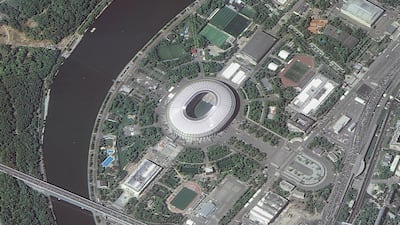
A picture taken from the International Space Station (ISS) shows the Luzhniki Stadium, which will host matches of the 2018 FIFA World Cup in Moscow, Russia. Reuters -
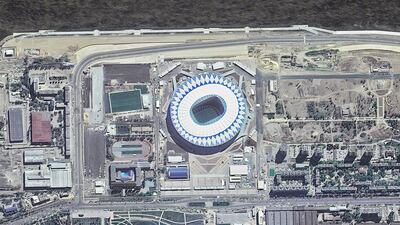
A picture taken from the International Space Station shows the Volgograd Arena, which will host matches of the 2018 FIFA World Cup in Volgograd, Russia. Reuters -
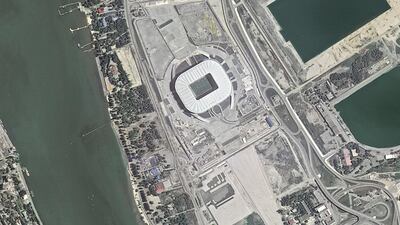
A picture taken from the International Space Station (ISS) shows the Rostov Arena, which will host matches of the 2018 FIFA World Cup in Rostov-on-Don, Russia. Reuters -

A picture taken from the International Space Station (ISS) shows the Ekaterinburg Arena, which will host matches of the 2018 FIFA World Cup in Yekaterinburg, Russia. Reuters -
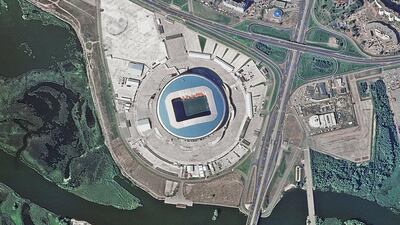
A picture taken from the International Space Station (ISS) shows the Kazan Arena, which will host matches of the 2018 FIFA World Cup in Kazan, Russia. Reuters -
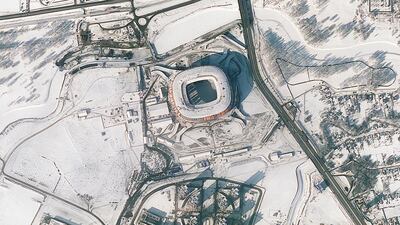
A picture taken from the International Space Station (ISS) shows the Mordovia Arena, which will host matches of the 2018 FIFA World Cup in Saransk, Russia. Reuters -

A picture taken from the International Space Station (ISS) shows the Samara Arena, which will host matches of the 2018 FIFA World Cup in Samara, Russia. Reuters -
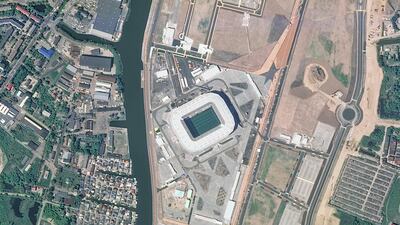
A picture taken from the International Space Station (ISS) shows the Kaliningrad Stadium, which will host matches of the 2018 FIFA World Cup in Kaliningrad, Russia. Reuters -

A picture taken from the International Space Station (ISS) shows the Spartak Stadium, which will host matches of the 2018 FIFA World Cup in Moscow, Russia. Reuters -
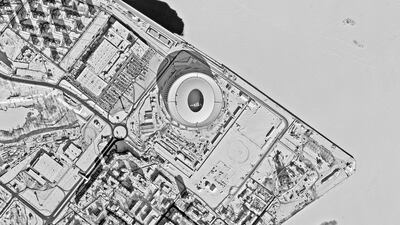
A picture taken from the International Space Station (ISS) shows the Nizhny Novgorod Stadium, which will host matches of the 2018 FIFA World Cup in Nizhny Novgorod, Russia. Reuters -
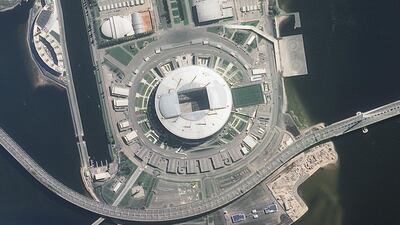
A picture taken from the International Space Station (ISS) shows the Saint Petersburg Stadium, which will host matches of the 2018 FIFA World Cup in St. Petersburg, Russia. Reuters -
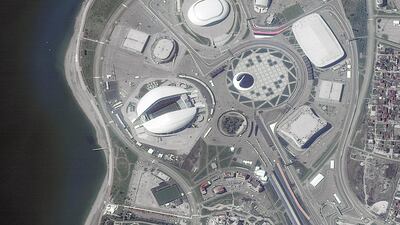
A picture taken from the International Space Station (ISS) shows the Fisht Stadium, which will host matches of the 2018 FIFA World Cup in Sochi, Russia. Reuters


Stark reminder of dangers of space travel
But it is the prospect of a lonely death in space itself, with no hope of rescue, that is most chilling. The 12 men who have walked on the Moon knew there was no way back if their equipment failed, but the aborted Apollo 13 mission, 50 years ago, came closest to disaster.
Only the ingenuity of the three crew and Nasa’s Mission Control brought them safely home after an explosion nearly 322,000km from Earth.
Now the Artemis programme promises to return astronauts to the lunar surface by 2024, with new spaceships, but all the attendant dangers.
Artemis will not even have back-up from the lunar lander, which provided life-saving refuge for the three Apollo 13 crew on their journey home. The new Orion spacecraft will travel to the Moon separately from the lander, which will link up only once the two craft are in lunar orbit.
And with a growing number of players in manned spaceflight, including Elon Musk’s deep space SpaceX Starship, Boeing and Blue Origin, funded by Amazon billionaire Jeff Bezos, the issue of whether a rescue can be effected is again on the agenda.
The Outer Space Treaty of 1967 was developed by the United Nations and requires astronauts from one state to assist those of another country if they get into trouble. But it doesn’t say how.
While building Skylab, the original US space station in 1973, Nasa kept a second shuttle on the launchpad during missions in case of an emergency.
For the ISS, a lifeboat called the Crew Return Vehicle was proposed, to be kept permanently docked on the space station, with enough seats for everyone on board.
The ship was a version of the Space Shuttle, but the Challenger and Columbia disasters cast doubt on the safety of the design and the project was scrapped.
Since then the Soyuz, and now Dragon capsules have served as “lifeboats”, an arrangement which has worked well ― until now.
While astronauts were previously aware of the dangers of space flight, the dramatic growth in space tourism ― soon to include the actor Tom Cruise who plans to shoot a movie on the ISS next year ― means the question of some kind of official rescue service is being considered.
The US-funded space research centre Aerospace published a report last year, highlighting what it called the “in space rescue capability gap”.
“Neither the US government nor commercial spaceflight providers currently have plans in place to conduct a timely rescue of a crew from a distressed spacecraft in low Earth orbit or anywhere in space,” it concluded.
Grant Cates, who worked on the Space Shuttle programme and now works for Aerospace, published his own analysis in the Journal of Space Safety Engineering last year.
“The risks involved in space travel are many, and they are magnified by the fact that there are no plans and attendant capabilities in place for the timely rescue of a crew from a disabled spacecraft,” he wrote.
At the same time, Gates concluded: “As the world’s greatest spacefaring nation [the US] has the wherewithal to develop and employ effective in-space rescue capabilities.”
Next year we could see the launch of the dearMoon mission. A SpaceX Starship will carry nine passengers on a six-day mission that will include a flyby of the Moon.
These will be no ordinary astronauts. Only the commander, the Japanese fashion retail billionaire, Yusaku Maezawa, has flown in space, and only as a tourist to the ISS.
The other eight include Steve Aoki, an American dance music producer and DJ, Rhiannon Adam, an Irish photographer, Dev Joshi, 23, an Indian TV star, a Czech choreographer, a YouTube star, a dancer who has worked with Kanye West and T.O.P, a South Korean rapper.
The stated objectives of dearMoon are world peace and artistic creation, but if something goes wrong it will be remembered more as a 21st-century version of the Titanic.
Except the Titanic did, at least, have a few lifeboats.