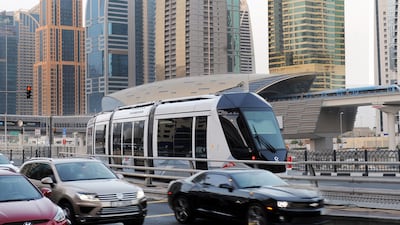
Dubai Metro, launched in 2009, remains the emirate's most popular mode of transport. Photo: AFP

Why Dubai Metro may signal way forward for Gulf urban rail growth


Daniel Bardsley
  • English
  • Arabic

The Gulf is gearing up for growth in the decades to come, with Dubai and Riyadh aiming to double their populations and significantly expand their economies.

Those ambitions will require the region's cities to focus on mobility, not only through building roads but by further enhancing public transport.

The UAE is taking steps to address its future needs with the 1,200km Etihad Rail route, which will connect the Emirates to the rest of the Gulf.

The opening of Dubai Metro in 2009 provided a blueprint for the future, offering an alternative to private cars, taxis and buses.

More than 621 million journeys were made on public transport in Dubai last year, with the metro accounting for 225 million of those trips, 40 million more than taxis and 70 million more than public buses.

It is not the only metro in the Gulf region because in Makkah a small seasonal system has been in operation since 2010, while Doha opened its 76km service in 2019.

Construction of Riyadh’s 176km metro is expected to be completed within the next year ready for a 2024 launch.

Call to treble number of Gulf metro lines

These projects are just the beginning. According to Effective Metro System and Investment, a new report from Strategy&, a consulting arm of the accountancy and professional services giant PwC, GCC cities now have about 400km of metro lines, but by 2030 will require a further 1,100km “to cope with projected growth”.

This will require, the report said, $220 billion in investment, although the direct and indirect socioeconomic benefits could be several times as large.

“Metros bring a lot of comfort and reliability for the user, especially driverless systems. It’s very safe and functional and a high-frequency system,” said Jean-Christophe Chuniaud, senior vice president, international east, at Systra, the company that developed Dubai Metro after carrying out its feasibility study.

“In Dubai … about 20 per cent of the population uses the metro. That’s 20 per cent less traffic on the road, 20 per cent pollution reduction, time saved, and saving on road infrastructure. It makes the cost of transport cheaper. A metro ticket is much cheaper than maintaining a car.”

  • Al Rashidiya metro station at the southern end of Dubai's Red Line has been renamed Centrepoint, after the department store.
    Al Rashidiya metro station at the southern end of Dubai's Red Line has been renamed Centrepoint, after the department store.
  • The newly named Sobha Realty metro station on the Red Line.
    The newly named Sobha Realty metro station on the Red Line.
  • Al Jafiliya station has been renamed Max Fashion.
    Al Jafiliya station has been renamed Max Fashion.
  • Dubai’s metro system consists of three lines – Red, Green and Route 2020.
    Dubai’s metro system consists of three lines – Red, Green and Route 2020.
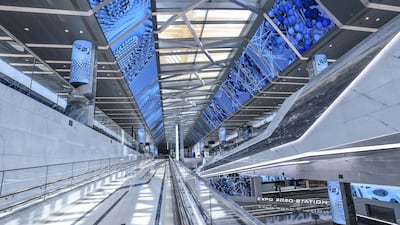
  • The Route 2020 stations – Jebel Ali, The Gardens, Discovery Gardens, Al Furjan, Jumeirah Golf Estates, Dubai Investment Park and Expo 2020 – are more futuristic than the original network.
    The Route 2020 stations – Jebel Ali, The Gardens, Discovery Gardens, Al Furjan, Jumeirah Golf Estates, Dubai Investment Park and Expo 2020 – are more futuristic than the original network.
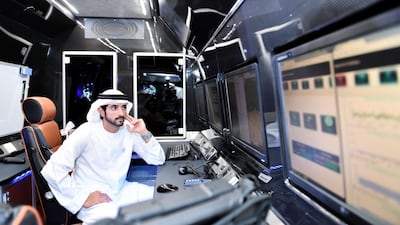
  • Sheikh Hamdan bin Mohammed, Crown Prince of Dubai, visits a monitoring suite for the transport network.
    Sheikh Hamdan bin Mohammed, Crown Prince of Dubai, visits a monitoring suite for the transport network.
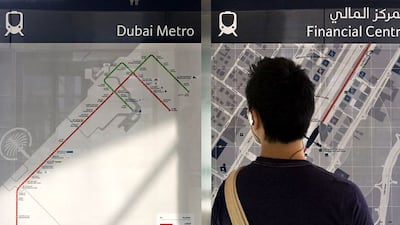
  • The Red Line starts at Centrepoint station and ends at UAE Exchange. The route has 29 stations – 24 elevated, four underground and one at ground level.
    The Red Line starts at Centrepoint station and ends at UAE Exchange. The route has 29 stations – 24 elevated, four underground and one at ground level.

Peter Schwinger, an independent transport consultant in Belgium who worked on transport planning for Abu Dhabi’s Department of Transport from 2013 to 2015, also pointed out that Dubai Metro has scaled up public transport usage in the city.

“Dubai, they have a metro … the percentage of trips done by public transport is above 15 per cent,” he said. “Then you look at all the other cities — Kuwait, Bahrain [Manama], Abu Dhabi, Sharjah — below 5 per cent.”

Many of these other places are keen not to miss out. Bahrain is developing a rail system, while cities including Abu Dhabi, Muscat, Jeddah, Damman and Kuwait City are looking to do the same.

China, India and Brazil are among the long list of developing nations to have invested heavily in urban rail in recent decades, while developed nations have also inaugurated networks in addition to earlier systems in North America and Europe that date back as far back as the 1800s.

Prof Peter White, emeritus professor at the University of Westminster in the UK and author of Public Transport: Its Planning, Management and Operation, said metros typically suit large, high-density cities where there is a level of demand that justifies the big investments required. Highly concentrated employment suits a system of radial movements from suburbs into the centre.

Helping to cut congestion

Evening traffic on Dubai's Sheikh Zayed Road. Antonie Robertson / The National

The way that many rail systems avoid the congestion of roads is key to their ability to attract drivers out of their cars.

When they work well, they can attract higher-income passengers, which helps to maximise ridership, frequency and revenue.

Actually turning a profit with a metro is not easy, but there are examples where urban rail is tied up with land ownership that has proved profitable.

Dr Kari Edison Watkins, an associate professor of civil and environmental engineering at the University of California, Davis, cited the Tokyo and Hong Kong networks as examples that have performed well financially.

“The system in Tokyo is simply amazing,” she said. “Much of the reason they’ve been able to build this quality transit system is because they’ve coupled land use to the provision of transit.

“They have much higher density along the transit line … Many lines are privately owned. The companies own the property and the line and reap the benefit of the higher densities.”

Dr Kari Edison Watkins, associate professor at the University of California, Davis. Photo: Dr Watkins

Cities, where urban rail transport has tended not to work so well, are those, Dr Watkins said, where the authorities compromised in terms of giving the system a dedicated space. This can even result in parked cars getting in the way of rail vehicles, compromising speed and reliability.

The layout of some Gulf cities poses difficulties to the successful implementation of urban rail, according to Dr Alexandra Gomes, a research fellow at the London School of Economics who has researched Abu Dhabi and Kuwait City.

“In many of the Gulf cities, people who drive live in areas that are low density, [which are] less attractive to place mass transit infrastructure,” she said.

“And people who don’t drive, they live in high density. You will improve their lives [by building a metro], of course, because they will have a more reliable system.

“But at the same time, if your objective is to take the cars out of the streets, if you want to reduce pollution, if you want to increase the levels of health, then you have to connect to the low density. There is a mismatch.”

She suggested, however, that some of the region’s cities may be able to address issues related to housing types and density to make them more amenable to urban rail.

Dr Alexandra Gomes is a research fellow at the London School of Economics. Photo: London School of Economics

Keeping eco goals on track

A well-planned metro system is likely to offer “agglomeration benefits”, which Mr Schwinger said were “largely untapped” at the moment.

These include better access to the labour market for employees and greater access to workers for employers. Improved productivity is another benefit.

Heavy investments in public transport have also been described as necessary if Gulf nations are to achieve their net-zero goals.

With all these potential benefits, what has often held the Gulf back when it comes to investing in metros?

Cost is an obvious factor, as is the disruption to traffic during construction and, said Mr Schwinger, the reality that it can be difficult to explain to Gulf citizens the benefits of a system for which they are not the key target market.

Many factors for or against metros and other urban rail systems centre on economics, but Dr Watkins also highlights that an effective system used by a wide range of people influences the nature of society. There are quality-of-life benefits to both the individual and the community.

“The great thing about metro systems is they’re very equitable,” she said. “Everybody can use the metro; you’re interacting with everybody from your community. That’s good for a community — to be doing something collectively.”


If you go

Flights

Emirates flies from Dubai to Phnom Penh with a stop in Yangon from Dh3,075, and Etihad flies from Abu Dhabi to Phnom Penh with its partner Bangkok Airlines from Dh2,763. These trips take about nine hours each and both include taxes. From there, a road transfer takes at least four hours; airlines including KC Airlines (www.kcairlines.com) offer quick connecting flights from Phnom Penh to Sihanoukville from about $100 (Dh367) return including taxes. Air Asia, Malindo Air and Malaysian Airlines fly direct from Kuala Lumpur to Sihanoukville from $54 each way. Next year, direct flights are due to launch between Bangkok and Sihanoukville, which will cut the journey time by a third.

The stay

Rooms at Alila Villas Koh Russey (www.alilahotels.com/ kohrussey) cost from $385 per night including taxes.

The specs: 2018 Chevrolet Equinox

Price, base / as tested: Dh76,900 / Dh110,900

Engine: 2.0L, turbocharged in-line four-cylinder

Gearbox: Nine-speed automatic

Power: 252hp @ 5,500rpm

Torque: Torque: 352Nm @ 2,500rpm

Fuel economy, combined: 8.5L / 100km

MATCH INFO

UAE Division 1

Abu Dhabi Harlequins 12-24 Abu Dhabi Saracens

Ad Astra

Director: James Gray

Stars: Brad Pitt, Tommy Lee Jones

Five out of five stars 

Wicked: For Good

Director: Jon M Chu

Starring: Ariana Grande, Cynthia Erivo, Jonathan Bailey, Jeff Goldblum, Michelle Yeoh, Ethan Slater

Rating: 4/5

MATCH INFO

South Africa 66 (Tries: De Allende, Nkosi, Reinach (3), Gelant, Steyn, Brits, Willemse; Cons: Jantjies 8) 

Canada 7 (Tries: Heaton; Cons: Nelson)

Studying addiction

This month, Dubai Medical College launched the Middle East’s first master's programme in addiction science.

Together with the Erada Centre for Treatment and Rehabilitation, the college offers a two-year master’s course as well as a one-year diploma in the same subject.

The move was announced earlier this year and is part of a new drive to combat drug abuse and increase the region’s capacity for treating drug addiction.

Start times

5.55am: Wheelchair Marathon Elites

6am: Marathon Elites

7am: Marathon Masses

9am: 10Km Road Race

11am: 4Km Fun Run

The%20National%20selections
%3Cp%3E6pm%3A%20Barakka%3Cbr%3E6.35pm%3A%20Dhahabi%3Cbr%3E7.10pm%3A%20Mouheeb%3Cbr%3E7.45pm%3A%20With%20The%20Moonlight%3Cbr%3E8.20pm%3A%20Remorse%3Cbr%3E8.55pm%3A%20Ottoman%20Fleet%3Cbr%3E9.30pm%3A%20Tranquil%20Night%3C%2Fp%3E%0A
SHAITTAN
%3Cp%3E%3Cstrong%3EDirector%3A%20%3C%2Fstrong%3EVikas%20Bahl%3Cbr%3E%3Cstrong%3EStarring%3A%20%3C%2Fstrong%3EAjay%20Devgn%2C%20R.%20Madhavan%2C%20Jyothika%2C%20Janaki%20Bodiwala%3Cbr%3E%3Cstrong%3ERating%3A%20%3C%2Fstrong%3E3%2F5%3C%2Fp%3E%0A
Women%E2%80%99s%20Asia%20Cup
%3Cp%3E%3Cstrong%3EUAE%20fixtures%3C%2Fstrong%3E%3Cbr%3ESun%20Oct%202%2C%20v%20Sri%20Lanka%3Cbr%3ETue%20Oct%204%2C%20v%20India%3Cbr%3EWed%20Oct%205%2C%20v%20Malaysia%3Cbr%3EFri%20Oct%207%2C%20v%20Thailand%3Cbr%3ESun%20Oct%209%2C%20v%20Pakistan%3Cbr%3ETue%20Oct%2011%2C%20v%20Bangladesh%3Cbr%3E%3Cbr%3E%3Cstrong%3EUAE%20squad%3C%2Fstrong%3E%3Cbr%3EChaya%20Mughal%20(captain)%2C%20Esha%20Oza%2C%20Kavisha%20Kumari%2C%20Khushi%20Sharma%2C%20Theertha%20Satish%2C%20Lavanya%20Keny%2C%20Priyanjali%20Jain%2C%20Suraksha%20Kotte%2C%20Natasha%20Cherriath%2C%20Indhuja%20Nandakumar%2C%20Rishitha%20Rajith%2C%20Vaishnave%20Mahesh%2C%20Siya%20Gokhale%2C%20Samaira%20Dharnidharka%2C%20Mahika%20Gaur%3C%2Fp%3E%0A

Mercer, the investment consulting arm of US services company Marsh & McLennan, expects its wealth division to at least double its assets under management (AUM) in the Middle East as wealth in the region continues to grow despite economic headwinds, a company official said.

Mercer Wealth, which globally has $160 billion in AUM, plans to boost its AUM in the region to $2-$3bn in the next 2-3 years from the present $1bn, said Yasir AbuShaban, a Dubai-based principal with Mercer Wealth.

Within the next two to three years, we are looking at reaching $2 to $3 billion as a conservative estimate and we do see an opportunity to do so,” said Mr AbuShaban.

Mercer does not directly make investments, but allocates clients’ money they have discretion to, to professional asset managers. They also provide advice to clients.

“We have buying power. We can negotiate on their (client’s) behalf with asset managers to provide them lower fees than they otherwise would have to get on their own,” he added.

Mercer Wealth’s clients include sovereign wealth funds, family offices, and insurance companies among others.

From its office in Dubai, Mercer also looks after Africa, India and Turkey, where they also see opportunity for growth.

Wealth creation in Middle East and Africa (MEA) grew 8.5 per cent to $8.1 trillion last year from $7.5tn in 2015, higher than last year’s global average of 6 per cent and the second-highest growth in a region after Asia-Pacific which grew 9.9 per cent, according to consultancy Boston Consulting Group (BCG). In the region, where wealth grew just 1.9 per cent in 2015 compared with 2014, a pickup in oil prices has helped in wealth generation.

BCG is forecasting MEA wealth will rise to $12tn by 2021, growing at an annual average of 8 per cent.

Drivers of wealth generation in the region will be split evenly between new wealth creation and growth of performance of existing assets, according to BCG.

Another general trend in the region is clients’ looking for a comprehensive approach to investing, according to Mr AbuShaban.

“Institutional investors or some of the families are seeing a slowdown in the available capital they have to invest and in that sense they are looking at optimizing the way they manage their portfolios and making sure they are not investing haphazardly and different parts of their investment are working together,” said Mr AbuShaban.

Some clients also have a higher appetite for risk, given the low interest-rate environment that does not provide enough yield for some institutional investors. These clients are keen to invest in illiquid assets, such as private equity and infrastructure.

“What we have seen is a desire for higher returns in what has been a low-return environment specifically in various fixed income or bonds,” he said.

“In this environment, we have seen a de facto increase in the risk that clients are taking in things like illiquid investments, private equity investments, infrastructure and private debt, those kind of investments were higher illiquidity results in incrementally higher returns.”

The Abu Dhabi Investment Authority, one of the largest sovereign wealth funds, said in its 2016 report that has gradually increased its exposure in direct private equity and private credit transactions, mainly in Asian markets and especially in China and India. The authority’s private equity department focused on structured equities owing to “their defensive characteristics.”

Updated: March 21, 2023, 4:18 PM