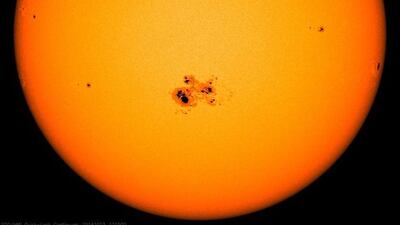

Space observers in Sharjah captured an image of a sunspot larger than Earth.
Sunspots – dark blotches on the surface of the Sun – are the first indicators of solar eruptions, which can cause geomagnetic storms on Earth.
Researchers at the Sharjah Academy of Astronomy, Space and Technology have been studying the sunspot as it grows.
They are using a telescope at the Sharjah Observatory to observe and capture images of the phenomenon.
They used a radio telescope to detect the previous sunspot.
"The new solar cycle, called solar cycle 25, has started and sunspots mean that solar activity is increasing," Mohammad Talafha, research assistant and observer at the academy, told The National.
“We used three different telescopes of different sizes that are attached to one giant telescope to observe the sunspot. We are studying it and we see that it is growing in size.”
Sunspots are caused by magnetic activity, which increases as the Sun enters a new cycle every 11 years.
The Sun can release solar eruptions that carry strong electrically charged particles capable of damaging satellites and causing solar storms on Earth.
In 1989, the Quebec province in Canada faced a power cut after a solar storm damaged the electricity grid.
The particles crossed through Earth’s magnetic field, causing Central and Northern Canada’s skies to light up with aurora borealis – or northern lights – for two full days and the phenomenon was visible in places such as Honduras and Dominica.
In 2003, a solar storm damaged 28 satellites in low-Earth orbit and destroyed two others.
Nasa and other astronomers predicted that this new solar cycle was going to be quiet, with minimum solar activity.
_____________
Solar eclipse in the UAE - in pictures
-
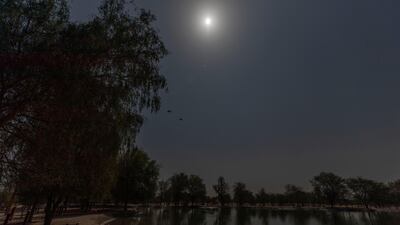
The partial eclipse appears over the UAE at Al Qudra Lakes, Dubai. Chris Whiteoak / The National -

A partial solar eclipse is seen from Rajpath in New Delhi, India, June 21, 2020. Reuters -

The partial eclipse appears over the UAE at Al Qudra Lakes, Dubai. Chris Whiteoak / The National -
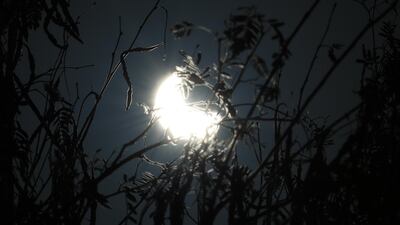
The partial eclipse appears over the UAE at Al Qudra Lakes, Dubai. Chris Whiteoak / The National -
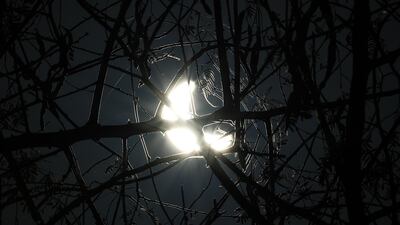
The partial eclipse appears over the UAE at Al Qudra Lakes, Dubai. Chris Whiteoak / The National -
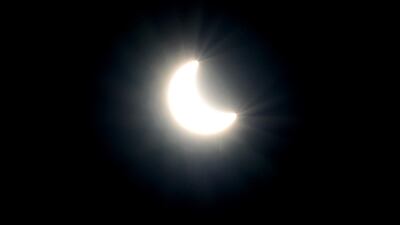
The partial eclipse appears over the UAE at Al Qudra Lakes, Dubai. Chris Whiteoak / The National -
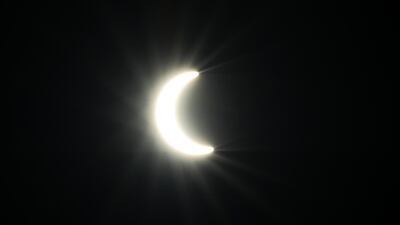
The partial eclipse appears over the UAE at Al Qudra Lakes, Dubai. Chris Whiteoak / The National -
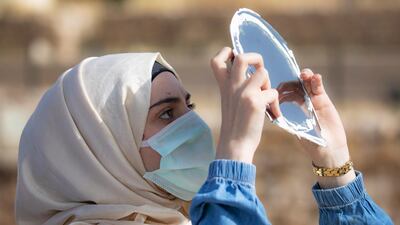
A woman wearing a face mask uses a mirror covered with a special filter to observe a partial solar eclipse at the Citadel in downtown Amman, Jordan. EPA -

The partial eclipse appears over the UAE at Al Qudra Lakes, Dubai. Chris Whiteoak / The National -

A partial solar eclipse is seen in Hefer Valley, Israel. AP Photo -
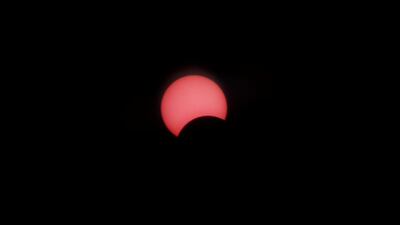
A partial solar eclipse is seen from the Cairo suburb of Maadi, Egypt, June 21, 2020. Reuters -
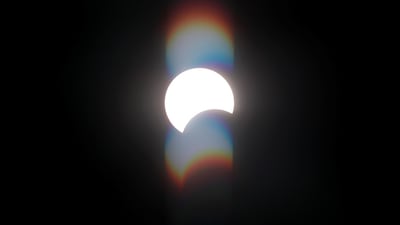
A partial solar eclipse is seen from the Cairo suburb of Maadi, Egypt, June 21, 2020. Reuters -
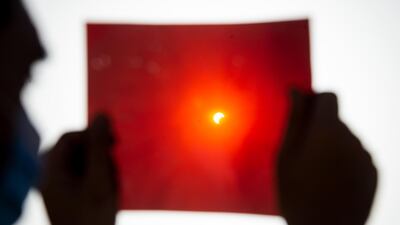
A man uses an X-ray plate to observe an annular partial solar eclipse in Cairo, Egypt. EPA -
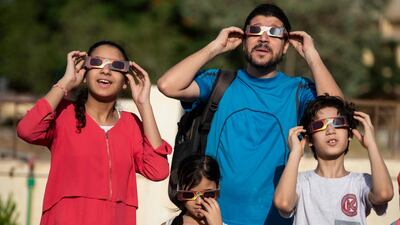
Members of a family use special protective glasses to observe an annular partial solar eclipse in Cairo, Egypt. EPA -

Muslim men perform mass prayers during a partial solar eclipse at the Amman Citadel, an ancient Roman landmark, in Amman, Jordan. Reuters



