


The largest solar flare in four years hit Earth’s atmosphere on Saturday, causing radio blackouts over the Atlantic Ocean and surrounding coastal areas.
Huge blasts of X-rays from the Sun travelled at the speed of light towards Earth after a newly formed sunspot – a dark blotch on the Sun strongly indicative of a solar explosion – exploded, only eight minutes after formation.
The largest in four years, it was classified as an X-flare, the brightest and strongest type of solar flare.
Known to be the largest explosions in the solar system, solar flares send out electromagnetic radiation that can damage satellites and cause power cuts.
“Yesterday, sunspot AR2838 burst through the surface of the Sun and promptly unleashed the strongest solar flare in four years,” Spaceweather.com reported.
“A pulse of X-rays ionised the top of Earth’s atmosphere, causing a short-wave radio blackout over the Atlantic Ocean. Mariners, aviators and amateur radio operators may have noticed unusual propagation effects below 30 megahertz just after 14.29 UT,” or 6.29pm, UAE time.
A solar flare is caused when built-up magnetic energy in the solar atmosphere is released.
There are three categories – C are small, M are medium and X are huge. The higher the number, the greater the intensity.
For instance, the one that hit Earth on Saturday was classified as an X.15-class solar flare.

The largest flare ever recorded was the X28-class in 2003, when a series of large solar storms formed above the Sun’s surface. Engineers had to switch some satellites to “safe mode” and astronauts aboard the International Space Station were asked to seek shelter from radiation.
The events were known as the “Halloween Storms” because they occurred in the autumn.
Increased solar activity is an indication that the new solar cycle, Solar Cycle 25, is reaching its height, meaning more sunspots and eruptions could be expected.
In November, a medium-sized solar flare narrowly missed Earth, but scientists had said the risk had not gone away. It also caused radio blackouts in the South Atlantic, despite not erupting in the direction of the Earth.
“We can measure the number of sunspots, but you can’t really predict solar eruptions – they can happen any time,” Dr Ilias Fernini, deputy general director for research laboratories and observatory at the Sharjah Academy, previously told The National.
“Everything is digital these days and if we lose any satellite or internet connection, we’d be in big trouble. That’s why we have to predict these activities, but anything could happen.”
Stunning images of space - in pictures
-
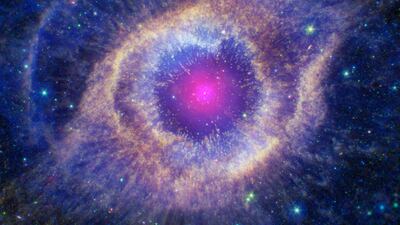
Helix Nebula is a phase when a star like the Sun runs out of fuel, it expands and its outer layers puff off, and then the core of the star shrinks. All photos: Nasa -
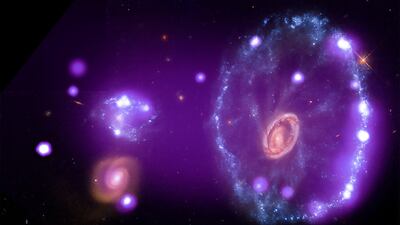
This Cartwheel Galaxy resembles a bull's eye, which is appropriate because its appearance is partly due to a smaller galaxy that passed through the middle of this object. -
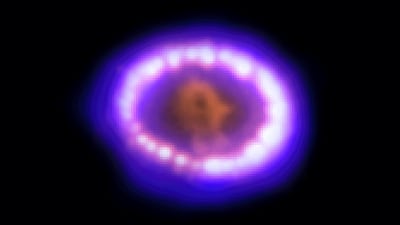
On February 24, 1987, observers in the southern hemisphere saw a new object in a nearby galaxy called the Large Magellanic Cloud. This was one of the brightest supernova explosions in centuries and soon became known as Supernova 1987A. -
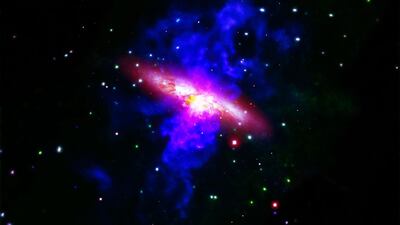
Messier 82, or M82, is a galaxy that is oriented edge-on to Earth. This gives astronomers an interesting view of what happens as this galaxy undergoes bursts of star formations. -
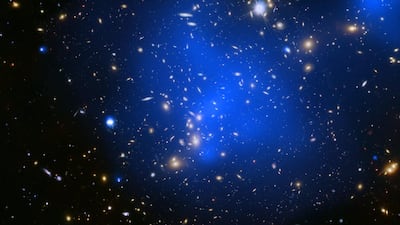
Galaxy clusters are the largest objects in the universe held together by gravity. They contain enormous amounts of superheated gas, with temperatures of tens of millions of degrees, which glow brightly in X-rays and can be observed across millions of light years between galaxies. -

What will be the next star in our Milky Way galaxy to explode as a supernova? Astronomers aren't certain, but one candidate is in Eta Carinae, a volatile system containing two massive stars that closely orbit each other.



