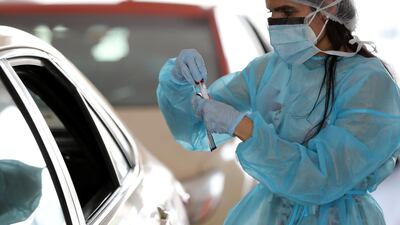
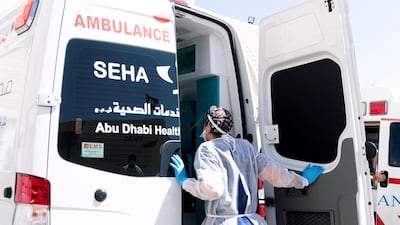
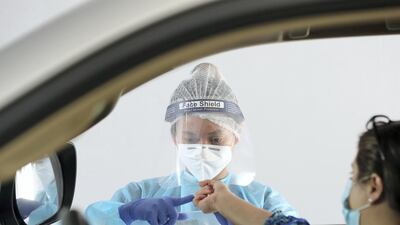
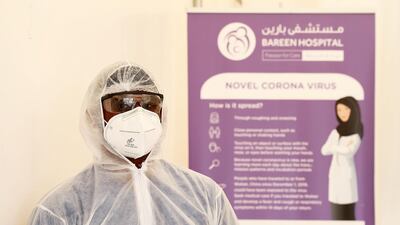
• A man is vaccinated at Bareen International Hospital in Mohamed bin Zayed City in Abu Dhabi. Courtesy: Bareen International Hospital
    A man is vaccinated at Bareen International Hospital in Mohamed bin Zayed City in Abu Dhabi. Courtesy: Bareen International Hospital
  • A man is vaccinated at Bareen International Hospital in Mohamed bin Zayed City in Abu Dhabi. Courtesy: Bareen International Hospital
    A man is vaccinated at Bareen International Hospital in Mohamed bin Zayed City in Abu Dhabi. Courtesy: Bareen International Hospital
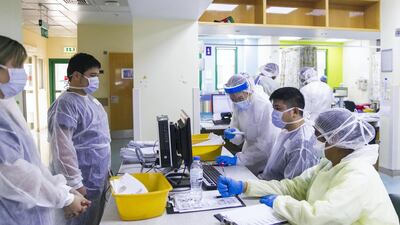
  • People queue to get vaccinated at Bareen International Hospital in Mohamed bin Zayed City in Abu Dhabi. Courtesy: Bareen International Hospital
    People queue to get vaccinated at Bareen International Hospital in Mohamed bin Zayed City in Abu Dhabi. Courtesy: Bareen International Hospital
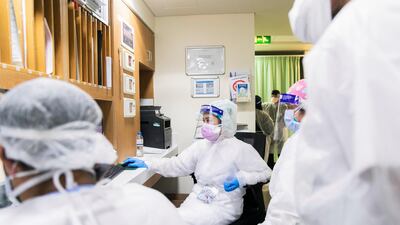
  • People register to get vaccinated at Bareen International Hospital in Mohamed bin Zayed City in Abu Dhabi. Courtesy: Bareen International Hospital
    People register to get vaccinated at Bareen International Hospital in Mohamed bin Zayed City in Abu Dhabi. Courtesy: Bareen International Hospital
  • People register to get vaccinated at Bareen International Hospital in Mohamed bin Zayed City in Abu Dhabi. Courtesy: Bareen International Hospital
    People register to get vaccinated at Bareen International Hospital in Mohamed bin Zayed City in Abu Dhabi. Courtesy: Bareen International Hospital
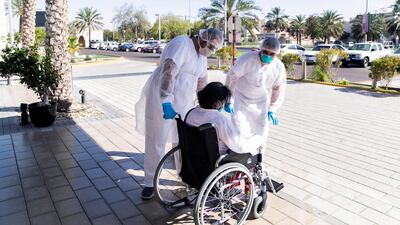
  • People register to get vaccinated at Bareen International Hospital in Mohamed bin Zayed City in Abu Dhabi. Courtesy: Bareen International Hospital
    People register to get vaccinated at Bareen International Hospital in Mohamed bin Zayed City in Abu Dhabi. Courtesy: Bareen International Hospital

More than 40 per cent of UAE population receive at least one dose of Covid-19 vaccine


Shuchita Gautam
  • English
  • Arabic

More than 40 per cent of the UAE’s population has received at least one shot of the coronavirus vaccine, health authorities said on Tuesday.

The Emirates has a target of inoculating 50 per cent of its people by the end of the first quarter.

Health authorities also said that nearly 48.6 per cent of the elderly have received the vaccine.

As of February 16, more than 5.19 million doses have been administered and the rate of doses per 100 people is 52.56, Dr Farida Al Hosani, spokeswoman for the health sector, said at the weekly Covid-19 briefing.

People who become infected with coronavirus after taking their first vaccine should still take the second dose after their recovery, she said.

Dr Al Hosani said the second injection was advised for those who had mild symptoms or remained asymptomatic.

Patients who get sick with severe illness and need hospital treatment should consult a doctor before taking their second dose.

“They should visit a doctor after making a full recovery and get an antibody test done and proceed ahead with the vaccine on a doctor’s recommendation,” she said.

Dr Al Hosani said Sinopharm, Pfizer-BionTech, AstraZeneca and Sputnik vaccines work differently, but all trigger the body’s immune system to fight the virus.

Most have also been found to be effective against the variant strains of coronavirus, but nobody knows for how long the immunity will last, Dr Al Hosani said.

“Antibodies will become less over time but the immune system has memory cells and these cells will remember the components of the vaccine if they contract the virus after a long time,” she said.

The Sinopharm vaccine works using dead viral particles to expose the body's immune system to the virus without risking a reaction. It stimulates the immune system and forms antibodies.

Pfizer-BioNTech vaccine works with RNA technology. This means that part of the gene code is injected into the body, prompting it to start producing s-protein on the shell of the virus that triggers immune response.

Both AstraZeneca and Sputnik V vaccines are based on a viral vector. It is placed on another virus called adenovirus, which is modified and molecules of the emerging coronavirus are added to it. The virus is considered weak but sufficient to produce antibodies.

The country has also carried out more than 28 million tests to detect infections.

UAE medics battling the coronavirus - in pictures

  • People get tested for coronavirus at the Mina Rashid screening centre in Dubai. Chris Whiteoak / The National
    People get tested for coronavirus at the Mina Rashid screening centre in Dubai. Chris Whiteoak / The National
  • Since the beginning of the coronavirus pandemic, health authorities have called upon citizens and residents to join with the efforts of health care professionals. Health workers, such as these Sheikh Khalifa Medical City, have led the way. Reem Mohammed / The National
    Since the beginning of the coronavirus pandemic, health authorities have called upon citizens and residents to join with the efforts of health care professionals. Health workers, such as these Sheikh Khalifa Medical City, have led the way. Reem Mohammed / The National
  • Healthcare workers at the emergency ward in Sheikh Khalifa Medical City. The President, Sheikh Khalifa, has paid tribute to the frontline workers who helped to curb Covid-19. Reem Mohammed / The National
    Healthcare workers at the emergency ward in Sheikh Khalifa Medical City. The President, Sheikh Khalifa, has paid tribute to the frontline workers who helped to curb Covid-19. Reem Mohammed / The National
  • Healthcare workers at Sheikh Khalifa Medical City receive a patient outside the emergency department. Reem Mohammed / The National
    Healthcare workers at Sheikh Khalifa Medical City receive a patient outside the emergency department. Reem Mohammed / The National
  • A consultant physician at the emergency department in Sheikh Khalifa Medical City, receives a Covid-19 patient. Reem Mohammed / The National
    A consultant physician at the emergency department in Sheikh Khalifa Medical City, receives a Covid-19 patient. Reem Mohammed / The National
  • People get the laser blood test tests at the Mina Rashid screening centre in Dubai. Chris Whiteoak / The National
    People get the laser blood test tests at the Mina Rashid screening centre in Dubai. Chris Whiteoak / The National
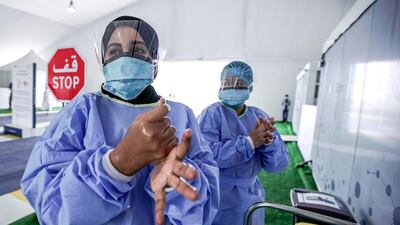
  • A nurse sanitises her hands after conducting a swab test at one of the UAE's screening drive-through centres in Mina Rashid, Dubai. Victor Besa / The National
    A nurse sanitises her hands after conducting a swab test at one of the UAE's screening drive-through centres in Mina Rashid, Dubai. Victor Besa / The National
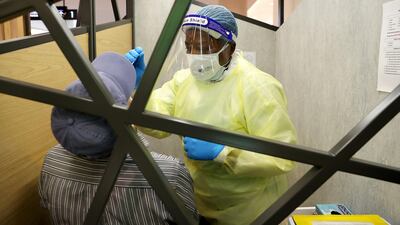
  • A health worker taking the Covid-19 nasal swab test at a testing station in thet Mall of the Emirates in Dubai. Pawan Singh / The National
    A health worker taking the Covid-19 nasal swab test at a testing station in thet Mall of the Emirates in Dubai. Pawan Singh / The National
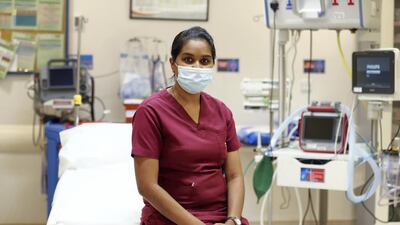
  • Nurse Renu Venugopal, who contracted Covid-19, recovered and continued to treat patients at Al Zahra Hospital, Sharjah. Chris Whiteoak / The National
    Nurse Renu Venugopal, who contracted Covid-19, recovered and continued to treat patients at Al Zahra Hospital, Sharjah. Chris Whiteoak / The National
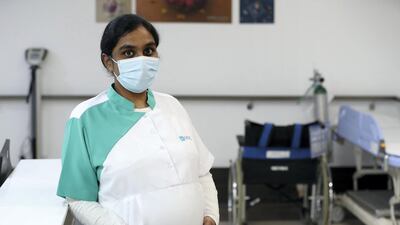
  • Ruth Deva Kiruba says being pregnant during a pandemic was surreal and sometimes lonely. Chris Whiteoak / The National
    Ruth Deva Kiruba says being pregnant during a pandemic was surreal and sometimes lonely. Chris Whiteoak / The National
  • EMT nurse Jephy Antony, who contracted Covid-19, recovered and continued to treat patients at the NMC Royal Hospital, DIP, Dubai. Chris Whiteoak / The National
    EMT nurse Jephy Antony, who contracted Covid-19, recovered and continued to treat patients at the NMC Royal Hospital, DIP, Dubai. Chris Whiteoak / The National
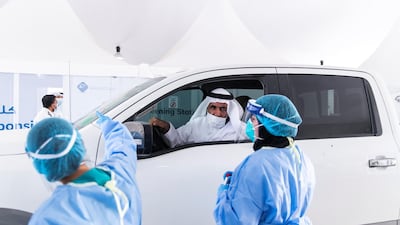
  • A visitor gets tested at the Ras Al Khaimah Covid-19 drive-through testing centre. Reem Mohammed / The National
    A visitor gets tested at the Ras Al Khaimah Covid-19 drive-through testing centre. Reem Mohammed / The National
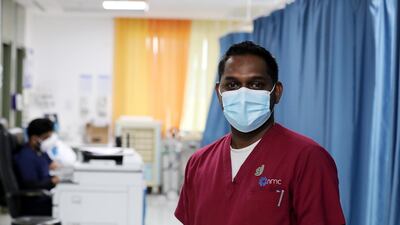
  • Nurse Nikhil Rajendran inside the fever clinic at the Bareen International Hospital in Mohamed Bin Zayed City in Abu Dhabi. Pawan Singh / The National
    Nurse Nikhil Rajendran inside the fever clinic at the Bareen International Hospital in Mohamed Bin Zayed City in Abu Dhabi. Pawan Singh / The National
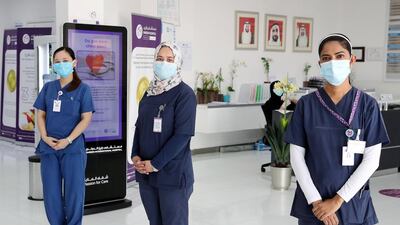
  • Shane Simeon Galang from Philippines, Mervat Aslan Mhgoub Mohamed from Egypt and Sowmya Kotian from India, who are nurses at the Bareen International Hospital in Mohamed bin Zayed City in Abu Dhabi. Pawan Singh / The National
    Shane Simeon Galang from Philippines, Mervat Aslan Mhgoub Mohamed from Egypt and Sowmya Kotian from India, who are nurses at the Bareen International Hospital in Mohamed bin Zayed City in Abu Dhabi. Pawan Singh / The National
Brief scores

Toss India, chose to bat

India 281-7 in 50 ov (Pandya 83, Dhoni 79; Coulter-Nile 3-44)

Australia 137-9 in 21 ov (Maxwell 39, Warner 25; Chahal 3-30)

India won by 26 runs on Duckworth-Lewis Method

Brief scoreline:

Liverpool 2

Keita 5', Firmino 26'

Porto 0

Match info

Uefa Champions League Group B

Barcelona v Tottenham Hotspur, midnight

Mercer, the investment consulting arm of US services company Marsh & McLennan, expects its wealth division to at least double its assets under management (AUM) in the Middle East as wealth in the region continues to grow despite economic headwinds, a company official said.

Mercer Wealth, which globally has $160 billion in AUM, plans to boost its AUM in the region to $2-$3bn in the next 2-3 years from the present $1bn, said Yasir AbuShaban, a Dubai-based principal with Mercer Wealth.

Within the next two to three years, we are looking at reaching $2 to $3 billion as a conservative estimate and we do see an opportunity to do so,” said Mr AbuShaban.

Mercer does not directly make investments, but allocates clients’ money they have discretion to, to professional asset managers. They also provide advice to clients.

“We have buying power. We can negotiate on their (client’s) behalf with asset managers to provide them lower fees than they otherwise would have to get on their own,” he added.

Mercer Wealth’s clients include sovereign wealth funds, family offices, and insurance companies among others.

From its office in Dubai, Mercer also looks after Africa, India and Turkey, where they also see opportunity for growth.

Wealth creation in Middle East and Africa (MEA) grew 8.5 per cent to $8.1 trillion last year from $7.5tn in 2015, higher than last year’s global average of 6 per cent and the second-highest growth in a region after Asia-Pacific which grew 9.9 per cent, according to consultancy Boston Consulting Group (BCG). In the region, where wealth grew just 1.9 per cent in 2015 compared with 2014, a pickup in oil prices has helped in wealth generation.

BCG is forecasting MEA wealth will rise to $12tn by 2021, growing at an annual average of 8 per cent.

Drivers of wealth generation in the region will be split evenly between new wealth creation and growth of performance of existing assets, according to BCG.

Another general trend in the region is clients’ looking for a comprehensive approach to investing, according to Mr AbuShaban.

“Institutional investors or some of the families are seeing a slowdown in the available capital they have to invest and in that sense they are looking at optimizing the way they manage their portfolios and making sure they are not investing haphazardly and different parts of their investment are working together,” said Mr AbuShaban.

Some clients also have a higher appetite for risk, given the low interest-rate environment that does not provide enough yield for some institutional investors. These clients are keen to invest in illiquid assets, such as private equity and infrastructure.

“What we have seen is a desire for higher returns in what has been a low-return environment specifically in various fixed income or bonds,” he said.

“In this environment, we have seen a de facto increase in the risk that clients are taking in things like illiquid investments, private equity investments, infrastructure and private debt, those kind of investments were higher illiquidity results in incrementally higher returns.”

The Abu Dhabi Investment Authority, one of the largest sovereign wealth funds, said in its 2016 report that has gradually increased its exposure in direct private equity and private credit transactions, mainly in Asian markets and especially in China and India. The authority’s private equity department focused on structured equities owing to “their defensive characteristics.”

Match info

What: Fifa Club World Cup play-off
Who: Al Ain v Team Wellington
Where: Hazza bin Zayed Stadium, Al Ain
When: Wednesday, kick off 7.30pm

Mobile phone packages comparison