


It is one year since UAE authorities lifted the requirement to wear face masks in all indoor public places, a move which marked a significant step forward in the country's recovery from the Covid-19 pandemic.
The end of the mandate on September 28, 2022, which had been in effect for two and a half years, came after rules on wearing face coverings outdoors had been removed in February of that year.
Twelve months on from the landmark moment, the medical community remains divided over the effectiveness of face masks – one of the enduring symbols of the global health crisis – in reducing infections of respiratory disease.
With few scientific trials to draw clear conclusions on how the coverings reduced Covid-19 infections, support for surgical face masks as a targeted intervention has become largely based on anecdotal support from doctors.
Face masks formed part of a multi-pronged attack on Covid-19 when infections first began circulating in early 2020.
Alongside social distancing, gradual natural immunity from infections and the development of vaccines, face masks were effective in slowing down the spread of the virus.
However, it remains unclear how valuable they were taken in isolation as a solitary measure when compared with the associated negative factors, such as reduced social interaction, discomfort and inconvenience – as well as generating environmental waste with unused face marks destined for landfill.
A mixed legacy
-

A security guard works without a mask in the Times Square Centre after safety measures were lifted last September. Dubai. Chris Whiteoak / The National -

Masks are no longer required at indoor places such as malls like Times Square Centre in Dubai. Chris Whiteoak / The National -

A Covid-19 safety sign is removed from Times Square Centre after face mask rules were removed. Chris Whiteoak / The National -

People have not been required to wear masks in the Emirates for 12 months. Chris Whiteoak / The National -

People shop in the Times Square Centre without masks after rules are lifted in malls. Dubai. Chris Whiteoak / The National -
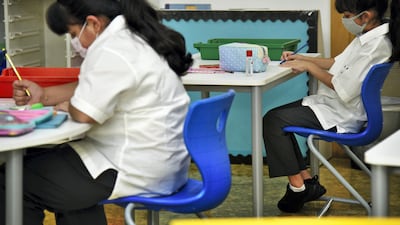
Mandatory wearing of face masks was no longer be required in schools in the UAE as of September 28, 2022. Shruti Jain / The National -
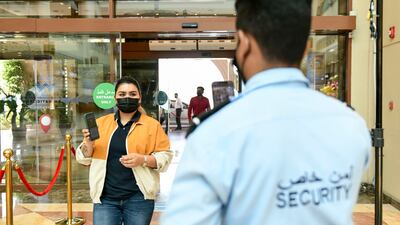
Al Hosn app was introduced to keep track of people's vaccination records and PCR test results during the pandemic. Khushnum Bhandari / The National -
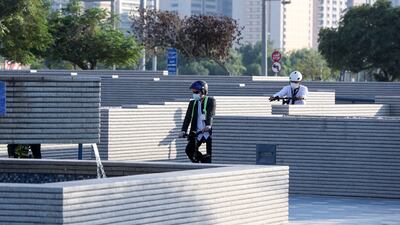
Until late February 2022, face masks were mandatory outside in the UAE. Khushnum Bhandari/ The National -
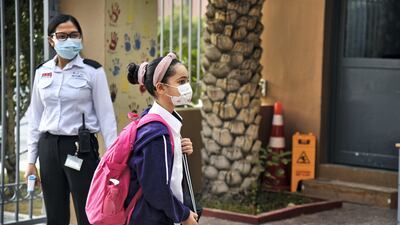
School childre nare no longer required to wear face masks. Shruti Jain/ The National -

The virtually empty Abu Dhabi-Dubai motorway on the first day of the UAE deep-cleaning campaign in 2020. Victor Besa / The National -

On March 27, 2020, workers began the UAE cleaning campaign. Victor Besa / The National


Dr Ram Shukla, internal medicine specialist at NMC Royal Hospital Sharjah, said face masks helped reduce infections during the pandemic but left a legacy of stigma.
“They did help enormously to prevent the spread of infection during the pandemic period but there is no doubt there were side effects, too,” he said.
“A minority of people did feel they were getting uncomfortable, breathless, constrained – and anxious.
“It is absolutely not recommended for the general public to start wearing masks again [as a precaution].
“Masks should only be worn during a pandemic.”
Substantial uncertainty and evidence gaps remain in the science behind support for wearing of face masks during a pandemic, with some systematic reviews of physical interventions reporting community masking did little to prevent Covid-19 or flu-like illnesses.
Doctors have since noted reduced infections of flu, while face masks were still mandatory in the UAE as part of pandemic protocols.

Limiting spread of virus
While it remains unclear how effective masks can be in open community settings, doctors said they were proven to reduce infections in medical facilities and shield vulnerable populations.
“During the pandemic, masks were helpful in two ways – to protect healthy people getting infected, and to protect others if someone had symptoms of respiratory infection,” said Dr Emad Al Nemnen, head of pulmonary disease at Burjeel Medical City, Abu Dhabi.
“Even for people living in the same apartment or house, we know the wearing of masks reduced transmission.
“Now they have been removed we are seeing a lot of respiratory infections, which was actually normal for us before the Covid-19 pandemic.
“Since we have stopped wearing masks, we can see people getting easily infected with influenza as they do not have enough antibodies [from previous infections].
“Generally, If someone has a suppressed immune system or any kind of chronic disease, they should wear a face mask if they visit a health facility or crowded area.”
Adolescent mental health
In 2021, research by the University of Cincinnati College of Medicine’s psychiatry and behavioural neuroscience department found wearing face masks had a minimal effect on social interaction among teenagers and children.
However, in adults, the university said feelings of anger and frustration were more likely in those wearing masks, due to the difficulty communicating or reading non-verbal cues.
“I was coaching several children who didn't want to remove their masks,” said Jasmine Navarro, a certified family well-being expert and founder of Nava, a UAE company focused on helping teenagers flourish.
“They were just too scared to remove them because they actually felt really safe having a mask covering their face.
“With one 14-year-old girl, she didn't want to take it off because she thought people would laugh at her.
“She had lost a lot of confidence and was afraid of being bullied or ridiculed for not wearing a mask.”
Young people were able to resolve their issues through coaching, to develop their self-awareness and confidence.
Typically, the process took three to six months.
“Once they got that awareness, which was quicker than with adults, they started feeling in control and empowered,” said Ms Navarro.
“They soon realised that could make things better for themselves and no longer needed to wear masks to cover their face.”

