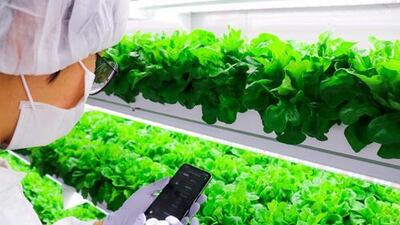

Sustainable farming in the UAE is set for a boost as UK agricultural technology firms queue up to develop new collaborations and more vertical farms in the country.
Historically, the UAE has imported the majority of its essential fresh produce due to difficult farming and agricultural opportunities in the arid desert environment.
That changed in recent years with fast-paced development in agri-tech, a growing sector dedicated to faming innovation.
Wider use of vertical farms and hydroponic growing methods has reduced demand for water and soil, and that trend will continue with new potential partnerships announced by Patrick Moody, British Ambassador to the UAE.
“The UAE government and businesses are showing real innovation in local food production,” said Mr Moody.
“Despite water scarcity challenges, the country is employing innovative technology across the sector, including hydroponics, solar production and solutions for reducing food loss and waste.
“Agri-tech and food security are key global challenges, and the UAE has demonstrated impressive achievement and progress in this area.”
The UAE Food Security Strategy focuses on diversifying food imports; supporting research and development to increase domestic food production; reducing food waste; maintaining food safety standards and increasing the UAE's ability to respond to crises like the coronavirus pandemic.
“The global pandemic has highlighted the importance of food security,” said Mr Moody.
“It really matters here in the Gulf and I see great potential for collaboration between the UK and the UAE.”
Vertical Future, a tech company in the UK, currently supplies produce to more than 100 London restaurants and thousands of homes.
It now wants to bring its innovation to the UAE.
Backed by the UK’s Department for International Trade, Vertical Future uses the vertical farming methods to develop fresh produce in controlled conditions without pesticides or soil.
After success at home, the company now hopes to bring its innovation to the desert to complement similar existing agricultural technology in Abu Dhabi.
It aims to set up vertical farms in the Emirates to decrease reliance on global supply chains, drastically reducing carbon emissions and the need for expensive irrigation systems.
“The UAE has a great tradition of innovation – it’s because of this that we are not only interested in attracting investment but also in collaborating together on innovative research,” said Lord Nigel Crisp, deputy chairman of the non-executive board at Vertical Future.
Food sustainability is a developing area of international collaboration with other partnerships already established.
The world’s largest indoor farm will be constructed by Abu Dhabi's RainMaker Capital Investment in partnership with Dutch innovators GrowGroup IFS.
Once complete, GreenFactory Emirates will produce 10,000 tonnes of fresh food a year from a 17.5 hectare farming plot.
Smartkas, an agri-tech company in Holland, is working alongside the Hamad Bin Khalifa Department of Projects to develop more high-tech farms in the UAE.
Smart-greenhouses will use artificial intelligence, cloud computing, drones and robotics to develop regional farming in a more sustainable manner.
British interest was triggered following an announcement by the Abu Dhabi Investment Office that financial incentives would be offered to agri-tech firms bringing innovation to the UAE.
Under the government’s Dh50 billion Ghadan 21 accelerator programme, more than Dh110 million is available to start-ups launching UAE operations.
The UK Department for International Trade highlighted potential for investment and cross-collaboration between the UK and UAE within the industries of robotics, vertical farming, software platforms, novel animal feed, and microbial crop protection solutions.
Launched in 2016 and valued at £57 million, Scotland-based Roslin Tech is another leading agri-tech start-up looking to make inroads into the UAE sustainable farming market.
It currently has supply lines across sustainable protein production, animal health, stem cell technology and cultured meat.
“We mine university technologies and bring them to industry to develop solutions for the agricultural and veterinary markets,” said Glen Illing, chief executive of Roslin Technologies.
“We are building on established ventures addressing alternative protein production solutions, including the high-growth markets of insect, shrimp and cultivated meat.”

