


Hundreds of pupils have contributed to a school journal that documented how they spent their isolation when school campuses closed nationwide to prevent the spread of Covid-19.
The 400-page journal was a pupil-led project at the Westminster School in Dubai and has entries from FS1 to graduating pupils, who expressed their thoughts through writing and drawings.
All educational institutions closed in the Emirates in March and 24-hour stay-home orders were instated in Dubai to prevent a spike in infections.
Pupils shared how they felt about being away from friends, teachers and staying indoors during the three-week stay-home order.
Saif Sultan, a pupil in year 3, wrote: “During the isolation I realised the worth of a lot of things, like playing under the sun, leaving the house, going to school, meeting my friends and a lot more.
“It was a lesson for me to appreciate everything. Studying online has made our eyes and backs weaker by sitting in front of devices for too long. We stopped writing as much as before, and studying became harder and boring.”
Arizza Dumayag, year 11 pupil, wrote that she used the spare time to develop new skills, such as baking, sewing and making mobile phone cases for friends.
She said she took on the extra activities to cope with the new changes caused by the virus.
“Quarantine has taught me that I have no patience at all,” wrote Arizza.
“I have been bored after just three days of staying at home with nothing to do. The first week of quarantine was easy to get through, but the more time I spent at home, the more my sanity was slipping. I was extremely bored and exhausted because I have not been sleeping properly now that school has been cancelled.
“Once quarantine is over the first thing I will do is hang out with my friends and eat lots of food. We will watch movies, drink bubble tea and just catch up on some stuff.”
Schools in Dubai and Abu Dhabi reopened last month but not all pupils are back in class.
Parents across the country were given the option between choosing in-person classes and e-learning for the first term, as the UAE continues its fight against the virus.
Meanwhile, Sharjah extended online learning for another two weeks.
“A pandemic doesn’t happen every day and we thoughts expressing our feelings could help during these times,” said Taif Ibrahim, one of the pupils who led the project.
“We wanted pupils to share their experiences and write or draw about what they felt and what they were doing. We didn’t want anyone feeling alone.”
The full journal is available online.
Back to school: Pupils return to in-person classes
-
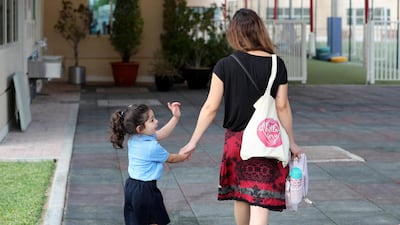
Parents see off their children off to classes for the first time since March in August 2020. Chris Whiteoak / The National -

Naividh Pillai, aged 3, looks a little bewildered as he arrives for his first day at Gems Wellington Academy with sister Alaikha and parents Meera and Deepesh. Antonie Robertson / The National -
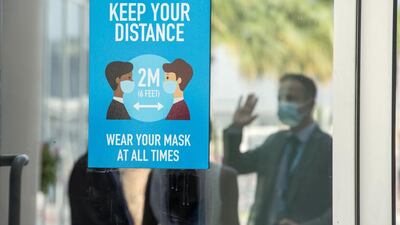
Gems Wellington Academy in Al Khail opens for the start of the school year. Antonie Robertson/The National -
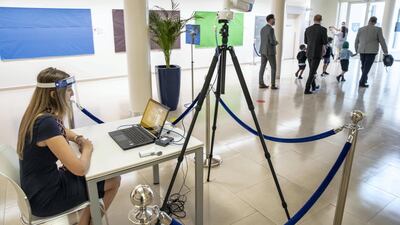
Gems Wellington Academy in Al Khail opens for the start of the school year. Thermal monitors at the entrance scan people for signs of fever or high temperature. Antonie Robertson/The National -
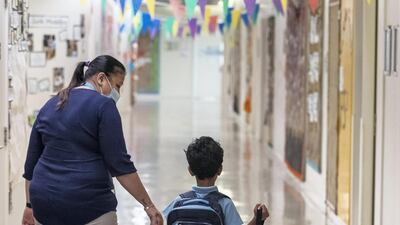
Gems Wellington Academy in Al Khail opens for the start of the school year. Antonie Robertson / The National -

A pupil wearing a colourful face shield arrives at Horizon International School in Dubai on Sunday. Chris Whiteoak / The National -
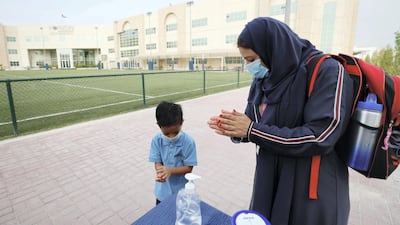
A mother helps her son sanitise his hands as he arrives at Horizon school. Chris Whiteoak / The National -
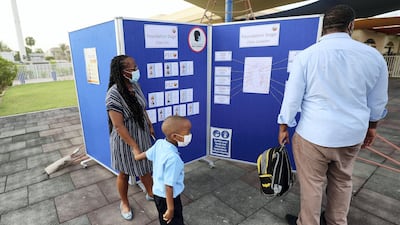
Children arrive for school at Horizon International School in Dubai. Chris Whiteoak / The National -
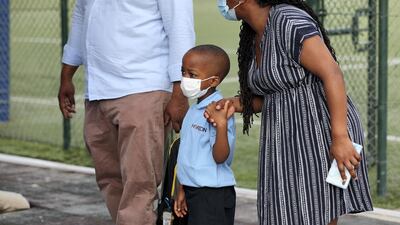
Children arrive for school at Horizon International School in Dubai. Chris Whiteoak / The National -
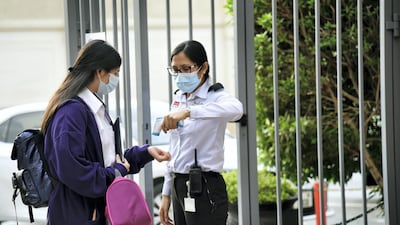
A pupil gets her temperature checked at the entrance of Al Mizhar American Academy. Shruti Jain for The National -
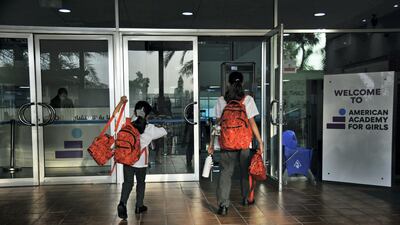
Pupils return to Al Mizhar American Academy in Dubai. Shruti Jain for The National -
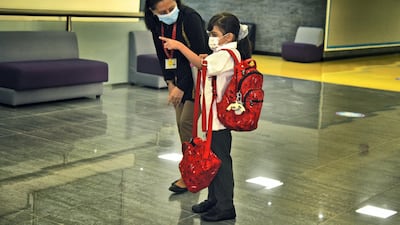
A staff member assists a pupil as Al Mizhar American Academy. Shruti Jain for The National -
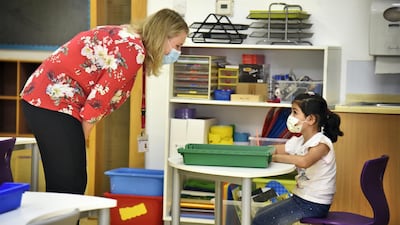
Tarryn Patel, a homeroom teacher from South Africa, attends to her grade 1 pupil at Al Mizhar American Academy. Shruti Jain for The National -
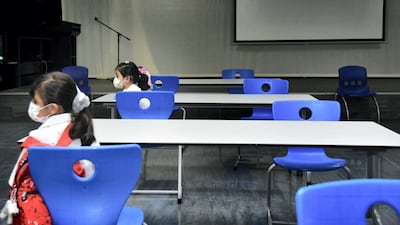
Pupils are spaced apart at the cafetaria at Al Mizhar American Academy. Shruti Jain for The National



