


Young people must continue to update their skills to keep pace with the evolving demands of the workplace, a UAE education expert has said.
Dr Sonia Ben Jaafar, chief executive of Abdulla Al Ghurair Foundation for Education, a privately-funded philanthropic organisation, said it was crucial not to stand still and instead continue on a learning journey.
She delivered the message as World Youth Skills Day was marked on Friday, a United Nations-designated event established in 2014 to raise awareness of the need to ensure the next generation is equipped with the tools to succeed.
Dr Ben Jaafar cited estimates that the “half life” of skills was now just four years. This means that every four years, a person’s skills become half as valuable to employers because the needs of industry change, putting a premium on retraining.
Major challenge to reskill global workforce

“We have one billion people that need to be reskilled by 2030. We have 85 million jobs that could be displaced by shifts in the division of labour. There’s all of these big numbers,” Dr Ben Jaafar said.
Issues are particularly acute in the Middle East and North Africa (Mena) region because of the larger than average number of young people, with about 60 per cent of the region’s population under 30.
“It’s not necessarily just about a gap now, it’s about the growing gap,” she said. “We have a mismatch between the skills demand and the local talent pool, and unless we are very specific about how we help skill and reskill, that will continue to grow.”
Universities have key role to play
Progress in giving young people skills has been made in the region, said Dr Ben Jaafar, particularly in the GCC, through the growth in the number and quality of universities, more of which now perform well in global league tables.
“Now we’re in a position in the UAE where we’re seeing very high quality universities from all over the world attracting people to study here,” she said, adding that the country had also developed a thriving start-up culture of entrepreneurship.
But it is essential that the skills people are learning at university are of the kind needed by employers, according to Dr Ben Jaafar.
“The notion that we can keep graduating young people with credentials that don’t lead to employment is a wealthy person’s privilege, and the vast majority of Arab youth do not have the luxury of education for education’s sake,” she said.
“They are relying on their family for continued financial support.”
The foundation, Dr Ben Jaafar said, acted as a bridge between sectors, such as government, education and the private sector, to help ensure that young people developed industry-relevant skills. It could, for example, fill particular skill gaps that a young graduate may feel he or she has.
Part of this is achieved through short courses or, as she described them, “nano” degrees, which are proving popular with young people who, regardless of whether they go to university or not, may not have the training needed for cutting-edge jobs.
Thousands of Emiratis aim to boost career prospects
The foundation and Zayed University announced this week that, two years on from launching a partnership, more than 2,500 Emiratis had enrolled in online programmes to better equip them for the workplace.
One programme that the foundation offers, and which Zayed University students are now able to enrol in, is TechUp, which aims to improve digital literacy skills.
It is part of the foundation’s efforts to provide what Dr Ben Jaafar described as “market-driven foundational courses and nano degrees”.
In some cases, the majority of young people who have enrolled on the foundation’s courses have been unemployed, so just by signing up they have improved their chances of securing work.
“They’re going to find their way into industry a lot faster because we’re building that bridge and so this is really exciting for the young people who are getting this digital skill they need now,” Dr Ben Jaafar said.
“Wherever you are as a young person, you have an opportunity to find a pathway, to gain full employment or entrepreneurship, but you have to do your job. We’re going to help you find your way.”
Investing in youth
Dr Ayesha Al Dhaheri, associate provost for student affairs at UAE University (UAEU) said young people were being given a platform to thrive in the Emirates.
“In the UAE, young people are most of the population. Our wise government has placed them at the centre of national strategic plans and programmes, giving them direct roles so that they are active in initiatives that form their future,” she said.
“It has given them many opportunities for education and vocational and technical training in all domains, so they are better able to execute their future orientated roles”.
UAE's top universities — in pictures
-
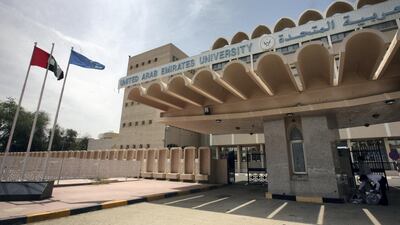
United Arab Emirates University in Al Ain has a strong standing in research and offers one of the country's main medicine degrees. Randi Sokoloff / The National -
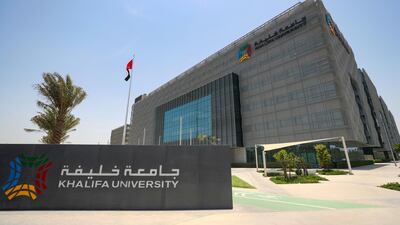
Khalifa University has rapidly climbed the global rankings in recent years but was knocked off the UAE top spot this year by UAEU. It boasts a nuclear engineering school staffed by top nuclear scientists, many of them from South Korea. Chris Whiteoak / The National -
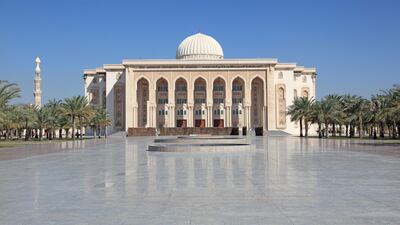
With its its striking architecture, American University of Sharjah offers about two dozen major degrees including humanities, engineering and business to about 5,000 students. It often scores strongly in global rankings and is particularly popular with Arab expat students. Alamy Photo -
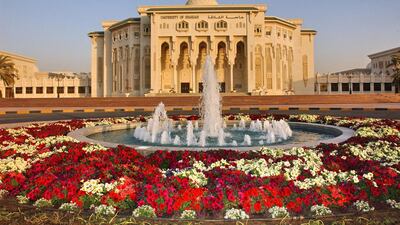
University of Sharjah was established in 1997 and is one of the country's largest, with about 14,000 students enroled. It also has campuses in the town of Dhaid and in Kalba, in Sharjah's east coast enclave. Wikicommons



